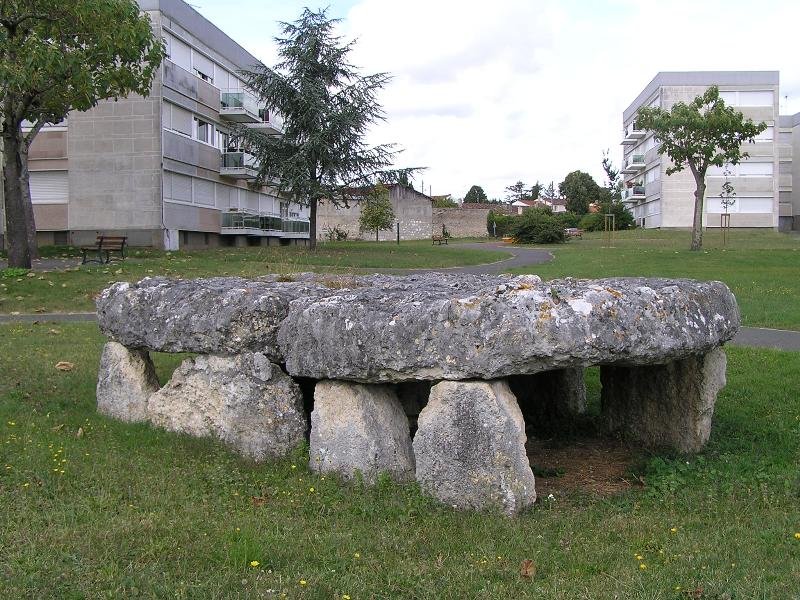

The dolmen de Séchebec, a megalithic monument located in Cognac, France, dates back to the Peu-richardian period, around 4500-3500 BC. The construction of the dolmen may date to this period, but it was reused during the Campaniforme period. Little is known about the builders of the dolmen, but it is believed that they were part of the prehistoric culture that thrived in this region. Around the 15th century, the dolmen was identified by A. Cousset as a boundary marker.
The dolmen was classified as a historical monument on March 13, 1930. It was excavated in 1958 by Claude Burnez, who restored it the following year. However, the restoration did not respect the dolmen’s original appearance or architecture.
The chamber of the restored dolmen measures 2.40m x 4.80m and originally stood approximately 1.60m high. The chamber was supported by five orthostates. No trace of a tumulus was discovered. The bones of about ten adults and at least four children were found inside the chamber, along with sixty-two stone tools, two tuning pins, a fragment of a third, and a fragment of a grinding stone.
Two bi-conically perforated pearls, a piece of ochre, a hundred dentals, shells (Nucella lapillus), and a number of artifacts were also found. The archaeological materials are now kept at the museum of art and history of Cognac.
Sources: Wikipedia, OpenStreetMap, Wikidata, Wikimedia Commons
Written by Nicolo Ciampini
Discuss this with the author and others
No comments yet. Be the first to start the conversation.