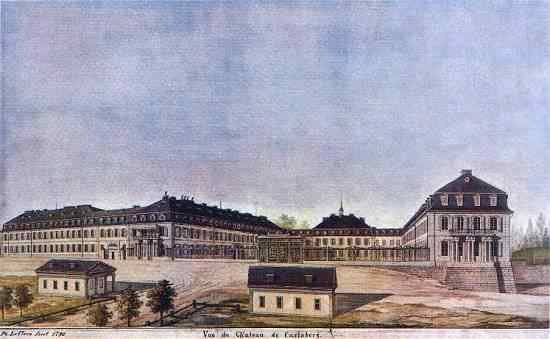
A 42-metre staircase rose like a towering spine of Baroque glory. It anchored a residence of immense scale, a sprawling vision of power carved into the Buchenberg ridge east of Homburg. This structure defined the largest country palace in Europe.
Duke Charles II August of Zweibrücken did not begin life at such heights. Born to a minor prince, his path opened through the extinction of three Wittelsbach branches. In 1775, the death of Christian IV yielded a massive inheritance. Charles August became heir to the Electorate of the Palatinate and the Bavarian throne, defended by France and Prussia. To signal status, he commissioned a palace transcending the Luisenhof, purchased in 1777 for 23,000 gulden and 60 Louis d'or.
His mistress, Caroline von Esebeck, assisted in this acquisition. From 1778 to 1788, a castle rose over the Luisenhof site. Architect Johann Christian von Mannlich, a court painter and building director, transformed the grounds. He created one of the first buildings in the Holy Roman Empire styled in Classicism, fusing Baroque and Classical aesthetics.
Inside, air hung heavy with Lyon drapery and polished wood. The Duke gathered finest French purveyors. Georges Jacob crafted gilded plankings while Jean-Jacques Kirstein provided Strassburg silverware. In the show bedroom, a bed à la Romaine sat as a functional archetype for kings. This village of barracks, nurseries, kennels, and stables overlooked the rolling countryside.
Grandeur proved fleeting. In 1793, French revolutionary troops swept the territory. The palace, a monument to a new dynasty, vanished in flames. Only the foundations and the Karlsberger Hof farm building in the valley remain. This farm stays intact today, a quiet witness to a palace that once dominated the European landscape.
Sources: Wikipedia, OpenStreetMap, Wikidata, Wikimedia Commons



Written by Aurora
Discuss this with the author and others
No comments yet. Be the first to start the conversation.