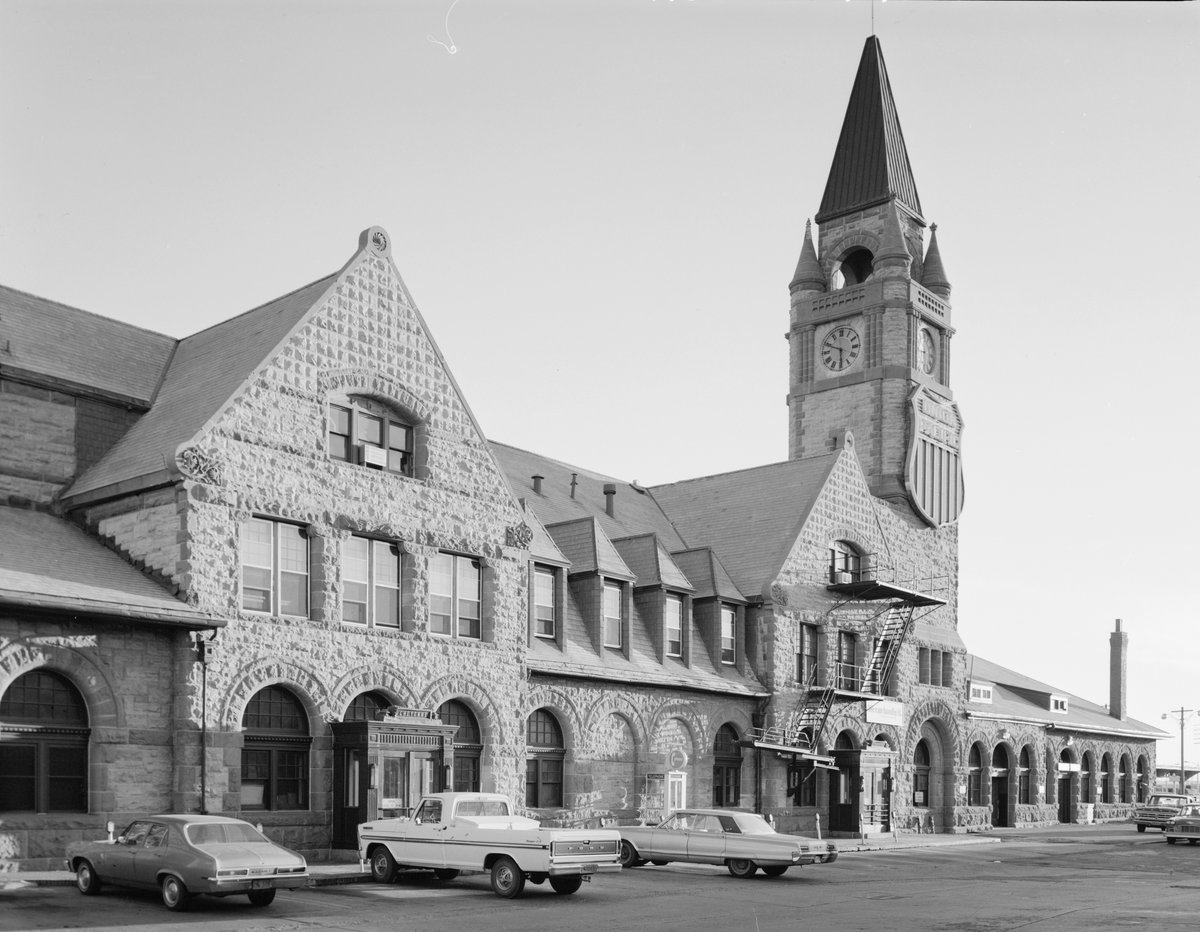
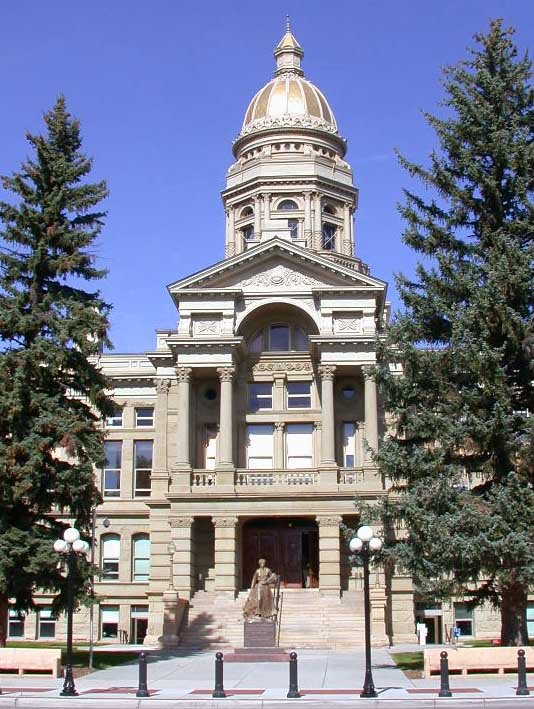
The Union Pacific Railroad built a significant depot in Cheyenne. In 1886, they hired John F. Coots to complete the station, which would become the railroad's largest station west of Council Bluffs, Iowa. They hauled the stone blocks from a quarry to the station by train. It was finished in 1887, standing directly down the street from and facing the Wyoming State Capitol building.
The architecture is Richardsonian Romanesque, featuring prominent rounded arches and heavy stone construction. Builders used red-orange and sand-colored stones from the Union Pacific quarry in Bellevue, Colorado. The red-orange stone was used to outline arches, windows, roof lines, floor lines, and doors, and was used to create false windows in some cases. The building features a six-story clock tower on the north side, though the tower's clock was not installed until 1890.
The building underwent several significant transformations over the years. In 1922, a 114-foot addition was built on the east side by H.W. Baum. This addition was a near mirror of the west part of the depot, and the quarry used in 1886 was reopened to provide matching stone. In 1929, the depot underwent a major renewal where steel replaced structural wood members, and the interior was redesigned in the Art Deco style by Gilbert Stanley Underwood.
Amtrak's San Francisco Zephyr stopped serving the station directly in 1979 in favor of a station in Borie, which eliminated a time-consuming backup move in and out of the Cheyenne station. Passenger rail service in Wyoming ended when Amtrak canceled the Pioneer in 1997. Today, the depot serves as the Cheyenne Depot Museum, which interprets the early history of the city and the construction of the Union Pacific Railroad. A plaza was built in front of the depot during a period of improvements from 2001 to 2006.
Sources: Wikipedia, OpenStreetMap, Wikidata, Wikimedia Commons

Written by Kyle McLonely
Discuss this with the author and others
No comments yet. Be the first to start the conversation.