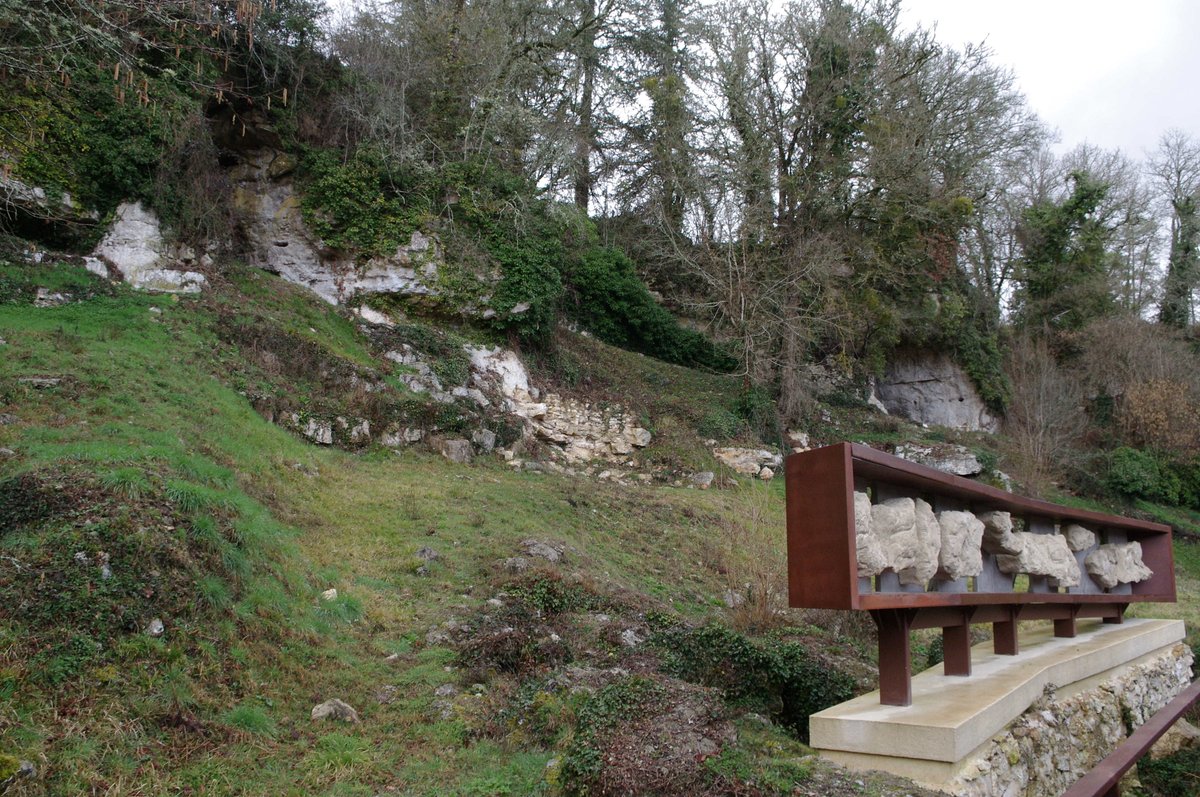

The **Roc de Sers** is an important archaeological site and sanctuary located in the Charente region of south-eastern France. **Excavations have revealed that the site dates back to the **Solutrean period**, around 17,200 BCE, and features a series of remarkable rock carvings and relief sculptures.**
The site is located in a limestone cliff between the Grotte de la Vierge and the Grotte du Roc, in the valley of the Echelle river, about 2 kilometres south of the town of Sers. The first fragments of the **Solutrean frieze** at Roc de Sers were unearthed near the cave entrance in 1927, and the full series of 14 limestone blocks has been reassembled and is exhibited at the French Museum of National Antiquities (Saint-Germain-en-Laye). A replica can be seen at the site itself.
The Roc de Sers frieze is considered an important **example** of Solutrean art, joining Lascaux Cave as a major exemplar of Upper Paleolithic art between 20,000 and 13,000 BC. The frieze contains a variety of figures, including horses, bison, and a number of abstract signs and rock engravings of bison and mammoths. One of the most famous and distinctive figures in the frieze is the **Chasseur Chassé** (Chasseur pursuivant), which depicts a horse on the left, and a bison/boar on the right, with characteristics of both species. It is unique in that it shows no trace of having been resculpted.
In addition to its animal relief sculptures, the **cave art** at Roc de Sers also includes **abstract signs and rock engravings** of bison and mammoths. The Roc de Sers site is only one of several paleolithic caves in France, which contain exceptional relief sculpture and petroglyphs.
Sources: Wikipedia, OpenStreetMap, Wikidata, Wikimedia Commons
Written by Nicolo Ciampini
Discuss this with the author and others
No comments yet. Be the first to start the conversation.