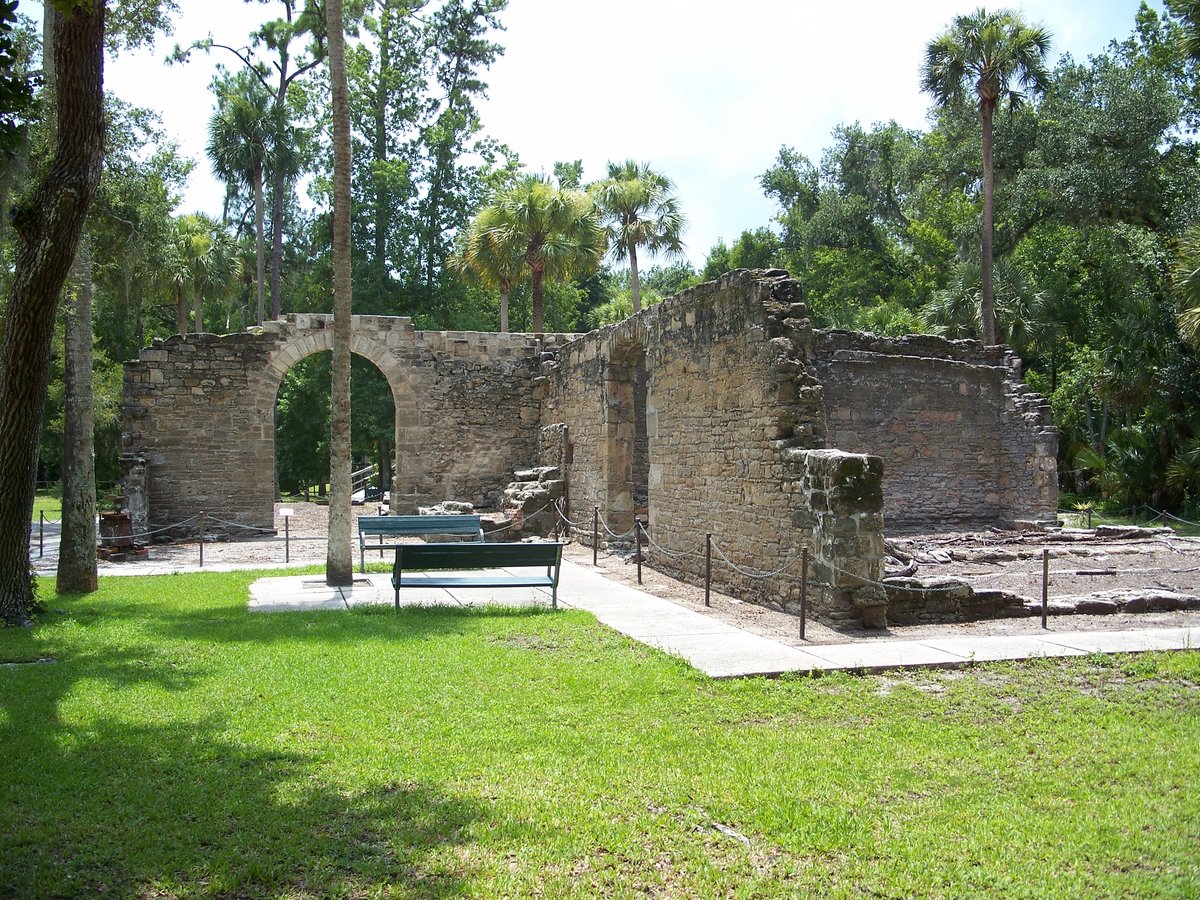

The New Smyrna Sugar Mill Ruins, located in New Smyrna Beach, Florida at 600 Old Mission Road, a mile west of the Intracoastal Waterway, were added to the U.S. National Register of Historic Places on August 12, 1970. In 1830, William Kemble constructed a steam-operated sugarcane mill and a saw mill at the site for William DePeyster and Henry Cruger. The masonry buildings were constructed of coquina, a sedimentary rock composed of fossilized tiny mollusc shells, quarried nearby.
The crushing house contained the steam-driven machinery that extracted the juice from the sugarcane. Eliza Cruger and other investors financed the construction of the mills on six hundred acres of land that Henry Cruger bought from an Episcopal minister, Ambrose Hull. The land had been part of the original grant made to Andrew Turnbull by the British during their twenty-year occupation of Florida, though Hull had received it as a grant from the Spanish crown during the Second Spanish period.
On Christmas Day in 1835, a band of Seminole Indians pillaged the plantation, setting the sugar mill and other buildings afire. Only the walls were left standing, with the machinery inside them, made by the West Point Foundry of Cold Spring, New York, mostly undamaged. The site was later altered by soldiers who were garrisoned there to keep the Seminoles under surveillance.
Sources: Wikipedia, OpenStreetMap, Wikidata, Wikimedia Commons

Written by Friendly Jane
Discuss this with the author and others
No comments yet. Be the first to start the conversation.