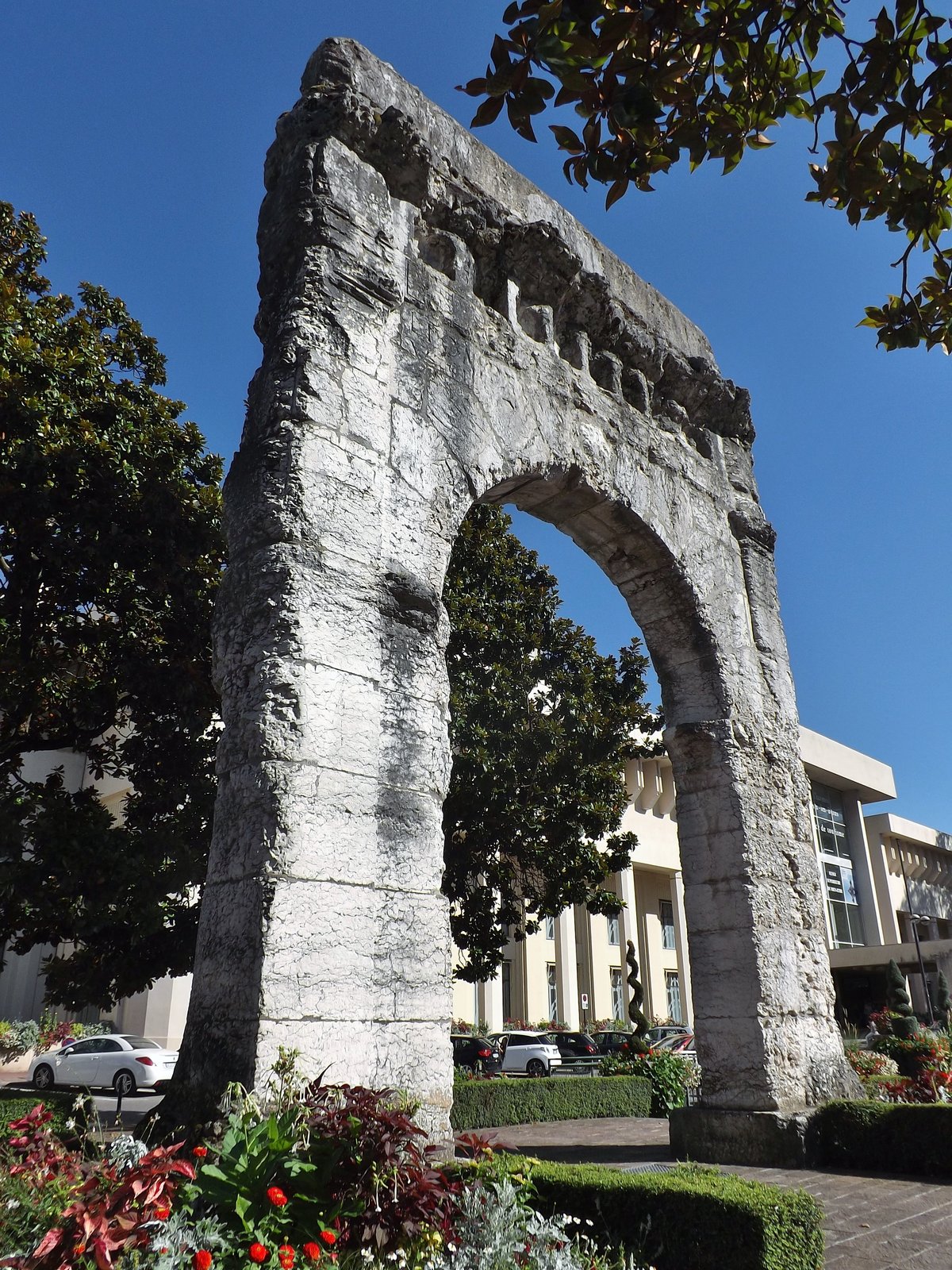

In the Rhône-Alpes region of France lies the town of Aix-les-Bains, home to the Roman Arch of Campanus. Erected in the 1st century AD by Lucius Pompeius Campanus, a patrician of Gallia Narbonensis, the monument was built on a lower terrace beside the city's ancient thermae. It stands 9.15 meters high and 7.1 meters wide, constructed from limestone blocks placed without mortar.
The arch features a single semicircular vault measuring 6 by 3.5 meters, which once supported a paved walkway. Above the two pylons is an entablature with an architrave and a frieze of eight niches which probably contained busts. On the west facade, the names of the ancestors of Lucius Pompeius Campanus are engraved into the stone.
While the arch bears inscriptions honoring the Campanus family, its exact function is a subject of study. It is located a long way from the Roman cemetery, leading some to suggest it may be a city gate rather than a funerary monument, as it provides a view toward the thermae. After being integrated into a stable wall and gradually buried, the structure was rescued in 1821.
Sources: Wikipedia, OpenStreetMap, Wikidata, Wikimedia Commons
Written by Nicolo Ciampini
Discuss this with the author and others
No comments yet. Be the first to start the conversation.