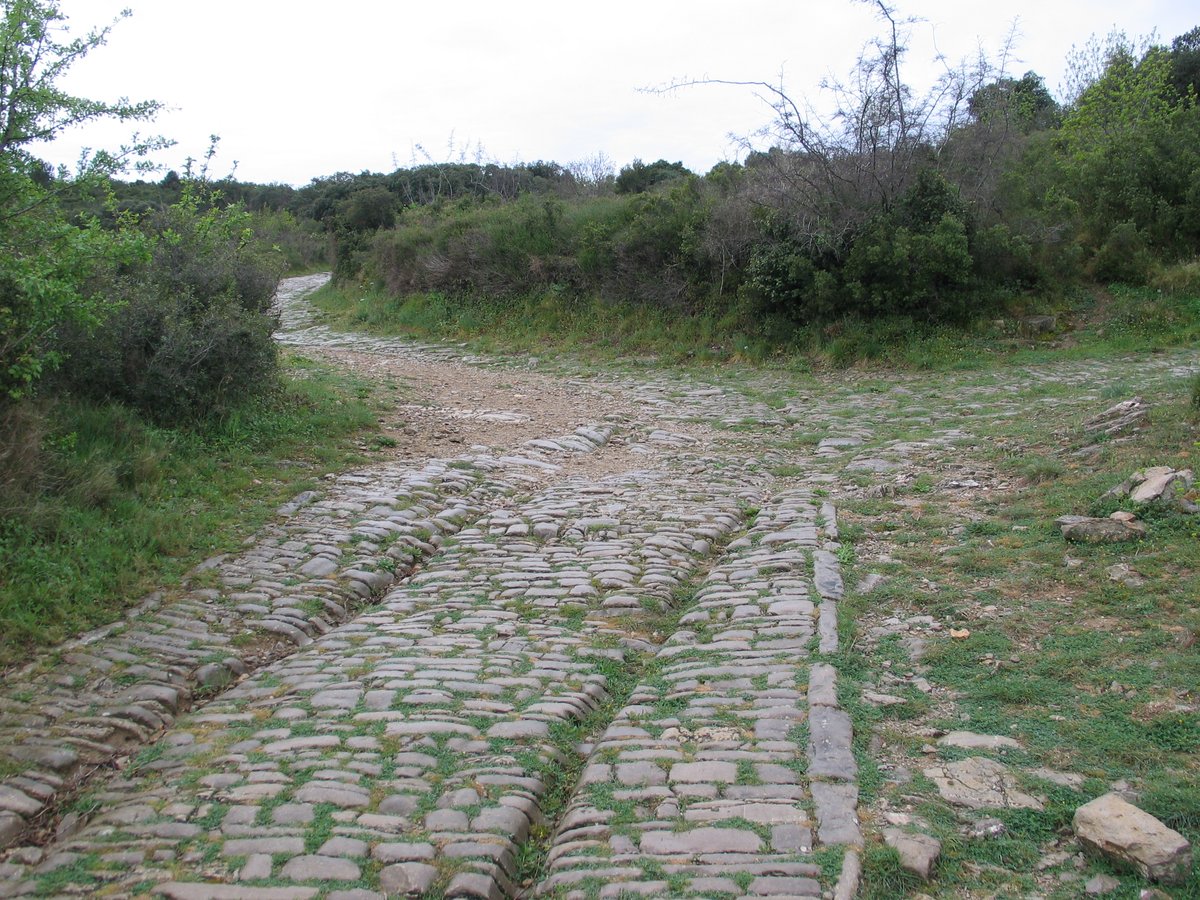

In the picturesque town of Villetelle, Occitania, Southern France, lies the intriguing Roman archaeological site of Ambrussum. Known as Ambrusium, the site boasts a rich, complex history that spanned 400 years. Ambrussum served as a bustling hub for travelers and merchants, acting as a staging post on the Via Domitia, a Roman road stretching from the Alps to the Pyrenees. The lower settlement, prone to flooding, offered stabling, lodging, and maintenance for carts and the Imperial postal service.
The hilltop settlement, initially built by pre-Roman Gauls, was later remodeled by the Romans and fortified with a wall featuring 21 towers. The Romans also constructed the oppidum, with evidence of various housing styles, from early one-room dwellings to elaborate courtyard houses. The Roman road ran at the foot of the settlement, leaving visible remnants of Roman chariot tracks. The bridge, Pont Ambroix, was constructed around 30 BC and remained in use until the Middle Ages; only one complete arch remains today.
Ambrussum is mentioned in historical records, including the Antonine Itinerary of AD 200, the Peutinger Map of 1520, and a pilgrim’s guide to the Holy Land of AD 333.
Sources: Wikipedia, OpenStreetMap, Wikidata, Wikimedia Commons
Written by Nicolo Ciampini
Discuss this with the author and others
No comments yet. Be the first to start the conversation.