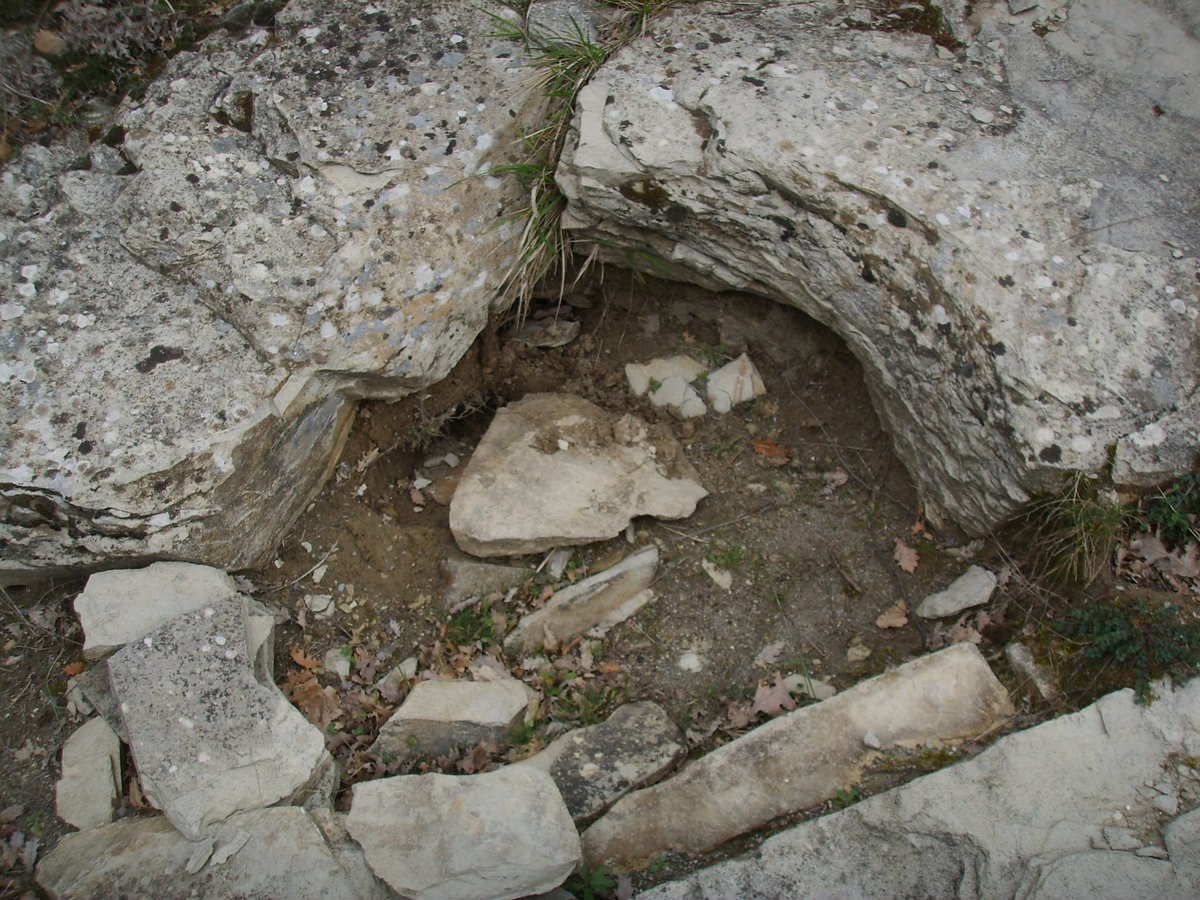

Why did the Etruscans build dry stone terraces in this limestone hill? It is a practical solution to the problem of burying the dead on a steep slope. Between the 8th and 6th centuries BC, various villages in Sesto Fiorentino used this site to house their ancestors.
They mostly practiced cremation. The earliest burials were simple pits - called pozzetto - where they dropped urns with the ashes of the deceased directly into the rock. Later on, between the end of the 8th and 6th centuries BC, they began digging wells of greater diameter and depth to hold large terracotta jars. In some cases, they dug pairs of side-by-side wells for individuals linked by family ties.
Some rectangular pits suggest a different scale - tombs in the form of stone chests where the jar was housed in a large box carved from vertical stone slabs and sealed by a horizontal one. During this period, significant remains of dry stone terracing survive, used to regulate the slope of the ground and delimit different areas of the cemetery.
Most of the upper parts of the structures are lost due to landslides and tampering following the abandonment of the site. What remains today are the lower parts carved into the limestone. The area is freely visitable, though most of the holes are covered and the recovered materials are kept in Sesto Fiorentino and Florence.
Sources: Wikipedia, OpenStreetMap, Wikidata, Wikimedia Commons


Written by Nicolo Ciampini
Discuss this with the author and others
No comments yet. Be the first to start the conversation.