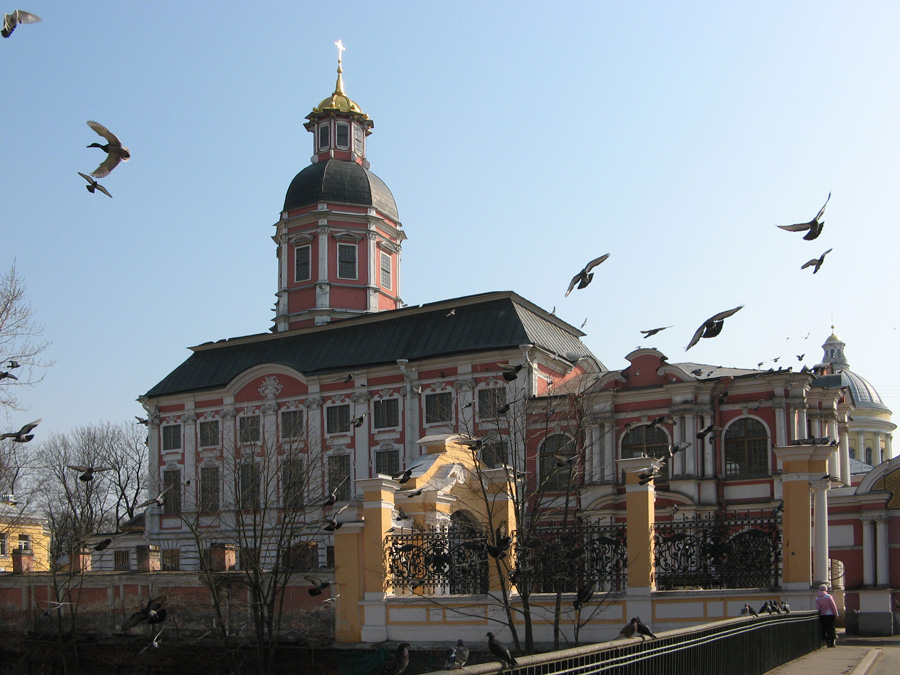

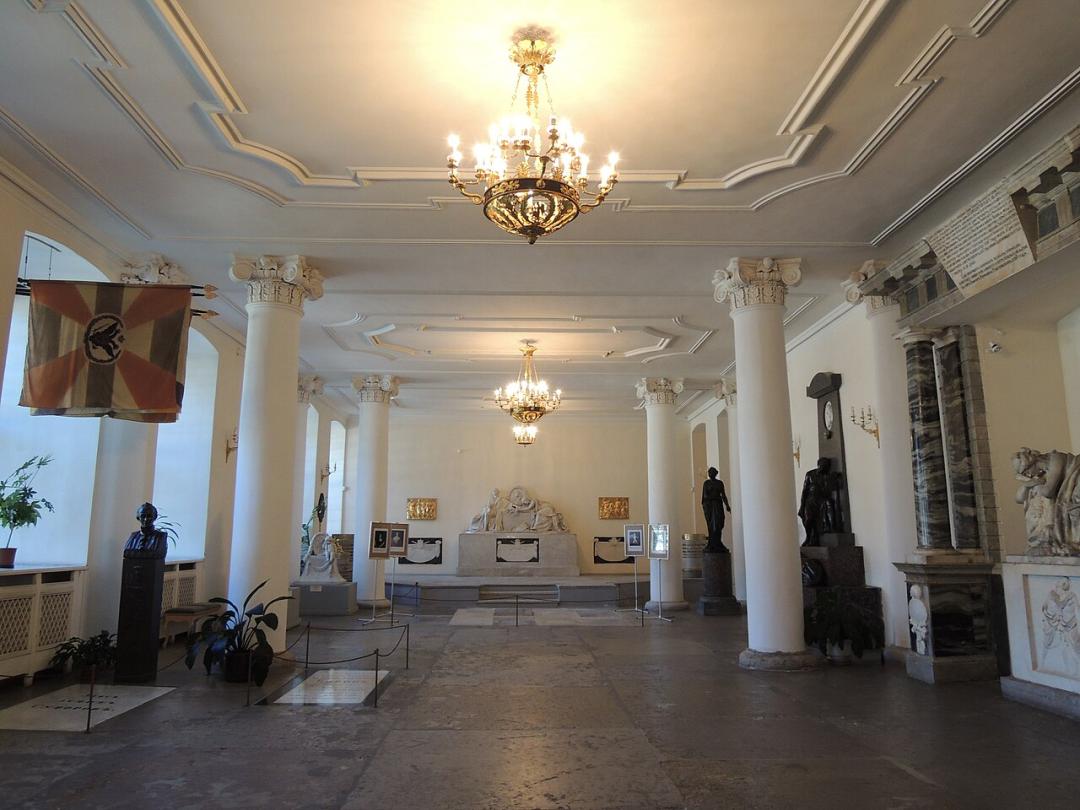
The grave of Suvorov is located separately in the royal crypt of the Alexander Nevsky Lavra. Among the numerous tombstones of Russian nobility, statesmen, and members of the imperial family, the tombstone with an epitaph of only three words stands out for its conciseness. Beneath the slab lies one of the most glorious and well-known Russian commanders, Alexander Vasilyevich Suvorov. The military successes of one of the five Russian Generalissimos, including Joseph Stalin, are a striking contrast to the inscription, familiar from childhood to anyone interested in Russian history.
Suvorov was famous during his lifetime for his simplicity, restraint, and conciseness. These qualities are well illustrated by the message about the capture of Warsaw on 25.10.1794 during the suppression of Tadeusz Kościuszko's uprising:
Suvorov sent the news of the city's capture to Catherine II in his usual concise form: "Hooray! Warsaw is ours!". "Hooray, Field Marshal!" replied Catherine, awarding Suvorov the rank of General-Field Marshal.
On May 18, 1800, at two o'clock in the afternoon, Alexander Vasilyevich Suvorov died at Kriukov Canal, house 23, in the city of Saint Petersburg. The 18th century was coming to an end. Suvorov felt the pivotal significance of the new year 1800: he considered it the first year of the approaching 19th century.
For the New Year, he wrote to the emperor:
"The eighteenth century disappears and flows away, but the bliss of the vast empire, built by the Father of the Fatherland, the thunder of victories of the arms raised by him to defeat the uprising against the universal hydra, these, merciful to mankind, feats, sealing the end of the past century above all centuries, triumph over the decay of fleeting time."
Although Suvorov died with the rank of Generalissimo, he was buried as a general. This was due to the conflict between Alexander Vasilyevich and Tsar Paul I. The emperor disliked the soldierly straightforwardness of the general and his remarks regarding army reforms. Three years before Suvorov’s death, by imperial decree, he was dismissed and deprived of the right to wear the uniform. However, circumstances forced the emperor to call the commander back to service. He returned to Russia from his last Swiss campaign seriously ill. When Paul I was informed of this, instead of support, he reprimanded Suvorov for the presence of army positions not provided for by the new regulations. The commander was not destined to attend the ceremonial reception or ride in a golden carriage. The angry emperor ordered that Suvorov’s death not be announced in the "St. Petersburg Gazette" and commanded that he be buried with honors one rank lower.
Suvorov’s body was taken out on May 24 at 9 a.m. The coffin could not pass through the narrow doors and therefore had to be lowered from the balcony into the hands of Suvorov’s grenadier veterans who had come to the funeral. According to one early version — because of this delay, Emperor Paul, who was meeting the coffin at the Alexander Nevsky Lavra, left without waiting and on the way met the funeral procession at the corner of Malaya Sadovaya and Nevsky. According to another, widely spread in late 19th and early 20th-century literature — Paul accidentally met the procession. According to a third version — Soviet historiography claimed that the emperor did not attend the funeral.
It is said that when those present at the funeral procession thought the carriage with the canopy would not pass under the arches of the Lavra gates, one of the veterans shouted: "It will pass! Our father Suvorov passed everywhere!". And indeed, the funeral carriage squeezed through the narrow monastery gates.
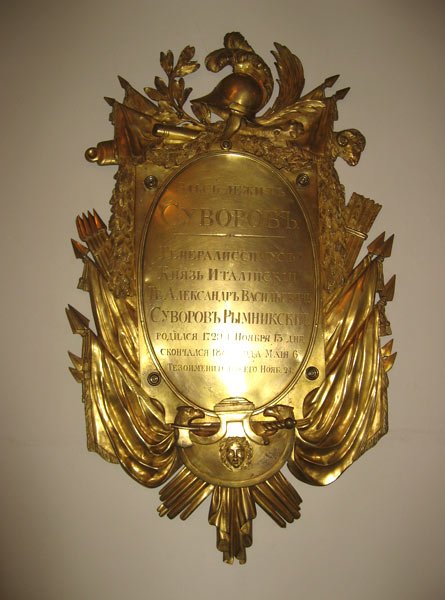
Identical inscriptions were made on the slab and on the wall plaque. The wall plaque is shaped like a figured shield of gilded bronze, with an oval medallion in the center framed by banners. Above it is an allegorical relief: a helmet, Hercules’ club, bucrania, garlands; below — a shield with Medusa’s head and halberds. On the medallion is engraved a long inscription: "Generalissimo, Prince of Italy, Count Alexander Vasilyevich Suvorov-Rymniksky, born in 1729, November 13, died 1800, May 6."
Only 50 years after Suvorov’s death, his grandson Alexander Arkadyevich, officers and soldiers of the regiments once commanded by his grandfather, asked to fulfill Suvorov’s last will. They recounted how, returning from the Swiss campaign, the commander traveled through Bavaria, Bohemia, Austrian Poland, and Lithuania. Everywhere he was met with triumph and royal honors. In the town of Neutingen, Suvorov inspected the tomb of Austrian Field Marshal Laudon. Reading the verbose, pompous inscriptions glorifying Laudon, Suvorov pondered and quietly, barely audibly said to the head of his office: "Why such a long inscription? I bequeath to you my will. On my tombstone write only three words: 'Here lies Suvorov'." His will was violated. At the burial site, a slab with a long, ornate inscription was placed: "Generalissimo, Prince of Italy, Count A. V. Suvorov-Rymniksky, born in 1729, November 13, died 1800, May 6."
Alexander Arkadyevich listened to the voices of the commander’s comrades, petitioned for a long time, and finally fulfilled his grandfather’s will by replacing this inscription with a short one of three words: "Here lies Suvorov."
Sources:
https://honzales.livejournal.com/323477.html
https://site2max.ru/saint-petersburg/aleksandro-nevskaya-lavra/#i-2
https://hramushakova.ru/index.php/737-generalissimus-suvorov-poslednie-dni


Written by Jermaine
Discuss this with the author and others
No comments yet. Be the first to start the conversation.