

The station was opened on November 15, 1955, as part of the first phase of the Leningrad Metro "Avtovo" – "Ploshchad Vosstaniya" (7 stations, 10.8 km), located on the Kirovsko-Vyborgskaya line (M1) between the stations "Chernyshevskaya" and "Vladimirskaya." The station's original project name was "Moskovskaya." Initially, project names were given based on the nearby railway stations. However, it was later named "Ploshchad Vosstaniya" after the square under which it is located. From its opening and for three years (until the line was extended to the "Ploshchad Lenina" station), it served as the terminus. In 1960, "Ploshchad Vosstaniya" became the first station of the Leningrad Metro with two exits to the surface — at that time, an exit to the Moskovsky railway station was opened.
In 1967, the "Ploshchad Vosstaniya" station became a transfer station to the Nevsky-Vasileostrovskaya line (Line No. 3), connecting to the "Mayakovskaya" station. The transfer hub is a rather unique solution — the end of the "Mayakovskaya" station complex directly adjoins the structures of the "Ploshchad Vosstaniya" station. Trains running on the 3rd line pass practically right above the 1st line station, for which special reinforcing arches were provided in the side halls of "Ploshchad Vosstaniya."
"Ploshchad Vosstaniya" can rightfully be considered station No. 1 of the Petersburg Metro. And although on October 7, 1955, the first train from the depot arrived at the "Avtovo" station, it was at "Ploshchad Vosstaniya" on November 15 that the ceremonial rally was held on the occasion of the opening of the second metro in our country, and it was here that the red ribbon was cut, after which the train with passengers departed along the new route.

Cutting the red ribbon. Photo: Pavel Markin
The "Ploshchad Vosstaniya" station is also the first because it is usually the starting point for guests arriving at the Moskovsky railway station to get acquainted with our city. The station building with its tall spire, located at the intersection of Ligovsky and Nevsky Prospects, is well known to many, not only residents of our city. It has long become one of the symbols of Petersburg and the main symbol of the Petersburg Metro.
The "Ploshchad Vosstaniya" station resembles its Moscow sisters but at the same time does not replicate any of them. The underground hall of the station is divided into three parts by massive pylons, which support snow-white arches. Usually, architects try to alter the ring-shaped outline of the hall, but this time the designers decided that the central hall should have a tunnel shape, so the base of the pylons is only 60 cm high, capped by a molded cornice. When designing the underground part of the station, the architects used classical shaping methods, consistent with the tradition prevailing in Soviet architecture of the 1950s.
Main colors: white vault, red pylon decoration, golden ornaments and grilles. This is one of the most beautiful stations of the Petersburg Metro. For the first series of stations, it was customary that both the above-ground and underground halls were designed by the same architects, so the underground part of "Ploshchad Vosstaniya" was also built according to the project by architects I.I. Fomin, B.N. Zhuravlev, V.V. Gankevich, and engineer E.A. Erganov.

To make the station more festive, the designers used red marble cladding, numerous metal details, and decorative stucco. The tradition of using colored stones in interiors and monumental architectural structures of the metro was established by Moscow architects during the construction of the first lines. The natural stone chosen for cladding emphasizes the individual character of the interior.
For example, the most important feature of the "Mayakovskaya" station in Moscow is the Ural rhodonite that decorates the columns of the underground hall. Various decorative and origin-specific rocks were used in metro construction. It is often said that the metro is a museum of decorative facing stones, a good visual aid for textbooks on mineralogy, petrography, lithology, and paleontology. The cladding of "Ploshchad Vosstaniya" uses very similar-looking but differently aged marbled limestones: Lower Jurassic from deposits in Georgia and Lower Silurian from the Nizhny Tagil deposit in the Urals. Only specialists in organic residue composition can distinguish them.
Great attention was paid to lighting in the preparation of the Leningrad Metro underground station projects. The future underground palaces of Leningrad were intended to be illuminated with the latest technology. "By all means, we sought to eliminate the feeling of 'undergroundness' in the metro, to provide daylight in the station premises," reported architect A. Andreev of "Lenmetproekt" in his article. "The illusion of natural daylight will be created by special fluorescent lamps. It is planned to use lamps emitting bluish 'morning' light, golden 'noon' light, and others."
The vaults of the station halls are decorated with white stucco arches with built-in light arcs. The authors decided to abandon chandeliers in the central hall, replacing them with fluorescent lamps enclosed in opal glass cases, providing soft, dim light.
The central hall is also illuminated by fixtures on the pylons. The lower parts of the pylons are clad with Ural marble from the Nizhny Tagil deposit, no higher than 60 cm, which is the lowest base among all Petersburg stations. The peculiar color of the marble is due to manganese oxides; during the war years, manganese ore was even mined in a small nearby quarry. The white color comes from remains of corals, sea lilies, and other marine inhabitants. Hundreds of millions of years ago, mollusks, starfish, sea urchins, lilies, and corals lived in ancient seas. The fragments of marine organism skeletons accumulated on the bottom along with calcium carbonate precipitated from the water, forming deposits of carbonate mud, which later turned into rock layers due to geological processes. In polished metro cladding sections, fossilized remains of marine organisms are visible to the experienced eye. At "Ploshchad Vosstaniya," one can find a vertical section of a small spiral-conical shell of a gastropod mollusk with four rapidly expanding whorls that barely overlap. The Nizhny Tagil limestones contain numerous remains of sea lilies.
The floor of the central hall is laid with polished red granite slabs with inserts of gabbro-norite from the Slipchinsky deposit and white fused stone.
The name "gabbro" comes from the Latin glaber — "smooth, even" and the Italian gabbia — "grid, cage," indicating the relatively uniform grain structure of this rock. Norite is a variety of gabbro by mineral composition. The largest deposit of velvet-black gabbro-norite is Slipchinsky in the Zhytomyr region (Ukraine). It was used in the construction of Lenin's Mausoleum.
There is an opinion that these two blind openings are an unrealized provision for a transfer to "Mayakovskaya." Ultimately, a different approach was taken, as described below.
Decorated ventilation grilles are installed between the light fixtures. On six pylons, instead of grilles, bronze medallion bas-reliefs entwined with oak leaves depict the dramatic events of February and October 1917. Initially, there were ten bas-reliefs (five pairs), arranged chronologically from left to right and repeated on the opposite side. The themes and execution are canonical, traditional for Soviet propaganda.
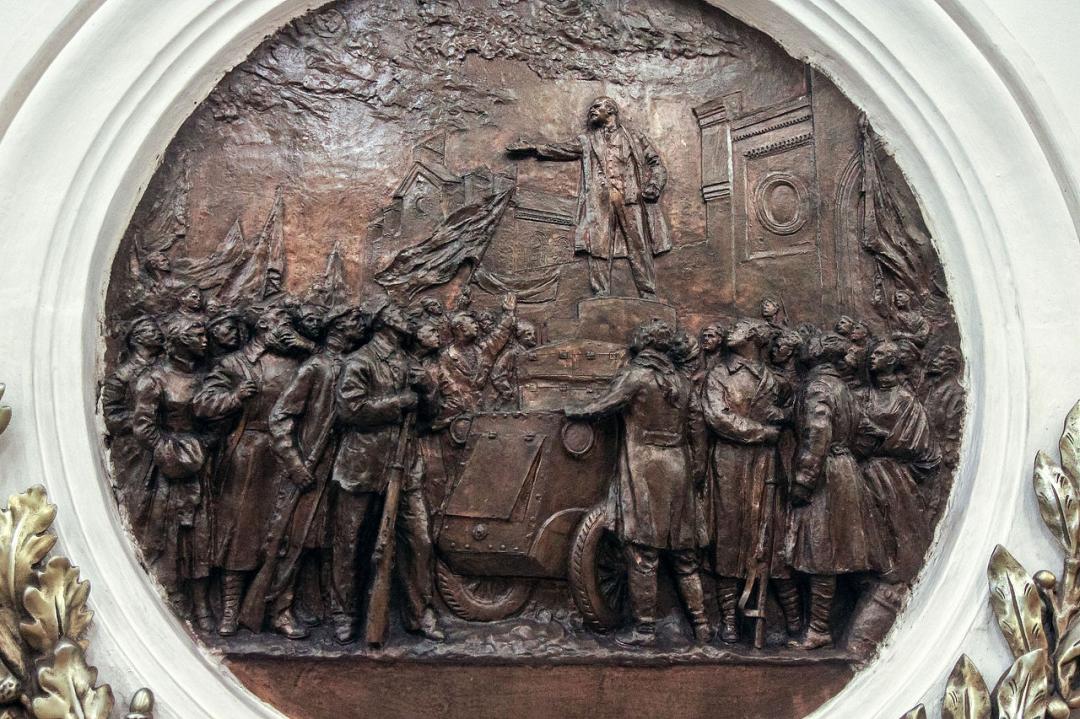
The first bas-relief ("V.I. Lenin's Speech at the Finland Station," sculptor A.I. Dalinenko) depicts the events of April 3, 1917, when Vladimir Lenin returned to Russia from exile. The leader is shown addressing workers, soldiers, and sailors from an armored car in the square in front of the Finland Station. In his speech, Lenin called for an end to the imperialist war and proclaimed the course for a socialist revolution.

The second bas-relief is "V.I. Lenin at Razliv" (sculptor V.B. Pinchuk). On July 7, 1917, the prosecutor's office issued an arrest warrant for Lenin, Trotsky, Zinoviev, and Kamenev for "treason to the Motherland and betrayal of the revolution." To escape arrest, Lenin and Zinoviev lived until August 8 in a hut on the shore of Lake Razliv near Sestroretsk, then moved to Finland. On the bas-relief, Lenin is oddly depicted with a beard and mustache, although it is known that at that time he shaved them off for disguise, and Zinoviev is absent.
The third bas-relief ("Aurora Salvo," sculptor A.V. Razumovsky) shows sailors disembarking, with the revolutionary cruiser itself in the background.
The next scene is "Storming of the Winter Palace" (sculptor V.I. Tatarovich) — one of the key events in Soviet historiography. The Bolsheviks' capture of the Provisional Government's residence, located in the Winter Palace in Petrograd, occurred on the night of October 25-26, 1917. As a result, the Provisional Government was overthrown and arrested. The storming was carried out without significant combat but under threat of force. In 1967, due to the construction of the transfer to the "Mayakovskaya" station, it was dismantled.
The last scene is "Proclamation of Soviet Power at the II All-Russian Congress of Soviets" (sculptor G.D. Yastrebenetsky). The bas-relief depicts Lenin speaking from the podium, with his supporters standing behind him. However, the leader's first appearance before the public after the July events (an unsuccessful armed coup attempt) is depicted with inaccuracies. First, Lenin still had no beard or mustache, as they had not yet grown back. His closest entourage included L.D. Trotsky, I.V. Stalin, I.T. Smilga, V.P. Milyutin, G.E. Zinoviev, L.B. Kamenev, and Ya.A. Berzin; only Stalin is present on the bas-relief, standing between a column and a banner.
Interestingly, this is the only depiction of Joseph Vissarionovich Stalin that, for unclear reasons, remained not only in the Petersburg metro but in all metros of our country after 1961. Perhaps at that time, the small image of Stalin simply went unnoticed.

Bas-relief "Lenin Proclaims Soviet Power." 1955.
Petersburg journalist Sergey Glezeryov managed to interview sculptor Yastrebenetsky about the creation of the bas-relief; here is what he said: "It seemed to me that I got the least interesting theme — Lenin's speech at the Congress of Soviets in Smolny. It was specified that besides Lenin, Stalin and Sverdlov had to be depicted. The work was done. Today I look at it with humor, and I really dislike that sometimes it is made an object of worship. Moreover, my attitude towards Stalin is very negative. Many of my relatives suffered from repression."
"At the same time, the Monument Sculpture Factory, which produced souvenirs, commissioned me to make a twenty-centimeter copy of this relief," adds Grigory Danilovich. "But as soon as the print run of this relief went on sale, the 20th Congress took place, where Khrushchev denounced Stalin. The relief was withdrawn from all stores, and the factory asked me to redo the same relief but without Stalin's image. Now next to Lenin stood a simple worker." It turned out that unlike his colleagues, the sculptor had to model Stalin only once, but this modest bas-relief survived during the years when monuments dedicated to the leader were removed across the country.
The end wall of the central underground hall was decorated until 1960 with a bas-relief portrait of Lenin (sculptors A.G. Pliskin, V.I. Sychyov), but it was dismantled during the construction of the second exit to the surface (exit to Moskovsky railway station).
When the "Ploshchad Vosstaniya" station was still being designed, it was planned that "a sculptural composition reflecting the cooperation of two greatest geniuses of humanity, V.I. Lenin and I.V. Stalin," would be installed at the end of the middle station hall. By the time the station opened in autumn 1955, the struggle against Stalin's cult of personality was already underway, though not yet publicly announced. Most projects of the first phase stations of the Leningrad Metro were hurriedly revised: images and mentions of Stalin were removed from the stations.

Bas-relief paired portrait of V.I. Lenin and I.V. Stalin intended for the "Ploshchad Vosstaniya" station by sculptors A.G. Pliskin and V.I. Sychyov. Source: "Unrealized Leningrad."
As a result, only the bas-relief portrait of Lenin by the same authors was retained. During the construction of the second exit to Moskovsky railway station, the bas-relief with Lenin was removed, and the end wall was dismantled.

There is little reason to regret this; it is noted that the "composition" of Lenin's bas-relief and decorative branches, behind which the door to service rooms was hidden, resembled a crypt. Bas-relief of V.I. Lenin on the end wall of the central hall.
One of the bas-relief authors, Vladimir Isaakovich Sychyov (1917–1995), also participated in creating high reliefs and bas-reliefs at the metro stations "Frunzenskaya," "Narvskaya," and "Ploshchad Vosstaniya."
The design of the platform halls is somewhat more modest than the central hall but still quite rich. The platforms are illuminated by richly decorated chandeliers featuring the hammer and sickle and five-pointed stars (similar chandeliers are installed at the "Novoslobodskaya" station of the Moscow Metro). The track walls are clad with red marble "Salieti," quarried near the village of Salieti in the area of the Georgian city of Chiatura. The white streaks are colonies of lime-secreting algae. Besides them, the marble tiles contain remains of sponges, gastropods, cephalopods, brachiopods, sea lilies, and sea urchins. Decorative grilles with the inscription "1955," the year the station opened, are installed on the track walls.
Initially, the floors in the track halls were covered with asphalt. In 1993, they were replaced with granite, but for some reason, of different colors: the platform towards "Vladimirskaya" is laid with red granite, and the platform towards "Chernyshevskaya" with gray.
The appearance of the "Ploshchad Vosstaniya" station was significantly distorted in 1967 when a transfer hub was arranged in the center of the underground hall. Massive structures supporting the "Mayakovskaya" station destroyed the perspective, dividing the central hall into two parts.
Riding up the escalator, one can immediately reach the "Mayakovskaya" station from the center of the underground hall. The first line is connected to the third line by a four-ribbon escalator installed in 1992-1993, replacing the old three-ribbon ones.
During the construction of the transfer, the central pylons had to be dismantled, leaving only six cast medallions with bas-reliefs at the station. Tatarovich was the most unfortunate; both his medallions "Storming of the Winter Palace," as well as one medallion by Pinchuk ("Lenin at Razliv") and one by Razumovsky ("Aurora Salvo"), were removed.
In 1992–1993, the transfer to the "Mayakovskaya" station was reconstructed. The three-ribbon escalators at the transfer hub were replaced with four-ribbon ones without changing the dimensions of the transfer chamber, which was achieved by using narrow balustrades. The new type of escalators was developed by the Petersburg factory named after Kotlyarov. Simultaneously, the text of the decree along with Lenin's bas-relief was removed from the opposite wall, considering that the Petersburg Metro no longer bore the leader's name. Almost immediately, most of this wall was covered with advertising posters.
Along the stairs, light fixtures similar to those installed on escalators at that time are installed. The decoration of the transfer tunnel is quite simple, its design echoes the "Ploshchad Vosstaniya" and "Mayakovskaya" stations. The floor is made of gray granite slabs; the walls have two-colored tiles: a low gray base topped with bright red ribbed ceramic tiles. Lighting is arranged as two strips of fluorescent lamps mounted on metal backings.
Under the station tunnel of "Mayakovskaya," the pedestrian tunnel is divided in half by a wall; under the stair descent is an original metal sign with the station name. Movement through the transfer is two-way; however, for transfers from the "Mayakovskaya" side, station attendants recommend using the pedestrian tunnel. In the near future, the construction of the deep-column station "Znamenskaya" with transfers to "Ploshchad Vosstaniya" and "Mayakovskaya" is planned, which will create a second three-station transfer hub in Petersburg after "Sennaya–Sadovaya–Spasskaya."
The station vestibule was designed by architects V.V. Gankevich, B.N. Zhuravlev, and I.I. Fomin on the eponymous Vosstaniya Square, on the site of the old Znamenskaya Church (built 1794–1804, architect F.I. Demertsev), demolished in 1938.
Not everything planned in the original project was realized; for example, a large sculptural group depicting armed Red Guards, sailors, and soldiers participating in the storming of the Winter Palace was supposed to be installed above the vestibule entrance. The building is crowned with a stainless steel spire, originally topped with a five-pointed star in a laurel wreath.
There is a legend that for the 40th anniversary of Victory in the Great Patriotic War, celebrated in 1985, when an obelisk "To the Hero City Leningrad" was installed in the center of Vosstaniya Square, also crowned with a five-pointed star, someone thought that two stars on one square were too many. The star on the metro station spire was removed a week before the obelisk's opening and replaced with a large letter "M," urgently made at the "Metrostroy" factory. However, the letter "M" in the wreath hardly resembled the metro emblem, where the letter "M" has curved legs, and after a few years, the letter disappeared along with the wreath. It remains unclear whether it was removed due to the danger of collapse or stolen by metal scavengers.
As mentioned, the vestibule of the "Ploshchad Vosstaniya" station is located on the site of the demolished Church of the Entry of the Lord into Jerusalem, popularly called Znamenskaya after the chapel consecrated in 1765 in honor of the Icon of the Sign of the Most Holy Theotokos, the most revered shrine of the church, created in 1175 in Novgorod by the Greek Christopher Semenov.
In 1794–1804, according to the project of the famous Russian architect Fyodor Ivanovich Demertsev, the church was rebuilt in stone. In 1809, a cast-iron fence and two chapels appeared. In 1912, architect Fyodor Alekseevich Korzukhin added two porticos to the middle part of the church, facing Ligovsky Prospect and Znamenskaya Street (now Vosstaniya Street).
In the 1840s, due to the construction of the St. Petersburg–Moscow railway, a square appeared near the church, where between 1844 and 1851 the Nikolaevsky (now Moskovsky) railway station was built, and in 1847 a hotel building (now "Oktyabrskaya"). The square was named Znamenskaya after the church, as was the new hotel. The Znamensky name was also given to the bridge over the Ligovsky Canal located on Nevsky Prospect.
It is interesting to note that the above-ground pavilion, by its scale and silhouette, somewhat resembles the pre-war demolished Znamenskaya Church, although the dome drum is slightly wider and lower than that of the church.

Attempts to close the church were made much earlier than 1938. According to legend, the world-famous scientist, the first Russian Nobel laureate Ivan Petrovich Pavlov, who was married in this church, prevented it. Rumors were fueled by the fact that the church elder looked very much like Pavlov. However, the church was closed only after the great scientist's death.
It was planned to remove the pediments, towers, and domes but preserve the existing porticos and add two upper floors to be decorated with pilasters. However, plans changed, and in March 1941, the church was blown up to clear space for the future metro station.
At the beginning of the war, church bricks were used to build a pillbox on Ligovsky Prospect near the hotel. Immediately after the war, a square was arranged on the church site, where a fountain created in 1809 by the project of Thomas de Thomon was relocated from Pulkovo. Originally installed at the 16th verst of the Tsarskoye Selo road in the village of Kamenka, it turned into a pile of granite and rubble during the war. The fountain was located on Vosstaniya Square for a short time; in 1950, it was moved to the Victory Park on Moskovsky Prospect. At the end of the last century, the fountain was dismantled again and stored at the Museum of Urban Sculpture, to be installed in 2003, for the 300th anniversary of St. Petersburg, at the corner of Moskovsky Prospect and Sennaya Square.

Blockaded Leningrad. Site of the demolished Znamenskaya Church, dismantling of the church remains for pillbox construction. 1942-1943.
As seen in the photo, the church was demolished to the foundation. Nevertheless, today many sources claim that the vestibule was rebuilt from the church. Construction of the above-ground vestibule of the station. In the foreground is an LM-49 tram; the rails from Nevsky have already been removed. As you can see, the vestibule contours do not match those of the demolished church, which destroys the legend that the vestibule is a rebuilt Znamenskaya Church.
In the early years, elderly Leningraders even crossed themselves when passing by the metro, either in memory of the lost church or mistaking the vestibule for a restored church.
On December 22, 2005, a memorial plaque made of black gabbro, created by artist Vyacheslav Rasteryaev, was installed on the pavilion facade in accordance with the city administration's order to place memorial plaques at sites of lost Orthodox churches, reminding of the demolished Znamenskaya Church.
Since Peter the Great's times, local stone — limestone tuff — was quarried in the Gatchina land. The main limestone quarry areas were three quarries near the villages of Pudost, Chernitsy, and Bornitsy. However, Pudost stone is considered the best for its technical qualities and color shades: from yellowish-gray to brownish-cream. The quarried limestone was light and convenient for finishing works: so soft that it could be sawed and cut with a knife. Only after prolonged exposure to air did it harden and acquire strength equal to well-burned brick. The quarries in the valleys of the Izhora and Pudost rivers existed until 1909 when the deposit was mostly exhausted. Later, in Soviet times, limestone was quarried in very small quantities and exclusively for restoration purposes. In the early 1950s, limestone was used to clad the walls of the above-ground vestibule of the "Ploshchad Vosstaniya" metro station. In 1964–1965, it was used in the repair of the Kazan Cathedral, and in 1970 — for the restoration of the Eagle Pavilion in Gatchina Park.
Due to the difference in elevation (Vosstaniya Square is higher, and Vosstaniya Street is lower), the entrance doors are level with the sidewalk, while the exits open onto the stylobate. Massive oak doors of the above-ground vestibule lead into a curved ticket hall arranged as a gallery.
It was planned to decorate the huge vestibule dome with a painting on the theme "From Smolny to Palace Square," with separate episodes of the historic October night: bonfires behind the Smolny fence, formation of Red Guard detachments, columns of insurgents on the way to the last stronghold of the Provisional Government, the "Aurora" shot, the arch of the General Staff with running soldiers and sailors.
Reflecting the main idea of the architectural design of the entire station complex — "The cooperation of the great leaders of the working people, Lenin and Stalin — organizers of the victorious October uprising, founders of the world's first socialist state," a sculpture depicting Stalin and Lenin in the Smolny interior was planned to be installed in the escalator hall.
For the first few years, access to the metro was granted upon presenting a ticket or other travel document to a controller. Each station employed up to twenty controllers and cashiers. However, the growing passenger flow forced automation of control and ticketing operations. The first turnstiles were tested at the "Narvskaya" station. They were revolving doors that opened when a 50 kopeck token was inserted. Later, they were replaced by Moscow turnstiles, which were open by default. Their design allowed faster passage to the escalator. Moreover, instead of a token, a 5-kopeck coin was inserted, which was the fare after the 1961 denomination. Along with the introduction of new turnstiles, coin exchange machines were installed in the metro by 1967.
From the round hall, escalators carry passengers to the underground hall. Specifically for this station, the "Krasny Metallist" factory (later the "Escalator" factory of the "Lenpodyomtransmash" association) designed and manufactured a new type of escalator LT-1, whose mechanisms remain operable even with ground subsidence. It was at the "Ploshchad Vosstaniya" station on August 5, 1955, at 8 a.m. that the first 48-hour test run of this escalator began.
The second vestibule with exits to Moskovsky railway station and Ligovsky Prospect opened on August 13, 1960. "Ploshchad Vosstaniya" became the first station in Petersburg with two exits.
The new structure was designed by architects A.S. Getskin and V.P. Shuvalova, authors of the above-ground vestibule of the "Pushkinskaya" metro station. The vestibule is integrated into a new building along Ligovsky Prospect, echoing the architectural forms of the old Moskovsky railway station. Railway passengers arriving at Moskovsky station gained direct access to the metro through pedestrian tunnels, which is significantly more convenient than at the similarly designed Leningrad station in Moscow. The authors were fortunate with the spatial solution of the escalator hall featuring a wide glass wall. Additionally, glass doors made from a single piece of Stalinite without any framing were used at the vestibule entrance for the first time. Tempered glass "Stalinite" (named after Stalin) is ordinary sheet glass heated to tempering temperature (650–680 °C) and then rapidly cooled with cold air on both sides.
In 1949, the area between Vosstaniya Street, Nevsky, and Ligovsky Prospects was fenced off to begin work on constructing the inclined passage. Three years earlier, the design of new metro stations had begun. The first projects of the station with the working name "Moskovskaya" at Vosstaniya Square, presented at the end of 1946 in an open competition for architectural design of the first phase underground stations, were considered unsuccessful by the jury.
The theme of the station's design was initially considered to be the historical and revolutionary events in the city. The station's appearance was to emphasize Leningrad's significance as the cradle of the October Revolution. Moreover, the station was to become a kind of city vestibule, as it was located near Moskovsky railway station, where all guests of Leningrad arrived.
It should be noted that the projects for the "Moskovskaya" station, as "central and a kind of city vestibule," were subject to heightened requirements. The first and second prizes were shared by three works by architects of "Lenproekt" G.A. Alexandrov, V.V. Khazanov, as well as M.A. Shepilevsky and Ya.N. Lukin.
In Alexandrov's project, the columns of the underground hall ended with the "swallowtail" of the Kremlin walls, and the ceiling was decorated with large red stars; Khazanov placed a sculpture of Lenin against the background of the mausoleum and Kremlin towers at the end of the station; Shepilevsky and Lukin decorated the columns with medallions depicting views of Leningrad.
According to the results of the 1948 competition, the jury recommended the following five projects of the "Ploshchad Vosstaniya" station for consideration by the City Architectural Council: architects V.V. Gankevich and B.N. Zhuravlev (1st prize); A.V. Vasiliev and G.A. Alexandrov (2nd prize); A.V. Zhuk and V.M. Zhuk (3rd prize); A.I. Lapirov and E.N. Sandler (4th prize); A.V. Vasiliev (4th prize).
Gankevich and Zhuravlev's project envisaged massive square pylons with bas-reliefs at the top, and a sculpture of Lenin on a round pedestal at the end. Lighting was to be provided by a system of parallel glowing arcs laid along the vault, separated by narrow ornament strips, together forming an almost continuous luminous ceiling. The City Architectural Council agreed with the jury's conclusion and recommended the project by architects Zhuravlev and Gankevich, which won first prize, for further development, noting: "The sufficiently festive and monumental architecture corresponds to the station's location on Vosstaniya Square — in the center of Leningrad."
At the beginning of 1950, by assignment of "Lenmetproekt," a third round was held among the most proven metro architects. For the "Ploshchad Vosstaniya" station, proposals were submitted by corresponding member of the USSR Academy of Architecture I.I. Fomin and architect B.N. Zhuravlev, as well as architects V.V. Gankevich and A.I. Pribulsky.
Both projects had significant similarities and differed only in vault solutions, lighting, and floor patterns. The authors tried to express the main theme "with tone saturation, combining red cladding with gilded details and bas-reliefs reproducing episodes of the heroic struggle for Soviet power under Lenin and Stalin." Nevertheless, it was noted that "the architectural solutions of the station do not convey the overall uplift, revolutionary pathos, and deep ideological content of the station's design, intended to reflect the theme of the Great October Socialist Revolution," so the authors were to refine and find a convincing architectural solution.
The basis for further development was the version by Fomin and Zhuravlev. The final project, accepted for implementation, was developed in 1952 by a team of architects consisting of I.I. Fomin, B.N. Zhuravlev, and V.V. Gankevich. Among this trio, the most renowned and decorated was Igor Ivanovich Fomin (1904–1989). His personality and character were greatly influenced by his father, the famous architect Ivan Alexandrovich Fomin, author of the Moscow Metro stations "Krasnye Vorota" and "Ploshchad Sverdlova."
Speaking about I.I. Fomin, it is worth recalling that together with the chief architect of Leningrad V.A. Kamensky, despite numerous public protests, he decided in early 1961 to demolish the Church of the Savior on Sennaya to clear the site for metro construction. A few years later, the same fate awaited two buildings restored according to Fomin's projects: first, a house in Kirpichny Lane was dismantled to the foundation for the construction of the above-ground vestibule of the "Admiralteyskaya" metro station, and then house No. 68 on Nevsky Prospect was demolished and rebuilt.
The second author of the "Ploshchad Vosstaniya" station project, Boris Nikolaevich Zhuravlev (1910–1971), joined the "Lenproekt" institute in 1938 in the workshop led by I.I. Fomin and E.A. Levinson after successfully graduating from the Academy of Arts. His first independent work in the workshop — the project of the new city center of Leningrad on Moskovskoye Highway — won 4th prize in a competition, and the residential building project on the square near the Kirov District Council, done jointly with Levinson and Fomin, took 1st place. While at the front in winter 1942, he had to perform an unusual task from the command of the 55th Army — under heavy enemy fire, to measure the bell tower of the Alexander Nevsky Church in Ust-Izhora, where the army command post was located. The bell tower, which was a good target for shelling, had to be blown up, but the measurement drawings allowed its restoration after the Victory.
Vera Vladimirovna Gankevich graduated from the architectural faculty of the All-Russian Academy of Arts in 1937. She worked for many years with Anatoly Isaakovich Pribulsky, who later became her husband. Together, they designed metro stations "Tekhnologichesky Institut-2," "Sennaya Ploshchad," the 19-story "Sovetskaya" hotel (now "Azimut"), the city's first high-rise building. Their last joint metro project was the "Lesnaya" station.
Engineer-designer E.A. Erganov from the "Lenmetproekt" institute also participated in the creation of the "Ploshchad Vosstaniya" station. Petersburg soils, consisting of loose ribbon clays, are a weak foundation for large structures. The builders of St. Isaac's Cathedral faced these difficulties as well. Hundreds of huge piles had to be driven under its foundation, but even they could not prevent subsidence. Metro vestibules have special requirements, allowing only minimal damped oscillations. Erganov and other institute engineers worked on creating a stable foundation form for the outdoor vestibule of the "Ploshchad Vosstaniya" station. Initially, twelve-meter reinforced concrete piles were planned. However, the huge columns quickly sank into the soil. Piles of another type and greater length also failed. Moreover, their driving caused strong vibrations threatening the integrity of neighboring houses. The problem was also caused by boulders frequently found in moraine deposits.
Then Erganov and colleagues proposed using a solid reinforced concrete slab as the foundation for the station vestibule. This bold project was nicknamed the "floating foundation" at the institute. Thanks to the wide slab, specific loads were reduced to normal values. Interestingly, Erganov's grandfather also worked on Petersburg's underground railway projects. He outlined his ideas in a special brochure. No above-ground vestibules were planned; instead, wide manholes in the pavement, fenced with railings, were used. To reach the metro platform, passengers had to descend stairs. The grandfather did not anticipate how complex metro construction in our city would be and what difficulties his grandson would face. Yevgeny Alekseevich Erganov was born in St. Petersburg in 1909, graduated from the Leningrad Hydraulic Engineering Institute, and was a participant in the Great Patriotic War. He worked at "Lenmetproekt" from September 8, 1947, to March 17, 1972, first as a senior inspector, group leader, then as chief project designer. Besides "Ploshchad Vosstaniya," he participated in designing the pavilion of the "Ploshchad Lenina" station on Botkinskaya Street (1962), the underground hall of "Mayakovskaya" (1967), and the vestibule of "Vyborgskaya" (1975).
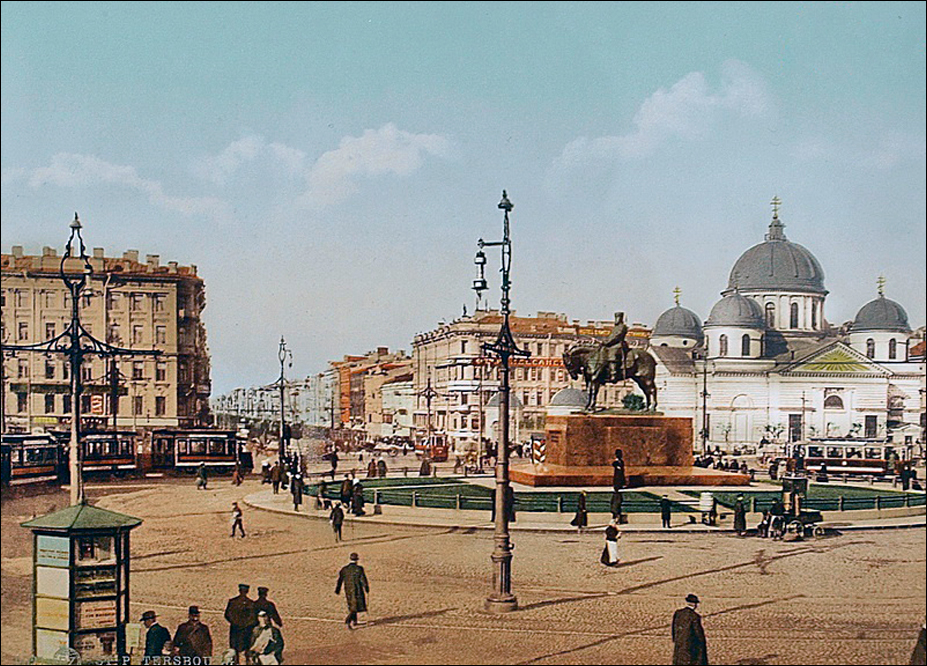
The current Vosstaniya Square, after which the metro station is named, was designed in the 1840s by architect Nikolai Yefimov. It was then called Znamenskaya, after the aforementioned Church of the Sign of the Lord. The square was renamed Vosstaniya Square on November 17, 1918, in memory of the February events of 1917.
Sources:
https://www.mirmetro.net/spb/01/20_ploshchad_vosstaniya


Written by Jermaine
Discuss this with the author and others
No comments yet. Be the first to start the conversation.