


The residents of Petersburg have long been accustomed to the luxurious decor of the Saint Petersburg Metro, yet even the most discerning viewer cannot calmly pass by the incredible beauty of the underground vestibule of the "Avtovo" metro station. The station’s interior is famous for its lavish decoration, bold architectural and artistic solutions. But special attention is drawn to the majestic columns clad in embossed glass. These columns made the station one of the brightest and most memorable not only in Petersburg but worldwide.
Let’s turn to history. In 1949, a competition was announced for the design of the first phase stations of the Leningrad Metro. The winners were architects Yevgeny Levinson and Andrey Grushke, who conceived the vestibule as an underground palace. The main feature of the interior was to be columns made of glass.

Historically, the creation of columns can be traced through various materials such as stone, wood, marble, even metal. Using such materials for architectural load-bearing elements seems quite logical. The idea of glass columns was a bold, innovative solution.
The use of glass in this context sparked debates, but the project was supported by Nikolay Nikolaevich Kachalov — a corresponding member of the USSR Academy of Sciences. It’s no surprise, as Professor Kachalov was a true pioneer in the glass industry.
So, the authors of this unique project had to solve many issues related to the use of glass on an architectural scale.
Of course, the columns could not be made entirely of glass. Firstly, it was necessary to avoid the feeling of fragility in these monumental forms, since their main function was to serve as support for the building. Secondly, large glass forms, due to their transparency, appear hollow, so it was necessary to maximize the optical properties of the material. That is, it was assumed that the column’s structure would have a core as its base, and the glass would serve as a decorative shell.
A model of the station has been preserved, where the columns are made entirely of crystal. It was even planned that they would be lit from the inside, but this idea was later abandoned. A 1/10 scale model of the columns was made at the Leningrad Artistic Glass Factory, where further experiments continued. These efforts helped the project authors solve an important question: how to achieve the impression of strength and monumentality in glass architectural elements and visually hide their internal supporting core.
For further development of the glass application project, an experienced engineer-technologist F.S. Entelis was invited. He supervised the technological processes and developed the system for fastening the fragile glass forms.
F.S. Entelis recalls working on the project: “The main task was to prevent the reinforced concrete columns from shining through the crystal. After many options, I came up with the idea of applying a proven principle, justified in certain elements of the ‘Stalin vase’ (the method of total internal reflection), which means that light rays falling on the outer surface, reflecting twice, return back. This principle excludes the possibility of seeing the concrete behind the crystal cladding.”
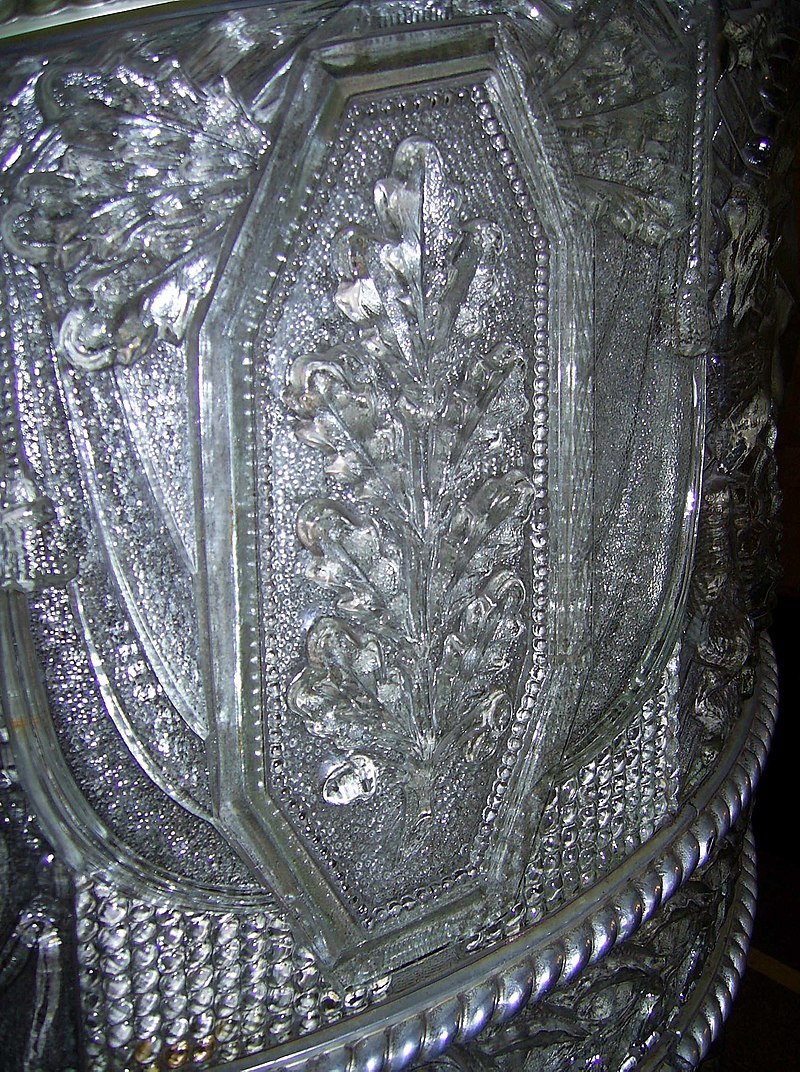
After numerous technological experiments, it was decided to produce small modular glass elements using pressing techniques, where both the outer and inner parts of each segment have relief. It turned out that this method of creating glass modules was not difficult for industrial production and was economically advantageous. Sculptor A.E. Gromov created a plastic model of diamond-shaped tiles of three types, differing from each other in ornament.
Thus, glass modules with double-sided relief were obtained, which needed to be installed on a vertical support. For this, additional metal fasteners were added to the external structure, wrapping the column from the base to the capital. This spiral system proved to be good not only as a decorative but also as a structural element capable of holding the glass modules. This structure was inspired by the relief of the famous Trajan’s Column, created in 113 AD, where images ascend in a spiral along the vertical shaft from bottom to top.
Finally, the many searches and technological experiments led to the final structural solution: the inner base of the column is made of concrete, painted black, and the glass modules with double-sided relief are attached to a metal spiral frame.
Thanks to this solution, the supporting pillars create the impression of glass monoliths. It was possible to visually preserve the main function of the column as a load-bearing support, emphasizing its grandeur and monumentality. And most importantly, a technological method was found by which the glass elements form a volumetric shape.
Academician Kachalov notes in his written work on glass: “It is hardly possible to find in our country, and perhaps abroad, a second such structure where architectural artistic glass is presented so boldly and fully. Here, in this architectural complex, it occupies an indisputably dominant position among other materials in its expression.”
According to the original project, all 46 columns of the station were to be clad in glass. However, this did not happen due to a new government decree “On the elimination of excesses in design and construction,” issued in November 1955. Thus, 16 columns were created according to the project, the rest were clad with marble tiles.
The fact is that until 1955, the architectural design of metro stations was supposed to promote the idea of accessible luxury. The dominant architectural style was neoclassicism, and projects with lavish decor including Soviet symbolism were popular. Creating a “palace for the people” was the main message from the top leadership.

The station was opened on November 15, 1955, as part of the first phase of the metro “Avtovo” — “Ploshchad Vosstaniya,” and it was at the “Avtovo” station that the first train of the Leningrad Metro arrived. Its decor is dedicated to the defense of Leningrad during the Great Patriotic War. The concept is conveyed through visual elements symbolizing military valor and glory.
It cannot be said that today the underground vestibule of “Avtovo” or the glass columns are perceived as modern or timeless. No, it is a monument of an era, a monument to the Soviet era with its grandest ideas.
The underground vestibule of the “Avtovo” metro station is, first and foremost, a technological achievement of its time, an incredible experiment conceived and realized by the Soviet state. Thanks to the architectural design of the station, and in particular, the grandeur of the glass column array, the mysterious underground space forever gained the fame of the “crystal palace.”
The station is mentioned in Vladimir Berezin’s post-apocalyptic novel “Travel Signs.” It is said that due to its shallow depth, “Avtovo” is an abandoned station subjected to radiation contamination.
Events in episode 162 of the animated series “Masyanya” also take place on the platform of the “Avtovo” station.
Sources:
https://www.designspb.ru/news/articles/crystal_dungeon/
Text: © Anna Sukhoivanenko, 2022
https://ru.wikipedia.org/wiki/Автово_(станция_метро)


Written by Jermaine
Discuss this with the author and others
No comments yet. Be the first to start the conversation.