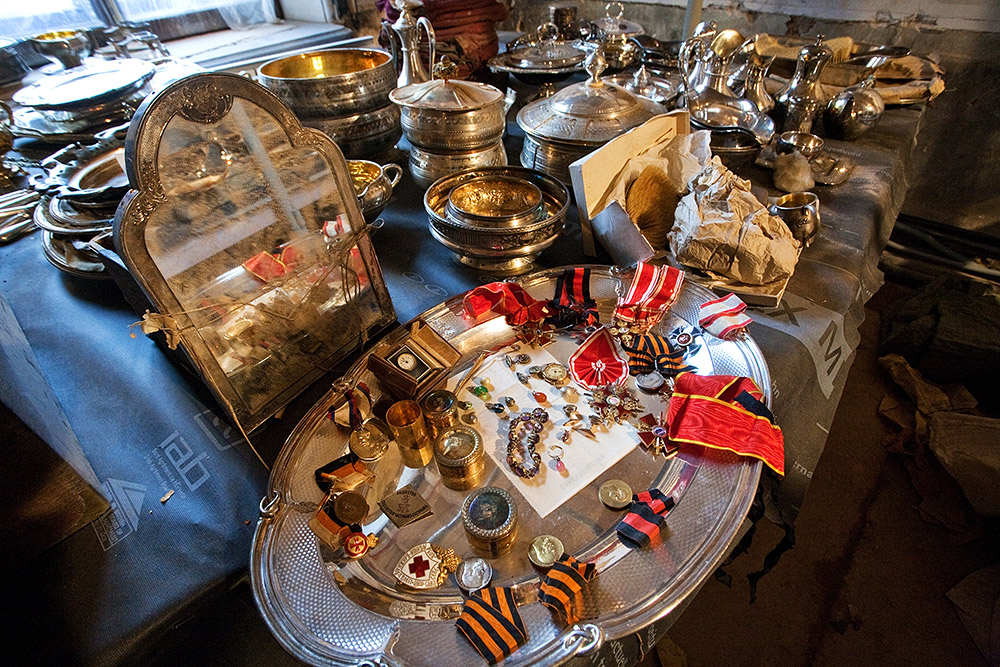

Restoration work was carried out in the Naryshkin-Trubetskoy house located on Tchaikovsky Street. While opening the ceilings, the builders discovered a small room that was not on any of the building’s plans. In this small sealed room, which was not marked on any of the building’s plans, restoration company workers found a treasure—a large number of unique silver items—Naryshkin’s ceremonial tableware sets with family hallmarks. According to preliminary expert opinion, this find is unparalleled in St. Petersburg in terms of cultural and historical significance, reports the press service of the Main Directorate of the Ministry of Internal Affairs of Russia for St. Petersburg and the Leningrad Region.
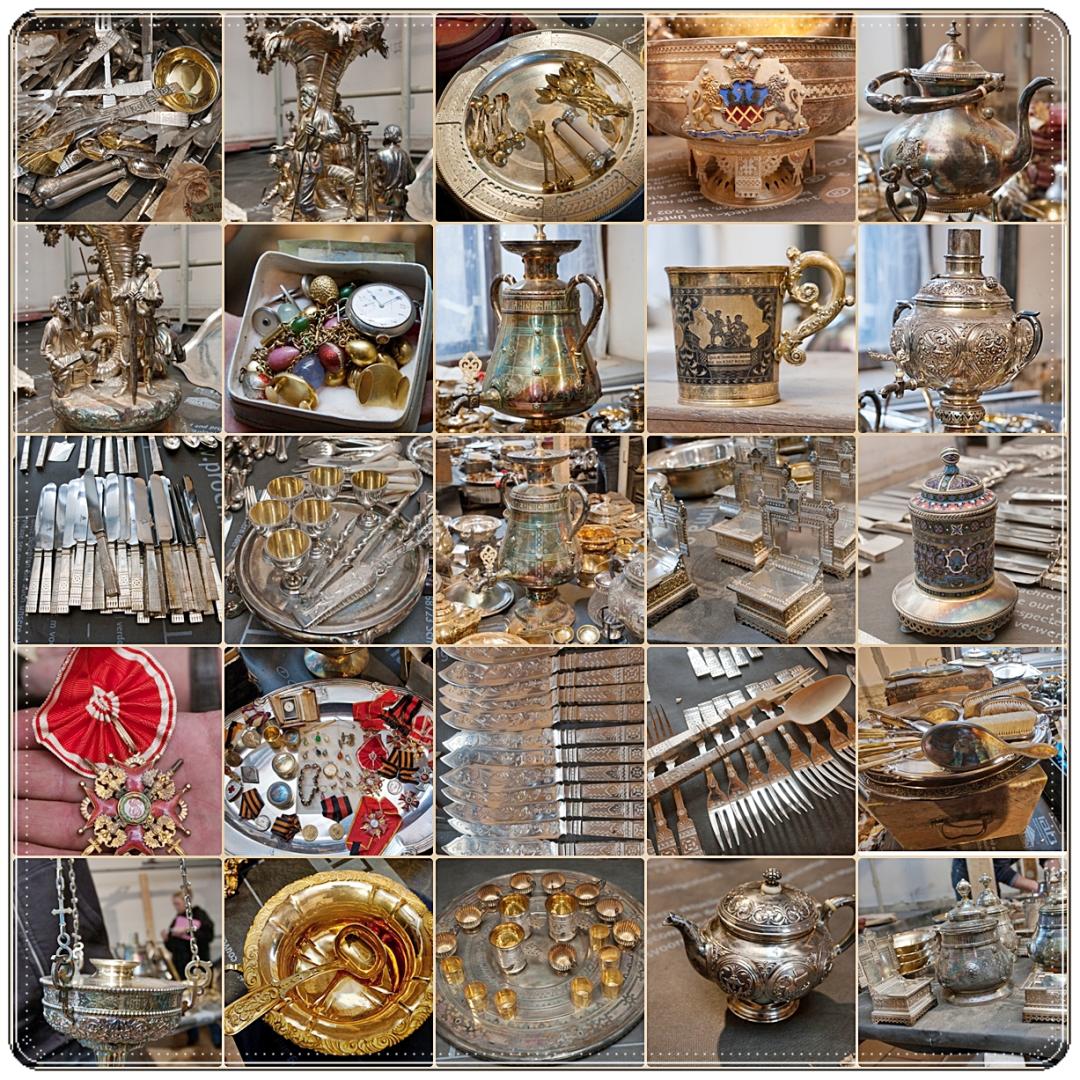
The room contained 40 bags of silverware bearing the Naryshkin family coat of arms. In total, several thousand items were found. They are now located in a larger room, about 15 by 15 meters. Moreover, this room is completely filled.
The treasure consists of three antique tableware sets in full sets: each contained more than a thousand components, from tea strainers to silver samovars. In a separate box lay jewelry, which experts called expensive costume jewelry, as well as Russian and foreign orders and medals, commemorative badges, award documents, clocks, and toiletry items.
Some of the silverware was partially wrapped in newspapers from August–September 1917. Another part of the silver was stored in special wooden boxes and lined with linen fabric, while some were wrapped in cloth bags. An employee of the KGIOP (Committee for State Control, Use and Protection of Historical and Cultural Monuments) said that judging by the smell, the fabric was thoroughly soaked with vinegar, which prevents silver from oxidizing.
All items are in excellent condition; many bear the coat of arms of the princely Naryshkin family. The hallmarks on the dishes correspond to three periods—1872, 1914, and 1915. Experts immediately stated that such complete sets have never been found in St. Petersburg before.
During the inventory of the treasure items, the presumed last owner of the tableware was identified: it was apparently Lieutenant Sergey Sergeyevich Somov of the Life Guards Hussar Regiment. His name was found in documents discovered in one of the boxes found in the sealed room. Specialists found a card of a student of the Imperial School of Jurisprudence, a certificate awarding the Order of the White Eagle to Lieutenant Sergey Somov of the Life Guards Hussar Regiment of His Majesty, as well as papers for the Order of St. Vladimir, 4th class (which was also among the finds), of which Somov was a recipient. The lieutenant may have been a distant relative of the Naryshkin family, whom they cared for and who became the custodian of the valuables after the Naryshkins left Petrograd.
The expert does not rule out that this find could spark a “gold rush.” He noted that in Russia it began back in the late 1990s and early 2000s and has been growing every year. “I am very often invited by commercial firms that receive mansions in Moscow for reconstruction to check them before they start work, as they bring in Tajiks, Moldovans, and other migrant workers. And arriving first at such mansions, I can already see that someone has ‘worked’ there before me,” said Poryvaev.
Besides the table silver, the discovered treasure includes decorative elements, such as massive silver candlesticks in the Art Nouveau style, jewelry, orders and medals of the Russian Empire, as well as two travel necessaires—one male and one female.
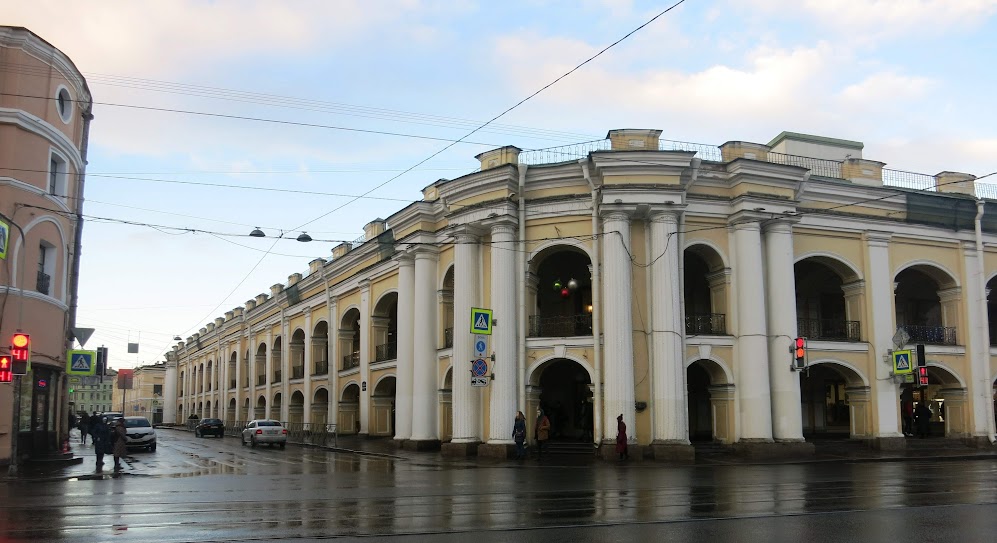
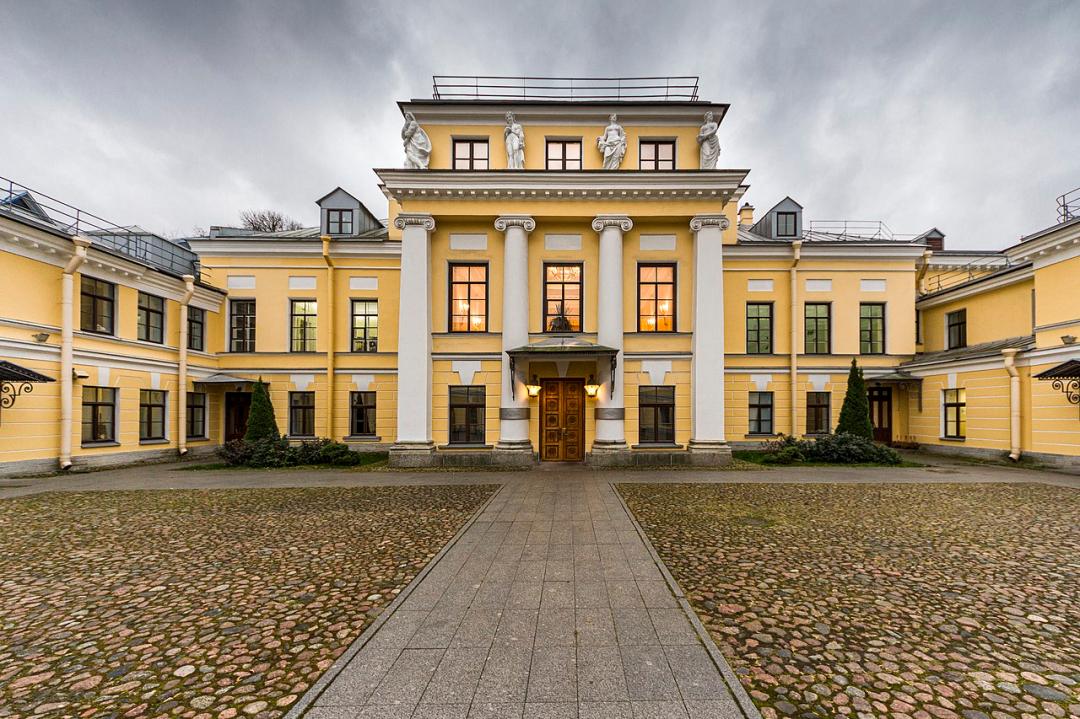
The Naryshkin-Trubetskoy house was built in the 18th century and was rebuilt twice in 1855 and 1875–1876 by Harold Bosse and Robert Gedike. Since the 1750s, two houses stood on the plot at No. 29 Tchaikovsky Street, one of which belonged to Pushkin’s great-grandfather, Abram Petrovich Hannibal.
After his death, the plot passed to his sons, and in 1801 the new owner of the house became Senator Ivan Nikolaevich Nepliuev. Later, the plot passed to his daughter, for whom two separate buildings were rebuilt into one in 1832 according to the project of K. F. Leman. Only in 1855 did Prince Petr Nikitich Trubetskoy buy the house. His wife, Elizaveta Esperovna Beloselskaya-Belozerskaya, tried to establish a high-society salon in the mansion, but it never gained such fame. Due to financial problems, Prince Trubetskoy was forced to rent out the house.
In 1874, the mansion was acquired by Prince Pavel Pavlovich Demidov, but the following year he resold it to Vasily Lvovich Naryshkin. It was for the Naryshkins that architect Gedike rebuilt the house. A garden was preserved in the courtyard, and new service buildings were constructed along Kirochny (now Druskeniksky) Lane. Here the architect created a large hall for 200–250 people. After 1917, the mansion’s owners left Russia. According to official sources, the cultural valuables stored there were transferred to the Hermitage in 1920, and some paintings were handed over to the Russian Museum. “The value of the treasure found in the mansion on Tchaikovsky Street is 189,542,000 rubles, or approximately €4 million,” said Alexander Gagarin, president of the College of Experts and Appraisers of Jewelry and Antiques.
This amount was calculated not by evaluating each jewelry item separately (in which case the total treasure would be worth about 42 million rubles), but by assessing the entire find as a whole. According to the expert, most items bear the Naryshkin family coat of arms, which allows these items to be considered as a collection. Moreover, this collection has confirmed provenance and includes items made by Russian and French masters at different times but in the same style. It should be noted that almost all items of Russian noble families after the revolution were either taken abroad or expropriated and then sold off separately. Therefore, the Naryshkin treasure also represents ethnographic value.
“This collection is a benchmark from a historical point of view,” said Gagarin. “It is intact, belongs to one family, was made by masters, and demonstrates the tastes of the era.”
Evgenia Fursikova, an art historian from the Konstantinovsky Palace, where the Naryshkin treasure is now exhibited, agrees with Gagarin. “No museum in the world has such a complete tableware collection,” she said. “It can be used to teach 19th-century etiquette.”
According to the art historian, such a unique collection must not be divided; it must be preserved in its original form.
The most expensive items in the treasure turned out to be a pair of candelabra. They are currently valued at 2.2 million rubles. These are unique items weighing about 15 kg. The cheapest item was a comb missing several teeth, valued at 500 rubles.
Alexander Novikov, a representative of the company “Intarsia,” said that the treasure’s examination took more than a year, involving many experts—art historians and jewelers. They compared the treasure items with similar pieces sold at Christie’s and Sotheby’s auctions and studied price lists of jewelry houses from pre-revolutionary Russia.
The workers who found the treasure will not receive any money. As explained by the St. Petersburg police, the migrant workers tried to secretly remove the treasure from the site in parts but were stopped by Intarsia’s security service. A criminal case was opened against them.
At the same time, Intarsia previously stated that the treasure was found not by the workers but by Dmitry Korolev, the head of restoration work in the Naryshkin mansion.
The Naryshkin descendants did not claim the treasure. However, many fraudsters and simply naive people with the same surname appeared, hoping to receive a large sum. Sometimes they came to the Konstantinovsky Palace, showed a passport with the surname Naryshkin, and demanded “their precious items.”
Sources:
https://spb.aif.ru/culture/event/135216
https://www.gazeta.ru/social/2013/12/19/5811645.shtml
https://www.gazeta.ru/social/2012/03/29/4111201.shtml?updated
Written by Jermaine
Discuss this with the author and others
No comments yet. Be the first to start the conversation.