Studies at the Main Engineering School (Mikhailovsky Castle)

Fontanka River Embankment, 2, Saint Petersburg, Russia, 191187

Dostoevsky moves into the Engineering (formerly Mikhailovsky) Castle, where the Main Engineering School is located. Dostoevsky's company officer, A. I. Savelyev, later recalled that "His favorite place to work was the embrasure of the window in the corner bedroom of the company, overlooking the Fontanka."

At the end of May 1837, fifteen-year-old Fyodor Mikhailovich Dostoevsky and sixteen-year-old Mikhail Mikhailovich Dostoevsky were brought to St. Petersburg by their father to enroll in the Main Engineering School. In the autumn, after preparation at Kostomarov’s boarding school, Fyodor managed to enter the third conductor class. Mikhail did not pass due to health reasons and went to the engineering cadets.
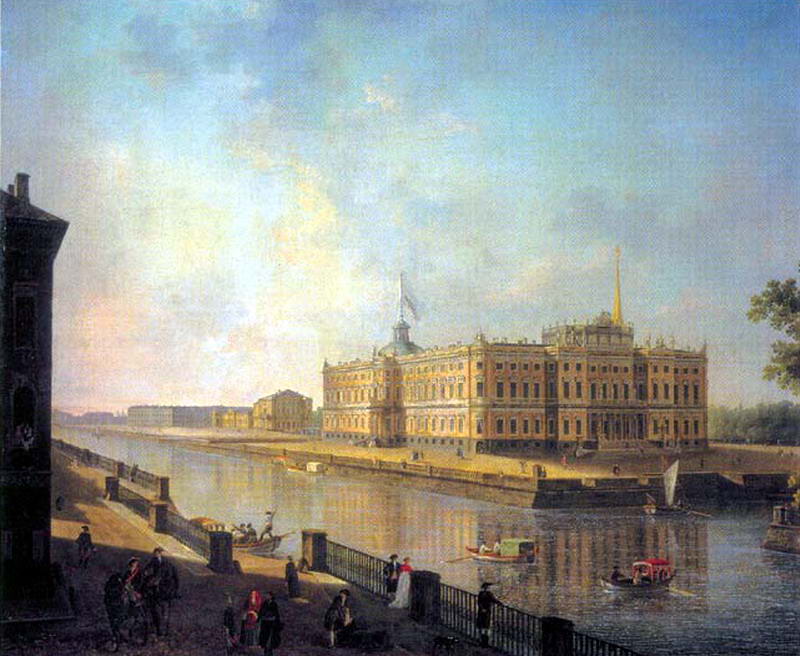

On January 16, 1838, Dostoevsky moved into the Engineering Castle. From that time, according to the writer, he studied “from early morning till evening,” after which he still had “lessons in fencing, dancing, singing” and guard duty. Already in February, in a letter to his father, Dostoevsky reported constant busyness, leaving no time even for frequent correspondence. He spoke very positively about the school, saying he was very satisfied and had wonderful teachers. According to his company officer A. I. Saveliev: “...at the school he behaved modestly, performed drill duties and academic tasks impeccably.” At the very beginning of his studies, he again encountered favoritism from the school administration: “Recently I learned that after the exam the general arranged for the admission of four new students at the state’s expense besides the candidate who was with Kostomarov and took my vacancy. What meanness! It completely shocked me. We, who struggle for every last ruble, have to pay, while others — children of wealthy fathers — are admitted free of charge.”

From the first days of study, Dostoevsky’s inclination toward “intellectual” subjects was clear — literature, languages, Divine Law, history, geography, geometry, physics. Military subjects such as artillery, fortification, and drawing plans of field fortifications, redoubts, and bastions were difficult for the future writer. Nevertheless, in April Fyodor Mikhailovich successfully passed intermediate exams, negatively noting the excessive importance of drawing: “I draw poorly, as you know, and this harmed me a lot... I became average in the class, whereas I could have been first... I have full marks in almost all intellectual subjects, so I have 5 points more than the first student in all subjects except drawing. And drawing is viewed more mathematically.” Besides drawing, the final grade was influenced by marks in the field service, in which Dostoevsky, for whom it was painful to “stand out before any officer,” scored no more than 3-4 out of 10. In mid-May, Fyodor was also exhausted and forced to spend seriously on preparations for the parade “where the entire royal family was present and 140,000 troops were stationed.”

In summer, conductors were sent for two months to Peterhof for practical exercises, which consisted of “surveying and leveling terrain, laying out and defiling field fortifications, and performing sapper and linear works.” In the first year, Dostoevsky had a double load — “battalion and sharpshooters.” At this time, a precise image of a possible future began to form for him. Financial difficulties were added to the field hardships. He wrote to his brother about the difficult financial situation: “During the march from the camps I had not a penny; I fell ill on the road from a cold (it rained all day, and we were exposed) and from hunger and had not a grosh to moisten my throat with a sip of tea.” In letters to his brother, Dostoevsky regularly complained about his miserable fate, hunger, and lack of money. From mid-August to October, classes continued at the school. On October 1, annual exams began. From October 3 to 26, Dostoevsky passed exams in Divine Law, algebra, German, geometry, geography, Russian language and literature, artillery, fortification, French, and history. He was not included in the lists of those promoted to the next classes, remaining in the third class for a second year. On October 30, in a letter to his father, he explained this failure by a quarrel with the algebra teacher during the year, because of which “some of the teachers were not favorable to me”: “Those who passed the exams a hundred times worse than me were promoted (through favoritism). What to do? Apparently, you cannot break through the road yourself. I distinguished myself in algebra and fortification, and they gave me inappropriate marks.” In summer, Dostoevsky wrote to his brother that he had read all of Ernst Hoffmann, almost all of Honoré de Balzac, Goethe’s “Faust,” Nikolai Polevoy, Victor Hugo, George Sand, Shakespeare.

On November 1, 1838, the new academic year began at the Main Engineering School. At first, Dostoevsky took the repetition of the year very negatively: “Oh horror! Another year, a whole extra year! I wouldn’t mind if the tears of my poor father did not burn my soul.” But later he noted a positive side in that he could “graduate first and receive a lieutenant’s commission directly.” The main thing for Dostoevsky was to prove to himself that the school required only rote learning from him. His letters regularly repeated the thought that it was “disgusting, but necessary,” “with aversion — but you cram.” In the end, the writer concluded that “field fortification is such nonsense that you can cram it in 3 days.” At the same time, his success in “field service” remained weak, because of which the writer even ended up in the group of laggards, who were prescribed daily drills.

At the beginning of the second year of study, Dostoevsky met Alexander Rizenkampf. Together with Grigorovich, Beketov, Vitkovsky, and Berezhetsky, the future writer organized a literary circle. Dostoevsky also worked as an editor of the lithographed newspaper at the school. In the winter of 1839, the writer became close to the Berezhetsky brothers and Beketov, with whom he “had long conversations and lengthy discussions on various issues.” According to the company officer’s recollections, Dostoevsky did not become close to anyone else: “Such an isolated position of Fyodor Mikhailovich caused good-natured mockery from his comrades, and for some reason he was given the nickname ‘Photios.’” In the first half of 1839, Dostoevsky planned to marry A. D. Lagvenova.

At this time, Dostoevsky was constantly in debt and could get money only from his father, even understanding his financial situation. Thus, in March 1839, he wrote: “I have spent a lot of money (on buying books, things, etc.) and had to borrow everything. How much longer will I take your last? I know we are poor.” Already in May, along with gratitude for the 75 rubles sent, Fyodor Mikhailovich asked to send at least another 40 rubles for boots, a trunk for books, postal supplies, and courtesies for the servants for the summer camps near Peterhof. There he added: “Respecting your need, I will not drink tea.” Semenov-Tyan-Shansky had earlier studied at the military school for guards non-commissioned officers and cavalry cadets, “a richer, aristocratic institution.” According to his recollections, 10 rubles were enough for summer camps in Peterhof. Regarding Dostoevsky’s requests, he writes that this was “not an actual need but was done simply so as not to fall behind other comrades who had their own tea, boots, and trunk.”

In May 1839, Dostoevsky successfully passed exams for promotion to the second class. His father wrote about the complete ruin of the estates but found and sent the necessary money. The summer was spent near Peterhof on practical exercises. On July 11, an order was issued transferring Dostoevsky to the second conductor class. On June 6, Dostoevsky’s father died: officially from an apoplectic stroke, unofficially said to have been killed in the field by his serfs. There is information that news of his father’s death caused Dostoevsky to have an epileptic seizure.

Studying in the second conductor class, the writer again found himself in a difficult financial situation, not even having money for frequent letters. Fyodor Mikhailovich’s general mood was expressed in his letter to his brother: “My only goal is to be free. For it, I sacrifice everything. But often, often I think, what will freedom bring me? What will I be alone in a crowd of strangers? I will be able to untie all this; but, I confess, it takes strong faith in the future, a strong consciousness in oneself, to live by my present hopes. I am confident in myself. Man is a mystery. It must be solved, and if you spend your whole life solving it, do not say you wasted time; I am engaged in this mystery because I want to be a man.” Konstantin Trutovsky, who entered the school in October, later recalled that Dostoevsky at that time “was very thin, his complexion was some kind of pale, gray, his hair light and sparse, his eyes sunken, but his gaze was penetrating and deep. The uniform sat awkwardly on him, and the knapsack, shako, and rifle seemed like chains he was temporarily obliged to wear and which burdened him.”

In November, Mikhail Dostoevsky wrote in a letter to Moscow about Fyodor’s extreme poverty, who did not even have money for postage. At this time, the future writer was fascinated by the works of Friedrich Schiller, highly appreciated the works of Victor Hugo and Gavriil Romanovich Derzhavin. From January 2 to 12, 1840, Dostoevsky passed half-year exams in algebra, literature, fortification, history, German, artillery, French, and drawing. From April 30 to June 1, he successfully passed annual exams in the second conductor class. From June 23 to August 25, the company was on practical exercises near Peterhof.

In the autumn of 1840, Fyodor Mikhailovich continued his studies in the first conductor class, and on November 29, “for good behavior and knowledge of field service,” he was promoted to non-commissioned officer. On December 27, by the highest order, he was “renamed to portepee-junker.” From January 7 to 18, half-year exams were held in fortification, history, French, analytics, geodesy, Divine Law, descriptive geometry, physics, architecture, drawing, and Russian literature. Dostoevsky’s company officer A. I. Saveliev later recalled that “in 1841 Fyodor Mikhailovich was already graduating from the senior class. As before, thoughtful, rather gloomy, one might say reserved, he rarely associated with any of his comrades, although he did not isolate himself, often sharing his study notes with them, and often wrote essays on assigned topics in Russian literature for his comrades.” “His favorite place of study was the embrasure of the window in the corner bedroom of the company, overlooking the Fontanka.” At the same time, the officer noted Dostoevsky’s nighttime writing work, the content of which he did not tell anyone. Saveliev noticed that “it was impossible to assume that F. M. Dostoevsky lacked time during the day for studies; the writing work at night, when no one disturbed him, was literary.”

In January 1841, the writer became interested in theater and conceived the drama “Maria Stuart,” on which he continued to work until 1842 but ultimately did not finish. In mid-February, Dostoevsky read to his brother Mikhail “excerpts from two of his dramatic attempts” — “Maria Stuart” and “Boris Godunov,” after which he began preparing for final exams: “Such cramming, God forbid, has never happened before. They are pulling the sinews out of us. I sit even on holidays. Faster to the pier, faster to freedom!” From April 22 to June 3, Dostoevsky successfully passed exams in analytics, geodesy, descriptive geometry, fortification, artillery, physics, French, Russian, history, architecture, Divine Law, and three types of drawing: fortification, architectural, and situational. From June 20 to August 5, he was on practical exercises near Peterhof. On August 5, after exams in fourteen subjects, Fyodor Dostoevsky was promoted “to field engineer-ensign with retention in the Engineering School to continue the full course of studies in the junior officer class.”

Sources:

https://ru.wikipedia.org/wiki/Dostoevsky_in_the_Main_Engineering_School

Vera Biron: Dostoevsky’s Petersburg

Follow us on social media

More stories from St. Petersburg of Fyodor Dostoevsky

The first address of Dostoevsky in St. Petersburg

Moskovsky Ave., 22, Saint Petersburg, Russia, 190013

The first address of Dostoevsky in St. Petersburg was Bolshoy Tsarskoselsky Prospect, the house of Collegiate Councillor Fyodor Dmitrievich Serapin, No. 7. The modern address is Moskovsky Prospect, No. 22. The house has been preserved (built in the 1820s). In a draft petition addressed to the monarch, M.A. Dostoevsky, who brought his elder sons Mikhail and Fyodor to St. Petersburg to enroll in the Main Engineering School, indicated his "temporary residence near Obukhov Bridge in the hotel at No. (text unfinished)." The researcher of Dostoevsky's work, Fedorov, suggested that the hotel where the Dostoevskys "could have stayed 'near Obukhov Bridge'" was the "stagecoach hotel in the 'huge' Serapin house, where 'order and cleanliness, arrangement and affordability (as the newspaper 'Northern Bee' wrote) are worthy of attention'."

Preparation for Admission to the Main Engineering School

Ligovsky Ave., 65, Saint Petersburg, Russia, 191040

Having placed his sons for exam preparation at the Main Engineering School in Captain Kostomarov’s boarding house, Mikhail Andreyevich Dostoevsky left back for Moscow on May 26 or 27. The historical address of the boarding house: Ligovsky Canal Embankment, house of the 3rd guild merchant Nikita Ivanovich Reshetnikov, No. 66. Captain Kostomarov’s boarding house. Modern address: Ligovsky Prospect, No. 65. The house has not been preserved (the current building was constructed in 1912–1913). The address is recorded in a memorial note by A.G. Dostoevskaya, made by her in the Notebook of 1876–1884: “Dostoevsky studied under Coronad Filippovich Kostomarov, on Ligovsky Canal, Reshetnikov’s house.”

Karavannaya Street, merchant Setkov's house, corner of Italian Street, No. 15

Karavannaya St., 16, Saint Petersburg, Russia, 191023

From August 18, 1841, Dostoevsky began studying in the lower officer class. Having gained the opportunity to live outside the Engineering School, Fyodor Mikhailovich immediately moved to Karavannaya Street to the house of merchant Setkov, at the corner of Italian Street, No. 15 (Modern address: Karavannaya St., No. 16/14). There, "shutting himself in his study, he devoted himself to literary pursuits."

My address: at the Vladimir Church in the Pryanishnikov house, in Grafsky Lane

Grafsky Lane, 10, Saint Petersburg, Russia, 191002

In the second half of 1842, Dostoevsky continued his studies in the higher officer class. From December 10 to 21, he successfully passed the semi-annual exams in jurisprudence, fortification, construction art, mineralogy, chemistry, theoretical mechanics, applied mechanics, and the law of God. On January 2, 1843, a drawing review was held at the school. Dostoevsky’s letters from early 1843 reveal a continuing shortage of money. However, Alexander Rizenkampf noted an improvement in the writer’s financial situation in his memoirs: “In the spring of 1843, Fyodor Mikhailovich’s health began to improve. Apparently, his financial means also improved.”

At the Vladimir Church, on the corner of Grebetskaya Street and Kuznechny Lane, the house of merchant Kuchin, at No. 9

Kuznechny Lane, 5/2, Saint Petersburg, Russia, 191002

The address is indicated in Dostoevsky's letter to his brother Mikhail dated February 1, 1846: "...near the Vladimir Church, at the corner of Grebetskaya Street and Kuznechny Lane, the house of merchant Kuchin, at No. 9." The specific historical address and the name of the homeowner are restored according to Tsyolov's 1849 "Atlas of the Thirteen Parts of St. Petersburg."

A brief stop at Rubinstein

Rubinstein St, 32, Saint Petersburg, Russia, 191002

It is difficult to say what guided the writer when he moved for a month before leaving for Reval from the house on Kuznechny to the house in Troitsky Lane. But the documents (including the police registration from May 13) indisputably show that, having settled in the Pavlovs' house no earlier than the very last days of April, the writer lived there for less than a month.

At the Kazan Cathedral, on the corner of Bolshaya Meshchanskaya and Sobornaya Square, in the Kochendorf house, No. 25

Kazan Street, 2, Saint Petersburg, Russia, 191186

Prokharchin is terribly disfigured in a well-known place. These gentlemen of the well-known place have even forbidden the word "official." All living things have disappeared. Only the skeleton of what I read to you remains. I withdraw from my story.

On Vasilievsky, Beketov Association

Bolshoy Prospekt Vasilievsky Island, 4a, Saint Petersburg, Russia, 199034

He reports on his friendship with the Beketov brothers: “These are capable, intelligent people, with an excellent heart, nobility, and character. They cured me with their company.” Dostoevsky works “day and night” on *Netochka Nezvanova*, which he “promised to present to Kraevsky” by January 5; in the evenings, “for entertainment,” he goes “to the Italian opera in the gallery,” and “around the post” (which began on February 3) he starts occasionally attending Petrashevsky’s Friday gatherings and using the books from his library.

Participation in the Petrashevsky Circle, health problems, arrest

6 Voznesensky Ave, Saint Petersburg, Russia, 190000

This instruction is borrowed from the "List of persons who attended the meetings of the Petrashevsky Circle on Fridays since March 11 of this year, 1849," compiled by the Third Department, where about Dostoevsky it is noted: "Residence: 1st Admiralty part, 2nd quarter, at the corner of Malaya Morskaya and Voznesensky Prospect, in the Shil house, on the 3rd floor, in Bremer's apartment." It was repeated in the secret order of the Third Department to Major Chudinov of the gendarme division regarding the arrest of the writer.

Bolshaya Podyacheskaya Street, No. 7

Bolshaya Podyacheskaya St., 5, Saint Petersburg, Russia, 190068

In relation to the police registration as a "residence permit," the mentioned "housewarming" can be understood precisely as the relocation of the brothers to a new address — to Protopopov's house on Bolshaya Podyacheskaya.

The Fateful Café in the History of Pushkin, Dostoevsky, and Tchaikovsky

Nevsky Ave., 18, Saint Petersburg, Russia, 191186

Fyodor Mikhailovich Dostoevsky loved to spend time here, and it was here that a fateful meeting in his life took place — a meeting with Mikhail Vasilyevich Butashevich-Petrashevsky. This happened in April-May 1846.

"To Remake the World Anew…" - Dostoevsky and the Petrashevsky Circle Case

Territory. Peter and Paul Fortress, 14, Saint Petersburg, Russia, 197198

Dostoevsky was delivered to the Peter and Paul Fortress on the night of April 23 to 24, 1849, from the Third Department of His Imperial Majesty’s Own Chancellery on the Fontanka Embankment (modern No. 15), accompanied by a gendarme lieutenant. In “individual” carriages under the guard of gendarme officers, with intervals of 10–15 minutes, thirteen of the “main culprits” were sent to the fortress.

The Civil Execution of the Petrashevsky Circle Members

Pushkinskaya, Saint Petersburg, Russia, 191180

The Petrashevsky Circle was a group of young people who gathered in the 1840s around the official and writer Petrashevsky: utopian socialists and democrats striving to reorganize autocratic and serf-owning Russia. They aspired in words but practically accomplished almost nothing. They met on Fridays at Petrashevsky’s place or at someone else’s among the circle members, most often at the poets Pleshcheev’s or Durov’s, discussing pressing issues, reading poetry, and showing interest in theater and music. They didn’t even create a secret society. They didn’t have time. But almost a quarter of a century later, after the uprising on Senate Square, Nicholas I still feared the free-thinking youth. For their conversations, for their dreams of a bright future for their people, for reading the “forbidden” works of their idol Belinsky, 23 dreamers — each just over 20 years old — were arrested on denunciation and went through almost the same fate as the Decembrists.

Narva Section of the 1st Quarter, for the 3rd Company of the Izmailovsky Regiment, house No. 5,

3rd Krasnoarmeyskaya St., 8b, Saint Petersburg, Russia, 190005

After the death of Emperor Nicholas I, the writer, like other members of the Petrashevsky Circle, was pardoned by Alexander II. In 1859, Dostoevsky was granted permission to live in Tver, and later in St. Petersburg. At the end of December 1859, Dostoevsky returned to St. Petersburg with his wife and adopted son Pavel, but the unofficial surveillance of the writer did not cease until July 9, 1875.

Malaya Meshchanskaya Street, corner of the Catherine Canal, the house of the general's daughter Anastasia Alekseevna Astafyeva

litera A, Kaznacheyskaya St., 4/16, Saint Petersburg, Russia, 190031

Since January 1861, *Vremya* became one of the major Petersburg magazines and soon began to compete with the most popular periodicals: in just its first year, *Vremya* matched the number of subscribers of *Otechestvennye Zapiski* and *Russkoye Slovo* (about 4,000 subscribers) and took third place behind the two absolute leaders — N.A. Nekrasov’s *Sovremennik* (7,000 subscribers) and M.N. Katkov’s *Russky Vestnik* (5,700 subscribers).

On Malaya Podyacheskaya, wife's illness

Malaya Podyacheskaya St., 2, Saint Petersburg, Russia, 190068

The address is indicated in Gaevsky's letter to Dostoevsky dated August 1, 1864: "In Malaya Podyacheskaya, in the house of Thomas," the modern address being Malaya Podyacheskaya Street, No. 2/96; the house has been preserved. In a draft letter to Rodevich, Dostoevsky refers to the apartment in this house as "my apartment." From July 1863, when Dostoevsky was absent from Petersburg, traveling across Europe, the writer's stepson Pavel Isaev lived at this address—initially together with the tutor Rodevich, and later alone—while the writer was in Moscow with his dying wife Maria Dmitrievna.

Alonkin's House, Meeting with Anna Snitkina

Stolyarny Lane, 16, Saint Petersburg, Russia, 190031

Anna Snitkina, the future wife of Dostoevsky, participated as a stenographer-transcriber in the preparation for the publication of the novel *The Gambler*. Dostoevsky had never before dictated his works and had always written them himself. This method of working was unfamiliar to him, but on the advice of his friend Milyukov, he was forced to resort to this new way of writing in order to finish the novel on time and fulfill contractual obligations to the publisher Stellovsky. The work of the stenographer exceeded all his expectations. On February 15, 1867, Anna Grigoryevna became the writer’s wife, and two months later the Dostoevskys left for abroad, where they stayed for more than four years (until July 1871). To help her husband pay off debts and avoid the seizure of property, as well as to raise enough money for the trip abroad, Anna Grigoryevna pawned all her dowry, which they were never able to redeem afterward.

27 Voznesensky, marriage to Anna Snikina

27 Voznesensky Ave., Saint Petersburg, Russia, 190068

At the address Voznesensky Prospect, in the house of the wife of retired Lieutenant Colonel Karl Fedorovich Shirmer, 27, apt. 25, the Dostoevskys settled after the reconstruction of 1860. Dostoevsky lived here for a very short time — from January 21 to April 14, 1867 — but this address is very significant in his life. The apartment was rented in January 1867 in connection with the upcoming wedding of the writer and Anna Grigoryevna Snitkina, which took place on February 15, 1867, at the Trinity Izmailovsky Cathedral. The "newlyweds" came here right after the wedding and spent their "honeymoon" here.

Hotel on Bolshaya Konyushennaya, imminent childbirth

Bolshaya Konyushennaya St., 27, Saint Petersburg, Russia, 191186

In her memoirs, Dostoevskaya wrote that upon returning to St. Petersburg from abroad in 1871, they "stayed at a hotel on Bolshaya Konyushennaya Street, but lived there only two days, July 8 and 9. This was most likely the furnished rooms known as the 'Volkovsky Rooms,' modern address: Bolshaya Konyushennaya 23; the building has not survived, and a modern DLT building, constructed in 1912–1913, now stands on this site. Staying there was inconvenient due to the impending addition to the family, and also beyond their means."

Furnished rooms at 3 Yekateringofsky Prospect, apartment 7

3 Rimsky-Korsakov Avenue, Saint Petersburg, Russia, 190068

The Dostoevskys stayed in these furnished rooms temporarily due to a lack of funds. Living for a long time "in furnished rooms was unthinkable: besides all sorts of inconveniences, the close proximity of small children, with their crying and wailing, disturbed the husband both in sleeping and working."

At Serpukhovskaya

Serpukhovskaya St., 11, Saint Petersburg, Russia, 190013

This address of Dostoevsky is not widely known, but it was here in May 1872 that he posed for the artist Perov for the famous portrait, which was exhibited the same year at the Academy of Arts during the II Itinerant Exhibition.

Izmailovsky Regiment, second company, house No. 14

3rd Krasnoarmeyskaya St., 11, Saint Petersburg, Russia, 190005

The description of this apartment is found with Anna Dostoevskaya: “Our apartment was located on the second floor of a mansion, deep in the courtyard. It consisted of five rooms, small but conveniently arranged, and a living room with three windows. Fyodor Mikhailovich’s study was of medium size and situated away from the children’s rooms, so that the children’s noise and running about could not disturb Fyodor Mikhailovich during his work.”

Ligovka — Gusev Lane, house No. 8

per. Ulyany Gromovoy, 8, apt. 36, Saint Petersburg, Russia, 191036

In the writer’s wife’s apartment, members of the initiative group for publishing the first posthumous Complete Works of the writer gathered. And one of them, the philosopher and literary critic Strakhov, who was writing a biographical essay on Dostoevsky for the first volume, mentioned in passing that in the 1870s he “lived on Ligovka, No. 27, in the house of Slivchansky,” adding in parentheses: “(the very volume in which this edition of his works is being made).”

Under arrest at the guardhouse at Sadovaya Street, No. 37

Sadovaya St., 37A, Saint Petersburg, Russia, 190031

Dostoevsky spent two days under arrest in the guardhouse at 37 Sadovaya Street, from March 21 to 23, 1874, according to the sentence of the Petersburg District Court dated June 11, 1873, for violating the censorship statute as the editor of the weekly magazine *Grazhdanin* (*The Citizen*). The execution of the sentence was postponed thanks to the assistance of the prosecutor of the Petersburg District Court, A.F. Koni.

The last address of Dostoevsky, at the corner of Yamskaya and Kuznechny Lane

Dostoevsky St., 2/5, Saint Petersburg, Russia, 191002

Historical address: Kuznechny Lane, corner of Yamskaya Street, house of the widow of a 2nd guild merchant, Prussian subject Rosalia-Anna Gustavovna Klinkoström, No. 5/2. Modern address: Kuznechny Lane, corner of Dostoevsky Street, No. 5/2. The house has been preserved (built in the first half of the 1840s, rebuilt in 1882, partially restored in 1968–1970).

Raskolnikov's House - Crime and Punishment

Grazhdanskaya St., 19/5, Saint Petersburg, Russia, 190031

It is commonly believed that "Raskolnikov's house" is house No. 5, the corner building at the intersection of Srednyaya Meshchanskaya and Stolyarny Lane. Today, this is 19/5 Grazhdanskaya Street (the corner of Grazhdanskaya St. and Przhevalsky St.). In the mid-19th century, this house belonged to one of the heirs of the carriage master Joachim and was five stories tall (now, after major renovations, it is four stories). From the archway, you need to turn immediately to the right; at the corner, there is a door to the staircase described in the novel.

The Old Pawnbroker’s House – Crime and Punishment

Griboedov Canal Embankment, 104d, Saint Petersburg, Russia, 190068

The old pawnbroker’s house is located on the embankment of the Griboedov Canal. The character killed by Rodion Raskolnikov in Dostoevsky’s novel *Crime and Punishment*, Alyona Ivanovna, who was engaged in usury, lived there. The address of the old pawnbroker has been the subject of many years of searches and discussions among researchers of the novel’s topography. Since the 1920s up to the present, various versions of the house’s location have been proposed, with most researchers considering the residential building facing three streets, located at the address: 104 Griboedov Canal Embankment, to be the one that most closely corresponds to the description in the novel.

The grave of Dostoevsky

Tikhvin Cemetery, Alexander Nevsky Square, 1, Saint Petersburg, Russia, 191167

And to this day, in the Alexander Nevsky Lavra, at the Tikhvin Cemetery, in the so-called Necropolis of the Masters of Art, lies the grave of Fyodor Mikhailovich Dostoevsky—the final resting place of the greatest writer in this world. The writer’s widow, Anna Grigoryevna, recalled that the Alexander Nevsky Lavra offered any place in its cemeteries for his burial. A representative of the Lavra said that the monastic community “requests to accept the place free of charge and will consider it an honor if the remains of the writer Dostoevsky, who zealously stood for the Orthodox faith, rest within the walls of the Lavra.” A place was found near the graves of Karamzin and Zhukovsky; two years later, a monument was erected based on a design by architect Vasilyev and sculptor Laveretsky (workshop of Andrey Barinov).

The House of Parfen Rogozhkin

Gorokhovaya St., 41, Saint Petersburg, Russia, 190031

One of the most important centers of artistic topography in the novel *The Idiot* is Parfyon Rogozhin's house. In this house, which Hippolyte compared to a cemetery, Rogozhin's elderly mother blesses the prince, after which he exchanges a pectoral cross with Parfyon—they become blood brothers. It is here that Myshkin's prophecy comes true: Rogozhin will stab Nastasya Filippovna, and both heroes will weep, embracing, by her body. So where is this gloomy three-story old house? The location of the house on Gorokhovaya Street, "not far from Sadovaya," despite what seems to be a clear authorial indication, raises many questions among local historians, according to Boris Tikhomirov, director of the Dostoevsky Museum and the leading expert on his work.

Grand Hotel Europe, Saint Petersburg (Fyodor Mikhailovich Dostoevsky)

Mikhailovskaya St., 1/7, Saint Petersburg, Russia, 191186

Fyodor Mikhailovich Dostoevsky was a frequent guest of the hotel. In the archives, a quote from Fyodor Mikhailovich regarding the unprecedented scale of the hotel's construction has been preserved: "... this is the architecture of a modern, huge hotel – this is already businesslike, Americanism, hundreds of rooms, a huge industrial enterprise."