P9FR+C3 Pushkinsky District, Saint Petersburg, Russia
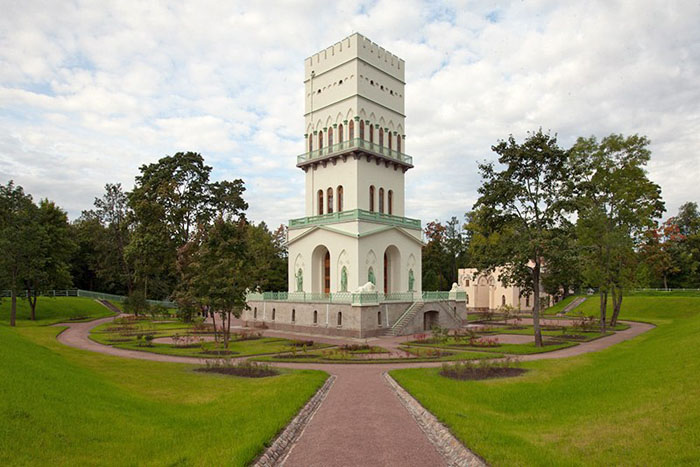
Off the main axis of the landscaped part of Alexander Park is a complex of structures inspired by the image of a medieval knight’s castle. It includes the Ruin Gate — two towers with a gate between them, as well as a moat and an embankment topped with a brick battlement. The dominant feature and core of the complex was and remains the White Tower — a “donjon” 37.8 meters high, the main tower in European feudal castles, located inside the fortress walls. Inside the White Tower, rooms were arranged one above the other. On the first floor were the dining room and buffet, on the second — the living room, on the third and fourth — the study and bedroom, on the fifth — the dressing room and library. The pavilion was topped with an open platform, from which there was a magnificent view of the surroundings of Tsarskoye Selo.

The complex was built between 1821 and 1827 according to the design of architect Menelas for the children of Emperor Nicholas I — Grand Dukes Alexander, Nicholas, Michael, and Constantine, who engaged here in games, military, and gymnastic exercises. Lessons in military affairs, fortification, and gymnastics were held here. For astronomy classes, a telescope was installed on the observation platform; also, on the top floor was the workshop of the court painter, who taught the tsesareviches painting. Around the White Tower was a sports ground where there were bowling alleys and running tracks, a log for balance training, carousels and swings, a huge ship’s mast with full rigging and a rope ladder. On it, Nicholas and Michael practiced climbing, and Constantine learned naval techniques. However, the sports ground was primarily intended for the heir to the throne — Grand Duke Alexander, the future Emperor Alexander II. For this reason, it was later called Sasha’s Tower. Activities in the White Tower and the adjacent complex helped develop skills in state governance. In the absence of the royal family, the entire sports ground was open to the general public. Perhaps it was thanks to this approach that Nicholas I, nicknamed Nikolai Palkin, managed to raise liberal reformers — Alexander II and his brothers. For reference: Michael was a viceroy in the Caucasus, historian, and archaeologist. Constantine, an admiral, also adhered to liberal values. He was elected chairman of the Committee for the Liberation of the Peasants, was involved in judicial reform, and the abolition of corporal punishment in the army. Nicholas rose from the rank of captain to General Field Marshal of the Russian army.
On the top floor of the Tower was the workshop of the court painter Sauerweid (1783–1844), who gave drawing and painting lessons to the imperial children. In addition, according to the design of the tutor of the heir Alexander Nikolaevich, the outstanding Russian poet Zhukovsky (1783–1852), a forebridge fortification — an earthen fortress shaped like an eight-pointed star — was built next to the Ruin Gate (according to the fortification doctrine of the outstanding 17th-century French engineer, Marshal of France Vauban).
Inside the White Tower, rooms were arranged one above the other: on the first floor — dining room and buffet, on the second — living room, on the third and fourth — study and bedroom, on the fifth — dressing room and library. The pavilion was topped with an open platform, offering a magnificent view of the surroundings of Tsarskoye Selo. Many famous St. Petersburg masters took part in the interior decoration of the tower: paintings were executed by Scotti and Brandukov, furniture was made by the court suppliers, the Gambs brothers, and the parquet was crafted by master Znamensky.
The facades of the tower are decorated with cast-iron sculptures, cast at the Alexandrovsky factory based on models by one of the representatives of the brilliant pleiad of Russian sculptors of the first half of the 19th century, Demut-Malinovsky (1779–1846). Four cast-iron lions on the terrace were made from models by Landini. At the base of the building are sculptures of four knights — French, English, German, and Russian — representatives of the allied powers at the time. For this reason, the White Tower was also called the House of Knights.
For some time, the White Tower was used for communication via optical telegraph with the guard post on the tower located at the barracks of the aeronautical park in the southern part of Saint Petersburg.

During the Great Patriotic War, the Nazis turned the House of Knights into an observation post. The White Tower was a good landmark for the defenders of Leningrad as well. As a result, it was almost completely destroyed, with only the plinth remaining, on which the historic building was restored.
Sources:
http://xn----7sbb4bxah.xn--p1ai/07.html#!prettyPhoto
https://www.tzar.ru/objects/alexandrovskypark/newgarden/belayabashnya

