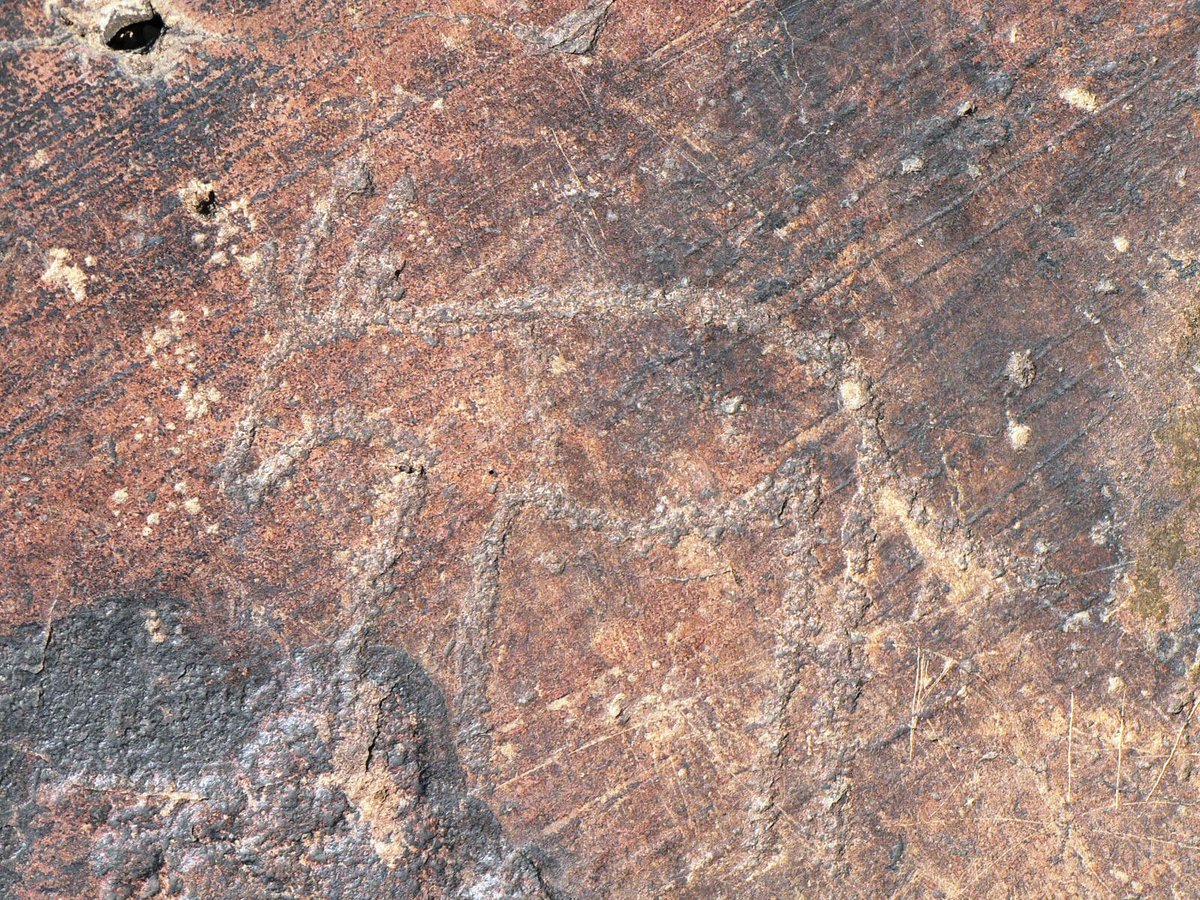

Near the small town of Barkly West, in the Northern Cape of South Africa, lies a geological feature known as the Nooitgedacht Glacial Pavements. The site dates back to the Palaeozoic-age Dwyka Ice Age, or Karoo Ice Age, approximately 300 million years ago. During this time, large ice sheets or glaciers covered high-lying areas, grinding their way southwards and smoothing the underlying Andesite rock pavements. These glaciers left behind scratch marks known as striations and a mixture of clay and rock that consolidated into a rock called Tillite. As the glaciers melted, large erratics or drop stones were left behind, and the changing environment created conditions conducive for life, reflected in the rich fossil record of the Karoo.
Along this portion of its course, the adjacent Vaal River and earlier generations of rivers have swept away a vast mass of Karoo rock and sediment to re-expose the volcanic Andesite landscape. At one time, between 120 and 90 million years ago, it is estimated that about 1 km of Karoo sediment overlay the Kimberley-Barkly West area. Diamonds were eroded out of pipes and caught in pockets of sediment and gravels; once discovered, these changed the course of modern South African history. Since 1869, the various gravels along the Vaal River have been worked intensively for high-grade alluvial diamonds. The Nooitgedacht diggings were open from 1949 to 1981, during which time the Venter Diamond, a 511-carat yellow stone, was found as the largest.
The images found on the andesite glacial pavements at Nooitgedacht are a form of rock art called rock engravings, or petroglyphs. They were produced by pecking out outlines of animals or geometric designs with a pointed stone, likely by ancestors of San and Khoe people during the past 1500 years. The engravings include depictions of humans, eland, rhinoceros, ostrich, giraffe, and anteater. While some argue these sites belong to a separate Khoekhoe herder rock art tradition, others suggest the geometric engravings may have been produced as part of girls' coming-of-age rites. Today, while some small-scale diggers still use pick and shovel, miners using heavy equipment obtain better results, though the impacts on the environment and heritage resources are not small.
Sources: Wikipedia, OpenStreetMap, Wikidata, Wikimedia Commons

Written by Mutabor
Discuss this with the author and others
No comments yet. Be the first to start the conversation.