

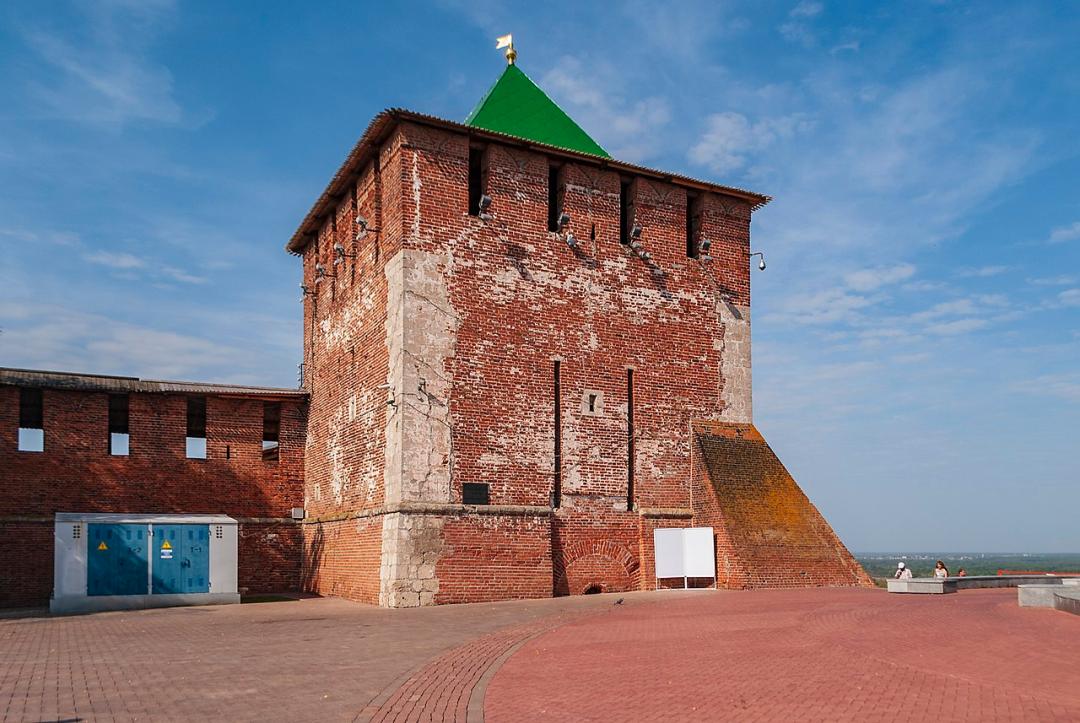
Zachatevskaya (Zachatskaya) Tower is a rectangular gate tower of the Nizhny Novgorod Kremlin, located in the lower hillside section between the Belaya and Borisoglebskaya towers. It is named after the nearby Zachatevsky Monastery, which was outside the Kremlin walls. In 17th-century documents, it is also called the "White" tower, apparently due to the white stone facing on its lower part. In some 18th-century documents, it is mentioned as the Zhivonosovskaya Tower (after the church and monastery dedicated to the Life-Giving Spring). It was destroyed by a landslide and later dismantled for building materials used in the Kremlin's repair from 1785 to 1787 by order of the Nizhny Novgorod governor Rebinder.
The lower section of the Kremlin is situated on a very geologically unstable site. There are underground water outlets here, and landslides frequently occurred, filling ancient ravines and gullies with alluvial soil. For example, near the Zachatskaya Tower, the thickness of these alluvial layers reaches 11–13 meters. All this became the determining factor for the inevitable destruction in this area.
The first known major repair of the Kremlin was carried out by Pervusha Danilov, sent from Moscow, in 1620 (that is, a hundred years after the Kremlin was built). He added many buttresses to the curtain walls and towers of the lower hillside section. However, the 1621–1622 Cadastral Book reports the poor condition of the wall, which people still passed through. The same and other documents describe the Zachatskaya Tower as two-tiered, that is, the same height as the walls. Although this may simply reflect the state of a deteriorating and partially rebuilt tower at that time. Still, the original appearance of the tower is unknown. In 1646, voivode Lodygin and clerk Patrikeev wrote about the destruction of both towers in the section and the walls through which people passed. The estimate by Nizhny Novgorod townsman Semyon Zadorin in 1650–1651 states that the "bulls," i.e., the buttresses, had crumbled, and the tower itself had settled onto them and shifted downhill away from both walls. His proposed plan for hydraulic works and wall reconstruction using oak piles was not implemented.
In the 18th century, the destruction and sliding continued. According to the 1765 inventory, two vaults of the passage at the tower collapsed, and the gates were bricked up from the outside and blocked with logs inside. After the partial dismantling of the Zachatskaya and Borisoglebskaya towers in 1785–1787, Governor Rebinder carried out repairs on the lower hillside section of the Kremlin from 1787 to 1790. In 1833, a thin brick wall was erected, and on the site of the tower, a "descent to the Life-Giving Spring" was built (with guardhouses on the sides and windows imitating loopholes). In the 19th century, a new phase of destruction began in the lower hillside section.
In 1965, under the guidance of the famous architect and restorer Agafonov, research on the tower began. Its remains were cleared. A significant pit was dug inside the cultural layer, and then it was left to decay for many years. Around 1980, further clearing took place, allowing architect Agafonova to create graphic reconstruction variants of the tower.
There were two reconstruction options for the tower: with gates on the front facade and with gates in the western side wall. Although there are no other examples of side-gate schemes in the towers of the Nizhny Novgorod Kremlin, there were hints of this here. The Zachatskaya Tower had the widest internal gates in the Kremlin, which were also beveled to the west. Such features would facilitate turning horse-drawn transport in the L-shaped passage. Moreover, the tower controlled the lowest — quite vulnerable — section of the Kremlin, without a moat or forebridge fortification. However, the option with a straight passage was chosen as more visually appealing. There were also various designs for the pavilion that was to cover part of the ruins.

The option to recreate the medieval structure using authentic materials was not even considered. The builders did not limit themselves to anti-landslide measures and, accordingly, a powerful reinforced concrete foundation. The structure was built using modern construction techniques, and all elements of the fortification are merely imitations. As a result, a protective casing was created over the ancient ruins, the museum gained additional space, and the Kremlin perimeter was closed off... Thus, it can be stated that the reconstructed tower is merely a modern museum space externally copying the appearance of the original Zachatevskaya Tower.
Construction was preceded by archaeological excavations that uncovered the lower part of the curtain wall, displaced by the landslide from its original location, the foundations of the buttresses that supported it in the 17th century, wooden piles — formwork and piles of the 16th-century foundation, and right in front of the tower — the aqueduct of the Life-Giving Spring.
For construction, oversized bricks were ordered (but they were too smooth and oddly of two different sizes) and blocks of very dense (unusually used) limestone, cut to pre-measured sizes. The latter allowed assembling the structure without any fitting, but this was uncharacteristic of ancient architecture. However, there was too little limestone.
To avoid new ground shifts, the builders carried out some drainage work through storm sewers. The new foundation of the walls and tower was laid not directly on the ruins but at their original location. The foundation was made as a reinforced concrete pad on piles 12 meters deep. The curtain walls and the front part of the tower were built from the largest bricks. The inner facade of the tower and some internal partitions were made from smaller, slightly darker bricks. Ordinary standard bricks were also used inside. The tower and curtain wall structure is divided into unconnected sections. Four breaks in the foundation and masonry were left for this purpose. This was done so that in case of foundation movement, the upper parts would not break but simply shift relative to each other. Also, iron mesh was laid every 4–6 layers in the brickwork. The masonry was done with cement. The joints were not smoothed as everywhere else in the Kremlin but were scored.
The entire structure — not only the tower but also the curtain walls — was made hollow: both the front wall and the pylons. Apparently, only the pylon near the gate in the wall was fully or at least in the lower part filled with cement. In the curtain walls, to the left and right of the tower, spacious rooms were created by reducing the number of arches. The one on the right also has passages almost up to the gates in the wall. From these blind rooms, one ventilation opening leads to the outer side of the curtain wall. All ceilings in the curtain walls and tower are flat, covered with reinforced concrete slabs. Since there should be a passage to the ruins under the wall beside the tower, another passage was designed here, reminiscent of the reconstruction option with side gates. The loopholes in the thin walls could not have deep niches; there are no ventilation ducts (outside only an imitation by recessing the masonry), and the loophole locations do not always comply with standards. There was clearly not enough limestone, so its line noticeably lowers on the side. On the walls, covering small loopholes of the battlements, a layer of cement was used instead of limestone slabs. The depth of the recesses for the drawbridge and its beams was reduced, although they were not planned at all, as the gates were glazed. All loopholes were glazed. The side pavilion was made in the simplest form — as a glass greenhouse. The stairs in the tower are not like those in other towers (spiral inside the masonry) but are ordinary stairwells, like in modern buildings.
The Zachatskaya Tower houses a museum exhibition. Part of the premises is occupied by reenactors.
Fragments of the ancient tower are partially located in the lower part of the current tower (on the site of the passage), partially under a glass annex, which also contains the foundations of the ancient curtain wall.
Legend of the Zachatskaya and Belaya Towers https://reveal.world/ru/story/nizhnij-novgorod-dostoprimechatel-nosti-istorii-lyudi-i-legendy/belaya-bashnya-kruglaya-bashnya-v-podgornoj-chasti-mezhdu-ivanovskoj-i-zachat-evskoj-bashnyamireveal.world/story/belaya-bashnya-kruglaya-bashnya-nizhegorodskogo-kremlya
Sources:
https://ru.wikipedia.org/wiki/Zachatevskaya_Tower




Written by Jermaine
Discuss this with the author and others
No comments yet. Be the first to start the conversation.