Olisov Chambers (Levin House)

7 Krutoy Lane, Nizhny Novgorod, Nizhny Novgorod Region, Russia, 603000

Olisov Chambers (Levin House) is a monument of urban planning and architecture in the historic district of Zapochaine (Ilyinskaya Sloboda) in Nizhny Novgorod. Built in 1676. Together with the Church of the Assumption of the Blessed Virgin Mary, they form an architectural ensemble of the posad (settlement) development of 17th-century Nizhny Novgorod.

Olisov Chambers (Levin House) is a monument of urban planning and architecture in the historic district of Zapochaine (Ilyinskaya Sloboda) of Nizhny Novgorod. Built in 1676. Together with the Church of the Assumption of the Blessed Virgin Mary, they form an architectural ensemble of the posad (settlement) development of Nizhny Novgorod in the 17th century.

The Olisov family originated in the 16th century: Zhdanko Olisov was a zemsky clerk and in 1572 made binding records on the residents of Nizhny Novgorod. In 1666, Afanasy Olisov, a descendant of the clerk, took the position of head of customs in Nizhny Novgorod, and two years later became a major supplier of grain to Moscow.

In 1672, Olisov arrived in Astrakhan, where he managed the tsar’s salt and fish industries. Proof of his successful service was that he remained in the position for four years instead of the usual one year at that time. Tsar Alexei Mikhailovich fully trusted the Nizhny Novgorod native with his lower-level industries, who regularly supplied salt, fish, caviar, and dried fish in the required quantities to the Kremlin’s Zhitny Dvor. On the night of January 29 to 30, 1676, Alexei Mikhailovich died. On June 16, his son Fyodor III Alekseyevich ascended the throne. During court intrigues, Olisov was removed from service in Astrakhan and summoned to personally answer before the young tsar in Moscow. Preparing for departure, Olisov gathered large cash valuables to bribe the capital’s officials and freed himself from accusations of personal enrichment during state service. After leaving for Nizhny Novgorod, he ordered his steward Vasily Andreyev to sell all his property in Astrakhan.

Upon arriving in Nizhny Novgorod, Olisov delayed his departure to the capital. At that time, the city was experiencing a period of mass ruin of the posad population due to excessive state levies. The community “as a whole” persuaded Olisov to become the zemsky elder, and upon learning of his upcoming meeting with the tsar, convinced him to convey the troubles of the Nizhny Novgorod posad, thanks to which the Romanov family had recently risen. Olisov went to Moscow as the full representative of the entire city. He managed to bribe the tsar’s personal advisor, the duma clerk Dementy Bashmachnikov, and the state treasurer Ivan Kamynin, who inclined the tsar favorably toward the Nizhny Novgorod native. The meeting with the tsar was extremely successful: Olisov received the highest merchant rank, again became the manager of the Astrakhan-Yaitsk industries, and all debts of Nizhny Novgorod to the treasury were canceled. A. F. Olisov was publicly proclaimed the “father and protector” of the city.

During the events of the summer of 1676, near the Assumption Church on Ilyinskaya Hill, built in 1672 with Olisov’s funds, stone chambers were erected that corresponded to the merchant’s elevated status. The construction was led by Olisov’s son, also named Afanasy by his parents.

In the 1915 lists of cultural heritage objects, it was noted that the chambers belonged to a certain Mr. Levin, but later it was found that this was an erroneous claim, since according to more accurate data from 1918, on the eve of nationalization, the house belonged to Levina. In 1976, during the development of the restoration project, the question was raised whether it was correct to consider Afanasy Firsovich Olisov the owner of the chambers. In 1999, in the essay “Every Family is Famous and Glorious,” local historian Filatov first named the masons who built the chambers — Andrey and Mikhail Grigoryev — however, there are no archival documents confirming this information.

Currently, the chambers have two floors, but originally at least one more log floor was built above the stone part, as it was believed that living in thick-walled brick buildings was harmful to health. Historical data about the wooden part of the chambers has not been preserved, so it was not restored during the renovation. Presumably, the building had a high barrel-shaped or four-sloped roof with shelves called a “kolpak,” under which were the living chambers of the women’s half of the house. On the roof ridges were pierced combs. The stove pipes were decorated in the form of whimsical “teremki” (small towers). The facade was decorated with thin glazed tiles made in the form of stamped gingerbreads.

The first floor of the chambers was service-oriented. It housed storerooms, kitchens, and the steward’s chamber, which is why it had few small window openings, closed at night with wrought iron shutters. Only one corner chamber on the first floor had two windows framed with pointed arch casings. All windows of the residential second floor were decorated with pointed arch casings made of special shaped bricks. Connected together, they formed a carpet-like belt that highlighted the residential part of the chambers.

From the square of the Assumption Church, a grand staircase led to the second floor with a unique portal made of individually crafted elements, unique for the architecture of that time. The building’s layout was thoughtful and rational: on the sides of the elongated vaulted corridor leading from the entrance, two living chambers were on the left, and on the right were spacious vestibules and a room isolated from the others. The vestibules ended at the far end with an exit to the gulbishche — a wooden platform on pillars with a roof. A warm “otkhod” (toilet) was attached to the vestibules, and near the entrance there was an internal stone staircase to the log part of the chambers.

Sources:

https://kelohouse.ru/dom60.html

https://ru.wikipedia.org/wiki/Chambers_of_A._F._Olisov


Follow us on social media

More stories from Nizhny Novgorod: Attractions, Stories, People, and Legends

Zachatevskaya (Zachatsskaya) Tower — a rectangular gate tower of the Nizhny Novgorod Kremlin

Kremlin, 2g, Nizhny Novgorod, Nizhny Novgorod Region, Russia, 603001

Zachatyevskaya (Zachatskaya) Tower is a rectangular gate tower of the Nizhny Novgorod Kremlin, located in the foothill section between the Belaya and Borisoglebskaya towers. It is named after the nearby Zachatyevsky Monastery, which was situated outside the Kremlin walls. In 17th-century documents, it is also referred to as the "White" tower, apparently due to the white stone cladding of its lower part. In some 18th-century documents, it is mentioned as the Zhivonosovskaya Tower (named after the church and monastery dedicated to the Life-Giving Spring). It was destroyed by a landslide and subsequently dismantled for building materials used in the repair of the Kremlin in 1785–1787 by order of the Nizhny Novgorod governor Rebinder.

The White Tower is a round tower located in the lower mountain area between the Ivanovskaya and Zachatyevskaya towers.

Kremlin, 2V, Nizhny Novgorod, Nizhny Novgorod Region, Russia, 603001

The White Tower is a round tower of the Nizhny Novgorod Kremlin, located in the lower part between the Ivanovskaya and Zachatyevskaya towers, opposite the turn of the Kremlin descent. It is the only surviving round tower in the lower part of the Nizhny Novgorod Kremlin and dates back to the 16th century. It was rebuilt in 1620. The tower received its modern name in the 19th century due to the preserved white stone cladding of the lower part of the outer facade. However, there is another reason for its name. It was built in the 16th century on monastery lands. At that time, these lands were called "white" in contrast to the peasant "black" lands. While the latter were taxed, the "white" lands were completely exempt from taxes.

Borisoglebskaya Tower — a round tower located between the Zachatyevskaya and Georgievskaya towers.

Kremlin, 4B, Nizhny Novgorod, Nizhny Novgorod Region, Russia, 603001

Borisoglebskaya Tower is a tower of the Nizhny Novgorod Kremlin, built in the 1970s on the site of the tower of the same name, which was dismantled 200 years earlier. It is located between the Zachatyevskaya and Georgievskaya towers.

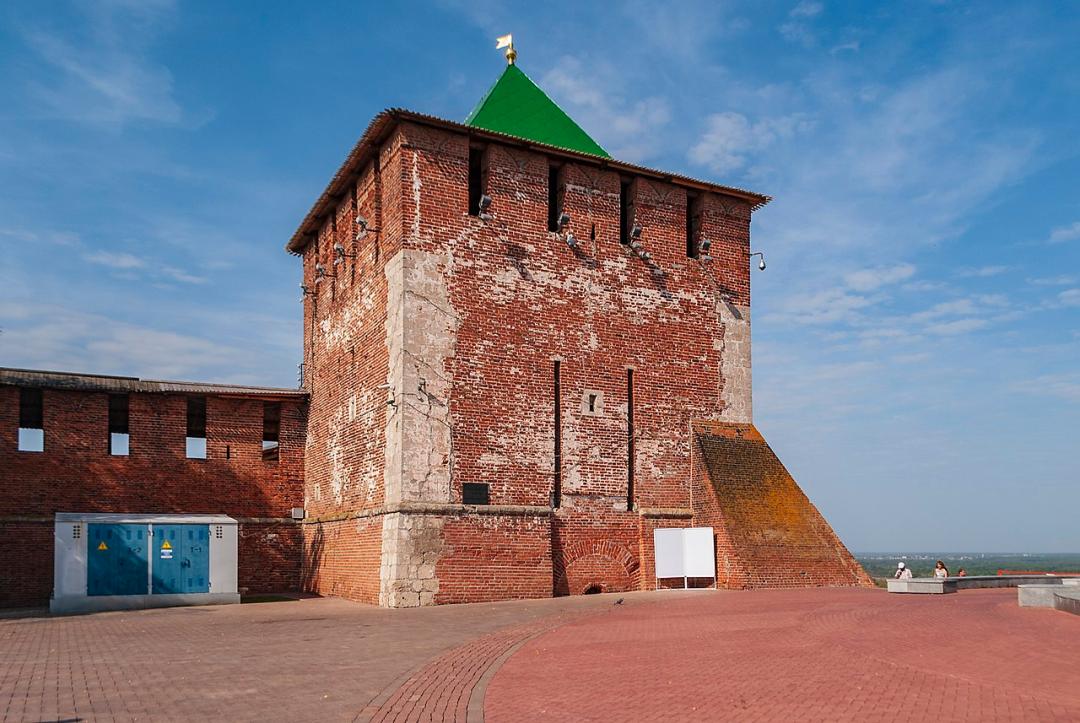
The Georgievskaya Tower (Yegoryevskaya Tower) is the easternmost tower of the Nizhny Novgorod Kremlin.

Kremlin, 4B, Nizhny Novgorod, Nizhny Novgorod Region, Russia, 603001

The Georgievskaya Tower (Yegoryevskaya Tower) is the easternmost tower of the Nizhny Novgorod Kremlin. It is located between the Borisoglebskaya and Porokhovaya towers, on the edge of the Volga riverbank, near the Valery Chkalov monument at the beginning of the Chkalov Staircase. In the 1220s, there was a traveler's house of Georgiy ("Georgievsky Terem") here, on the edge of the slope.

The Powder Tower is a round tower located in the upper part between the Dmitrievskaya and Georgievskaya towers.

Kremlin, 6B, Nizhny Novgorod, Nizhny Novgorod Region, Russia, 603005

The Powder Tower is a round tower of the Nizhny Novgorod Kremlin. It is located in the upper part between the Dmitrievskaya and Georgievskaya towers, opposite the former building of the Nizhny Novgorod Seminary on Minin and Pozharsky Square.

Dmitrievskaya (Dmitrovskaya) Tower — a gate tower facing Minin and Pozharsky Square

Kremlin, 6A, Nizhny Novgorod, Nizhny Novgorod Region, Russia, 603005

Dmitrievskaya (Dmitrovskaya) Tower is a gate tower of the Nizhny Novgorod Kremlin, opening onto Minin and Pozharsky Square. It is considered the main gate of the fortress and is an unofficial symbol of Nizhny Novgorod. Its current appearance in the Russian style was acquired in 1895.

The Ivanovskaya Tower is the oldest and largest four-tiered gate tower of the Nizhny Novgorod Kremlin.

Kremlin, 2B, Nizhny Novgorod, Nizhny Novgorod Region, Russia, 603001

The Ivanovskaya Tower is the largest four-tiered gate tower of the Nizhny Novgorod Kremlin. It is located in the lower part of the hill between the Chasovaya and Belaya towers. The lower section of the Ivanovsky Descent, formerly called Bolshaya Mostovaya Street, passes through it. It is named after the Church of John the Baptist, located at its approaches, which has stood on the Nizhneposadsky Market since the 15th century. Another version states that the tower's name commemorates its founder — Tsar Ivan III, who began rebuilding the Nizhny Novgorod Kremlin in stone in 1500. The tower acquired its modern appearance only in the 1950s, when restorers doubled its height.

The Storeroom Tower is a round tower located in the upper part between the Dmitrievskaya and Nikolskaya towers.

territory Kremlin, building 4, office 5, Nizhny Novgorod, Nizhny Novgorod region, Russia, 603005

The Storage Tower is a round tower of the Nizhny Novgorod Kremlin. It is located in the upper part between the Dmitrievskaya and Nikolskaya towers, near the beginning of the Zelensky Descent. The tower's current name is due to its continuous use as a warehouse for military and civilian goods.

Koromyslova Tower — a round tower in the upper part between the Nikolskaya and Taynitskaya towers

Kremlin, 12A, Nizhny Novgorod, Nizhny Novgorod Region, Russia, 603082

Koromyslova Tower is a round tower of the Nizhny Novgorod Kremlin, located in the upper part between the Nikolskaya and Taynitskaya towers. If you view the structure from the opposite side of the Zelensky Descent, you can notice that the tower, together with the adjoining curtain walls, resembles the shape of a woman carrying a yoke.

Taynitskaya Tower — a round tower in the upper part between the Koromyslova and Northern towers

Kremlin, 1B, Nizhny Novgorod, Nizhny Novgorod Region, Russia, 603082

Taynitskaya Tower is a round tower of the Nizhny Novgorod Kremlin. It is located in the upper part between the Koromyslovaya and Severnaya towers. Unlike the other round towers (except for the Chasovaya), it features a watchtower on the spire, similar to the Chasovaya and Nikolskaya towers.

The Northern Tower is a round tower located in the upper part between the Taynitskaya and Chasovaya towers.

Kremlin, 1b, Nizhny Novgorod, Nizhny Novgorod Region, Russia, 603082

The Northern Tower is a round tower of the Nizhny Novgorod Kremlin. It is located in the upper part between the Taynitskaya and Chasovaya towers. Contrary to its name, the tower is not the northernmost structure in the Kremlin, but the fortress wall extending from the Taynitskaya Tower towards the Northern Tower aligns with the direction of north.

The Clock Tower - a tower on the top of the Kremlin hill

Kremlin, 1g, Nizhny Novgorod, Nizhny Novgorod Region, Russia, 603082

The Clock Tower is a tower of the Nizhny Novgorod Kremlin, located at the top of the Kremlin hill on the bank slope of the Volga River between the Northern and Ivanov towers, at the very edge of the Kremlin hill. The section between the Clock Tower and the Northern Tower is the shortest in the Kremlin: its length is only 39 meters.

The Nikolskaya Tower is a passage tower located in the upper part between the Kladovaya and Koromyslovaya towers.

Kremlin, 11A, Nizhny Novgorod, Nizhny Novgorod Region, Russia, 603005

The Nikolskaya Tower is a passage tower of the Nizhny Novgorod Kremlin. It is located in the upper part between the Kladovaya and Koromyslovaya towers. A pedestrian bridge, built over the Zelensky descent in 1982 on the site of an old wooden bridge constructed "in cages," adjoins the tower closely.

Nizhny Novgorod Kremlin

territory Kremlin, building 4, office 5, Nizhny Novgorod, Nizhny Novgorod region, Russia, 603005

The Nizhny Novgorod Kremlin is a majestic medieval fortress, one of the best preserved in Russia. It is the second largest after the Moscow Kremlin, a fortress in the historic center of Nizhny Novgorod and its oldest part. It is located on the high right bank, at the confluence of the Volga and Oka rivers.

Peter I's House

27 Pochainskaya St., Nizhny Novgorod, Nizhny Novgorod Region, Russia, 603001

Peter's house is located on the northern slope of the hillside descending towards the Volga River. According to established belief, it was in this house, owned at the end of the 17th century by the "merchant of the guest hundred" Yefim Chatygin, that Tsar Peter the First stayed in May 1695 during his Azov campaign.

The State Bank building in Nizhny Novgorod

Bolshaya Pokrovskaya St., 26, Nizhny Novgorod, Nizhny Novgorod Region, Russia, 603005

The complex of buildings of the State Bank was constructed in 1911–1913 to commemorate the 300th anniversary of the Romanov Dynasty (which is marked by the dates "1613" and "1913" on its main pediment). This is the most prominent building on the main tourist street of Nizhny Novgorod, the second truly outstanding monument of our city after the Stroganov Church. Once, next to the bank, there was the Church of the Intercession of the Holy Virgin, which gave its name to Bolshaya Pokrovskaya Street.

Rukavishnikov Estate

Verkhnevolzhskaya Embankment, 7, Nizhny Novgorod, Nizhny Novgorod Region, Russia, 603005

Architectural ensemble in the historic center of Nizhny Novgorod. Built during the eclectic period in 1875–1877. The building's project was designed by the Moscow architect Boytsov. The estate complex, located on the Upper Volga Embankment, shapes the river panorama of Nizhny Novgorod, marking the corner intersection of the embankment and Piskunov Street, playing an important urban planning role. It is one of the most significant and well-known architectural monuments of the city.

"Chess House" or the House with Augurs (Troitsky's Gambling House)

35 Piskunova St., Nizhny Novgorod, Nizhny Novgorod Region, Russia, 603005

A striking Art Nouveau monument, the Troitsky gambling house, the "Chess House," the "House with Augurs" – one of the lost landmarks of Nizhny Novgorod. The entrance to the house was shaped like a horseshoe, and the field inside the shutters was decorated with chess squares. The cornices above were adorned with male heads bent over a chessboard, which was represented by the roof of the house.

Spassky Old Fair Cathedral

Yarmarochny Lane, 10, Nizhny Novgorod, Nizhny Novgorod Region, Russia, 603086

The Spassky Old Fair Cathedral is an Orthodox church in Nizhny Novgorod. It was built between 1818 and 1822 by mechanical engineer Augustin Betancourt, based on a design by architect Auguste Montferrand, in the Russian Empire style. The cathedral was erected as the main architectural dominant of the Nizhny Novgorod Fair — the largest ensemble in Russian late classicism architecture. From 1886 to 1888, the church was reconstructed by civil engineer Robert Kilevain.