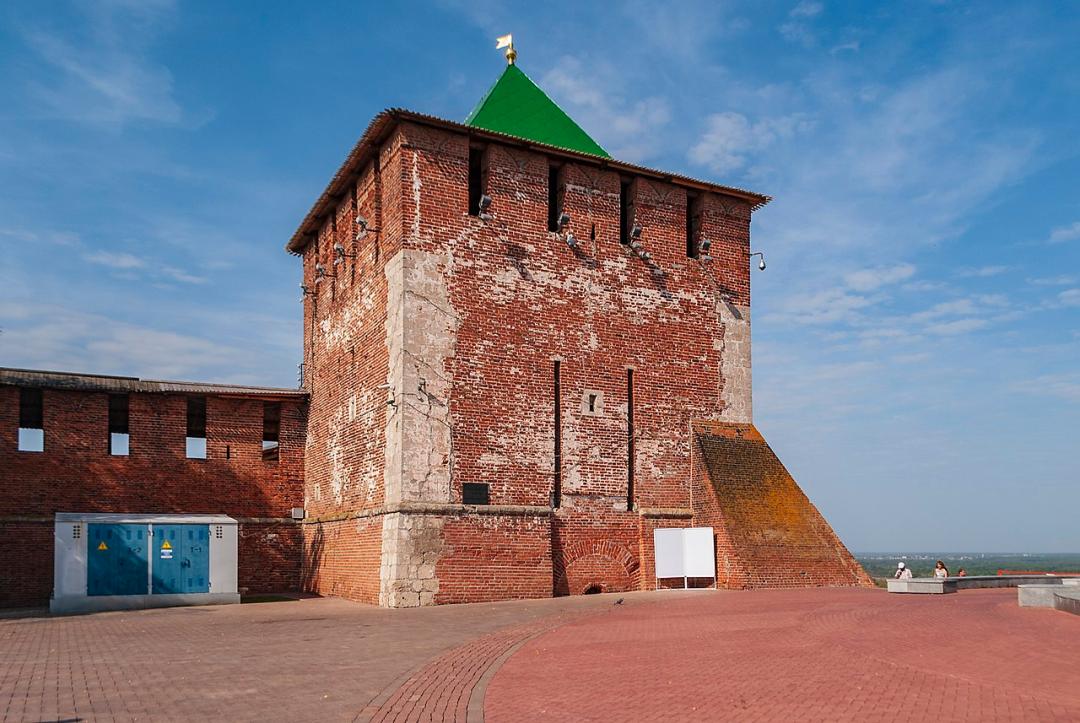
The Clock Tower - a tower on the top of the Kremlin hill

Kremlin, 1g, Nizhny Novgorod, Nizhny Novgorod Region, Russia, 603082

The Clock Tower is a tower of the Nizhny Novgorod Kremlin, located at the top of the Kremlin hill on the bank slope of the Volga River between the Northern and Ivanov towers, at the very edge of the Kremlin hill. The section between the Clock Tower and the Northern Tower is the shortest in the Kremlin: its length is only 39 meters.

The Clock Tower is a tower of the Nizhny Novgorod Kremlin, located at the top of the Kremlin hill on the Volga riverbank slope between the Northern and Ivanovskaya towers, at the very edge of the Kremlin hill. The span between the Clock Tower and the Northern Tower is the shortest in the Kremlin: its length is only 39 meters.

In ensemble with the Northern Tower, complemented by the giant steps descending from the cliff wall, this section is the most beautiful in the Nizhny Novgorod Kremlin.

The tower got its name from the tower clock, which existed on it as early as the 17th century. Positioned at the highest point of the fortress, the Clock Tower served as the main watch post and was likely the command center for the fortress garrison. According to the Nizhny Novgorod local historian Nikolay Khramtsovsky, the tower’s name can be explained as follows: in the 16th century, at the expense of the state treasury, the main city clock and alarm bells were installed on the structure, the ringing of which called the defenders of the citadel to defense.

The 1621 census book writes about them: “...and on the tower a clock house made of logs, and on the tower battle clocks, clocks and a bell made from the state treasury.” By the beginning of the 18th century, the tower clock was reconstructed and marked the fractions of the hour by bell strikes. “In those clocks there are two bells for the hours, and a large hour bell” (1703).


The clock mechanism was located at the top of the tower, inside a wooden clock house shaped like a pentagonal log structure. According to the daily count of Ancient Rus, the dial had 17 divisions, corresponding to the number of hours of the longest summer day. Daytime and nighttime hours were counted separately: the first hour of sunrise marked the 1st hour of the day, and the hour of sunset marked the 1st hour of the night.

In the 18th century, after reconstruction, the clock mechanism began to strike fractions of the hour, as evidenced by the 1703 inventory made by the Nizhny Novgorod voivode. A specially trained clockmaker was assigned to the tower to monitor the accuracy of the clock. From the watchtower of the Clock Tower, they observed the approach of the enemy along the Volga and by land. The fortification had no artillery installations or cannons, but gunpowder and food supplies were stored in the tower’s cellar.

During the fire of 1807, the Clock Tower lost its stone vaults, and through cracks appeared on the walls. In 1954, restorers revived the structure, restoring the vaults, battlements, fragments of damaged masonry, and the wooden superstructure. The upper spire of the tower was crowned with a gilded weather vane-flag in the shape of a deer — the symbol of Nizhny Novgorod.

During the Great Patriotic War, anti-aircraft machine guns were stationed on the upper platform of the Clock Tower, serving as air defense for Nizhny Novgorod.

Sources:

https://ru.wikipedia.org/wiki/Clock_Tower_(Nizhny_Novgorod)

http://www.niro.nnov.ru/?id=26250

Follow us on social media

More stories from Nizhny Novgorod: Attractions, Stories, People, and Legends

Zachatevskaya (Zachatsskaya) Tower — a rectangular gate tower of the Nizhny Novgorod Kremlin

Kremlin, 2g, Nizhny Novgorod, Nizhny Novgorod Region, Russia, 603001

Zachatyevskaya (Zachatskaya) Tower is a rectangular gate tower of the Nizhny Novgorod Kremlin, located in the foothill section between the Belaya and Borisoglebskaya towers. It is named after the nearby Zachatyevsky Monastery, which was situated outside the Kremlin walls. In 17th-century documents, it is also referred to as the "White" tower, apparently due to the white stone cladding of its lower part. In some 18th-century documents, it is mentioned as the Zhivonosovskaya Tower (named after the church and monastery dedicated to the Life-Giving Spring). It was destroyed by a landslide and subsequently dismantled for building materials used in the repair of the Kremlin in 1785–1787 by order of the Nizhny Novgorod governor Rebinder.

The White Tower is a round tower located in the lower mountain area between the Ivanovskaya and Zachatyevskaya towers.

Kremlin, 2V, Nizhny Novgorod, Nizhny Novgorod Region, Russia, 603001

The White Tower is a round tower of the Nizhny Novgorod Kremlin, located in the lower part between the Ivanovskaya and Zachatyevskaya towers, opposite the turn of the Kremlin descent. It is the only surviving round tower in the lower part of the Nizhny Novgorod Kremlin and dates back to the 16th century. It was rebuilt in 1620. The tower received its modern name in the 19th century due to the preserved white stone cladding of the lower part of the outer facade. However, there is another reason for its name. It was built in the 16th century on monastery lands. At that time, these lands were called "white" in contrast to the peasant "black" lands. While the latter were taxed, the "white" lands were completely exempt from taxes.

Borisoglebskaya Tower — a round tower located between the Zachatyevskaya and Georgievskaya towers.

Kremlin, 4B, Nizhny Novgorod, Nizhny Novgorod Region, Russia, 603001

Borisoglebskaya Tower is a tower of the Nizhny Novgorod Kremlin, built in the 1970s on the site of the tower of the same name, which was dismantled 200 years earlier. It is located between the Zachatyevskaya and Georgievskaya towers.

The Georgievskaya Tower (Yegoryevskaya Tower) is the easternmost tower of the Nizhny Novgorod Kremlin.

Kremlin, 4B, Nizhny Novgorod, Nizhny Novgorod Region, Russia, 603001

The Georgievskaya Tower (Yegoryevskaya Tower) is the easternmost tower of the Nizhny Novgorod Kremlin. It is located between the Borisoglebskaya and Porokhovaya towers, on the edge of the Volga riverbank, near the Valery Chkalov monument at the beginning of the Chkalov Staircase. In the 1220s, there was a traveler's house of Georgiy ("Georgievsky Terem") here, on the edge of the slope.

The Powder Tower is a round tower located in the upper part between the Dmitrievskaya and Georgievskaya towers.

Kremlin, 6B, Nizhny Novgorod, Nizhny Novgorod Region, Russia, 603005

The Powder Tower is a round tower of the Nizhny Novgorod Kremlin. It is located in the upper part between the Dmitrievskaya and Georgievskaya towers, opposite the former building of the Nizhny Novgorod Seminary on Minin and Pozharsky Square.

Dmitrievskaya (Dmitrovskaya) Tower — a gate tower facing Minin and Pozharsky Square

Kremlin, 6A, Nizhny Novgorod, Nizhny Novgorod Region, Russia, 603005

Dmitrievskaya (Dmitrovskaya) Tower is a gate tower of the Nizhny Novgorod Kremlin, opening onto Minin and Pozharsky Square. It is considered the main gate of the fortress and is an unofficial symbol of Nizhny Novgorod. Its current appearance in the Russian style was acquired in 1895.

The Ivanovskaya Tower is the oldest and largest four-tiered gate tower of the Nizhny Novgorod Kremlin.

Kremlin, 2B, Nizhny Novgorod, Nizhny Novgorod Region, Russia, 603001

The Ivanovskaya Tower is the largest four-tiered gate tower of the Nizhny Novgorod Kremlin. It is located in the lower part of the hill between the Chasovaya and Belaya towers. The lower section of the Ivanovsky Descent, formerly called Bolshaya Mostovaya Street, passes through it. It is named after the Church of John the Baptist, located at its approaches, which has stood on the Nizhneposadsky Market since the 15th century. Another version states that the tower's name commemorates its founder — Tsar Ivan III, who began rebuilding the Nizhny Novgorod Kremlin in stone in 1500. The tower acquired its modern appearance only in the 1950s, when restorers doubled its height.

The Storeroom Tower is a round tower located in the upper part between the Dmitrievskaya and Nikolskaya towers.

territory Kremlin, building 4, office 5, Nizhny Novgorod, Nizhny Novgorod region, Russia, 603005

The Storage Tower is a round tower of the Nizhny Novgorod Kremlin. It is located in the upper part between the Dmitrievskaya and Nikolskaya towers, near the beginning of the Zelensky Descent. The tower's current name is due to its continuous use as a warehouse for military and civilian goods.

Koromyslova Tower — a round tower in the upper part between the Nikolskaya and Taynitskaya towers

Kremlin, 12A, Nizhny Novgorod, Nizhny Novgorod Region, Russia, 603082

Koromyslova Tower is a round tower of the Nizhny Novgorod Kremlin, located in the upper part between the Nikolskaya and Taynitskaya towers. If you view the structure from the opposite side of the Zelensky Descent, you can notice that the tower, together with the adjoining curtain walls, resembles the shape of a woman carrying a yoke.

Taynitskaya Tower — a round tower in the upper part between the Koromyslova and Northern towers

Kremlin, 1B, Nizhny Novgorod, Nizhny Novgorod Region, Russia, 603082

Taynitskaya Tower is a round tower of the Nizhny Novgorod Kremlin. It is located in the upper part between the Koromyslovaya and Severnaya towers. Unlike the other round towers (except for the Chasovaya), it features a watchtower on the spire, similar to the Chasovaya and Nikolskaya towers.

The Northern Tower is a round tower located in the upper part between the Taynitskaya and Chasovaya towers.

Kremlin, 1b, Nizhny Novgorod, Nizhny Novgorod Region, Russia, 603082

The Northern Tower is a round tower of the Nizhny Novgorod Kremlin. It is located in the upper part between the Taynitskaya and Chasovaya towers. Contrary to its name, the tower is not the northernmost structure in the Kremlin, but the fortress wall extending from the Taynitskaya Tower towards the Northern Tower aligns with the direction of north.

The Nikolskaya Tower is a passage tower located in the upper part between the Kladovaya and Koromyslovaya towers.

Kremlin, 11A, Nizhny Novgorod, Nizhny Novgorod Region, Russia, 603005

The Nikolskaya Tower is a passage tower of the Nizhny Novgorod Kremlin. It is located in the upper part between the Kladovaya and Koromyslovaya towers. A pedestrian bridge, built over the Zelensky descent in 1982 on the site of an old wooden bridge constructed "in cages," adjoins the tower closely.

Nizhny Novgorod Kremlin

territory Kremlin, building 4, office 5, Nizhny Novgorod, Nizhny Novgorod region, Russia, 603005

The Nizhny Novgorod Kremlin is a majestic medieval fortress, one of the best preserved in Russia. It is the second largest after the Moscow Kremlin, a fortress in the historic center of Nizhny Novgorod and its oldest part. It is located on the high right bank, at the confluence of the Volga and Oka rivers.

Peter I's House

27 Pochainskaya St., Nizhny Novgorod, Nizhny Novgorod Region, Russia, 603001

Peter's house is located on the northern slope of the hillside descending towards the Volga River. According to established belief, it was in this house, owned at the end of the 17th century by the "merchant of the guest hundred" Yefim Chatygin, that Tsar Peter the First stayed in May 1695 during his Azov campaign.

The State Bank building in Nizhny Novgorod

Bolshaya Pokrovskaya St., 26, Nizhny Novgorod, Nizhny Novgorod Region, Russia, 603005

The complex of buildings of the State Bank was constructed in 1911–1913 to commemorate the 300th anniversary of the Romanov Dynasty (which is marked by the dates "1613" and "1913" on its main pediment). This is the most prominent building on the main tourist street of Nizhny Novgorod, the second truly outstanding monument of our city after the Stroganov Church. Once, next to the bank, there was the Church of the Intercession of the Holy Virgin, which gave its name to Bolshaya Pokrovskaya Street.

Rukavishnikov Estate

Verkhnevolzhskaya Embankment, 7, Nizhny Novgorod, Nizhny Novgorod Region, Russia, 603005

Architectural ensemble in the historic center of Nizhny Novgorod. Built during the eclectic period in 1875–1877. The building's project was designed by the Moscow architect Boytsov. The estate complex, located on the Upper Volga Embankment, shapes the river panorama of Nizhny Novgorod, marking the corner intersection of the embankment and Piskunov Street, playing an important urban planning role. It is one of the most significant and well-known architectural monuments of the city.

Olisov Chambers (Levin House)

7 Krutoy Lane, Nizhny Novgorod, Nizhny Novgorod Region, Russia, 603000

Olisov Chambers (Levin House) is a monument of urban planning and architecture in the historic district of Zapochaine (Ilyinskaya Sloboda) in Nizhny Novgorod. Built in 1676. Together with the Church of the Assumption of the Blessed Virgin Mary, they form an architectural ensemble of the posad (settlement) development of 17th-century Nizhny Novgorod.

"Chess House" or the House with Augurs (Troitsky's Gambling House)

35 Piskunova St., Nizhny Novgorod, Nizhny Novgorod Region, Russia, 603005

A striking Art Nouveau monument, the Troitsky gambling house, the "Chess House," the "House with Augurs" – one of the lost landmarks of Nizhny Novgorod. The entrance to the house was shaped like a horseshoe, and the field inside the shutters was decorated with chess squares. The cornices above were adorned with male heads bent over a chessboard, which was represented by the roof of the house.

Spassky Old Fair Cathedral

Yarmarochny Lane, 10, Nizhny Novgorod, Nizhny Novgorod Region, Russia, 603086

The Spassky Old Fair Cathedral is an Orthodox church in Nizhny Novgorod. It was built between 1818 and 1822 by mechanical engineer Augustin Betancourt, based on a design by architect Auguste Montferrand, in the Russian Empire style. The cathedral was erected as the main architectural dominant of the Nizhny Novgorod Fair — the largest ensemble in Russian late classicism architecture. From 1886 to 1888, the church was reconstructed by civil engineer Robert Kilevain.