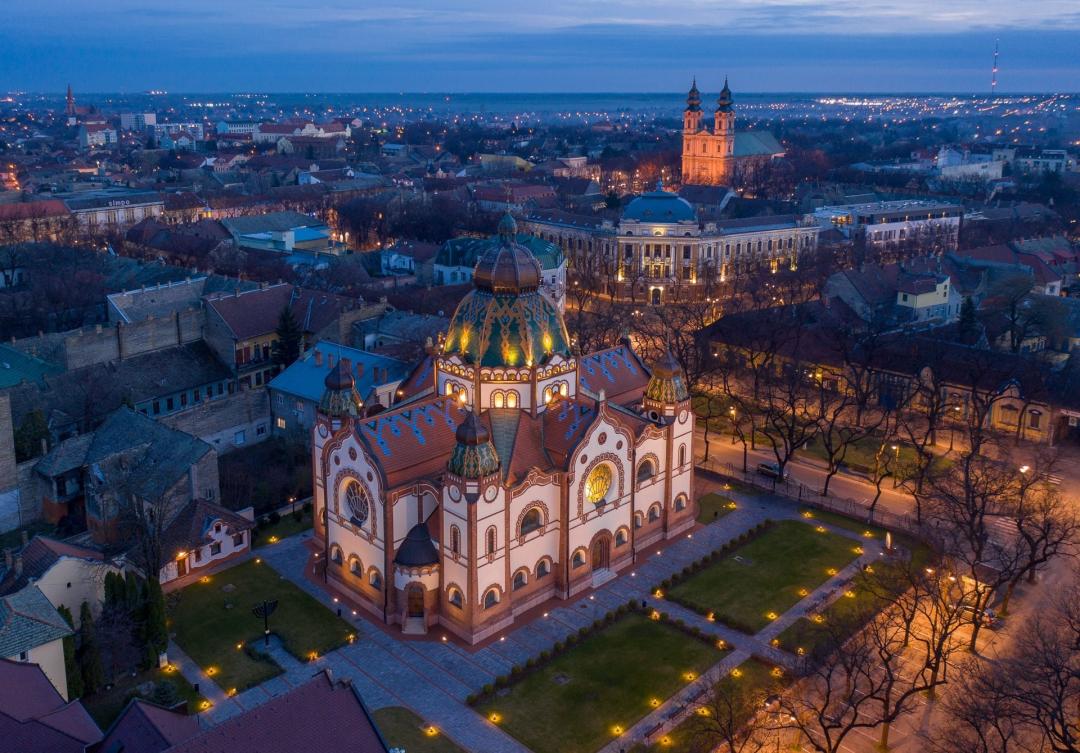

In 1899, the Jewish community of Szeged announced a competition for the construction of a new synagogue. The Jewish community of Subotica, which had significantly strengthened its importance and numbers, already owned a plot at the corner of Széchenyi Square and Jókai Street, donated by Adolf Geiger on April 19, 1892. Intending to build a synagogue, the Directorate of the Religious Community of Subotica, chaired by Dr. Izidor Milko, closely followed the competition in Szeged. Lipót Baumhorn (1860–1932), a great synagogue designer, won first prize for a traditional design in the "free style." Marcel Komor and Dezső Jakab, architect partners from Budapest, applied an unusual synagogue design with a "new façade," but despite the support of Ödön Lechner, an architect and jury member who devised the "new Hungarian national style," their projects did not receive approval from the conservative evaluation committee. Nevertheless, the jury recommended their project for purchase along with several other tender projects. The Jewish community of Subotica, which had already moved beyond the unsuccessful synagogue design competition, immediately took their project drawings. The construction company of Ferenc Nagy and Lukács Kladek won the contract to carry out the work, receiving 197,818 crowns. There was still a shortage of 60,000 crowns (40%) of the actual construction cost. Most of the necessary initial capital was provided by community members through the pre-sale of seats: "The attached purchase conditions are fair. The most modest financially member of the community can buy a seat because the purchase price will be paid only 20% in installments over five years."
The amount needed to complete the construction was also secured by bonds with a 5% interest rate, an idea of community president Izidor Milko. After adapting the project to local conditions, construction of the new synagogue began in 1900. Meanwhile, the designers easily convinced the community leadership to build the new synagogue in the "Lechner Eastern Hungarian style" Art Nouveau. The building was completed under the guidance of Marcel Komor and Dezső Jakab in about three years by autumn 1902, but additional work took another year. The synagogue's consecration took place on September 17, 1903, about which the contemporary press reported:
"On September 17, an extraordinary new synagogue of the Jewish community was put into operation in Subotica. The sacred feeling of brotherhood, which intensified the entire celebration, was much more captivating than the solemnity and splendor of the synagogue itself; it was not just a day of consecration of the synagogue but a day of celebration for the entire population of Subotica."
All life in Subotica for several hours centered around the new synagogue. Authorities, state officials, military personnel, and priests from all regions gathered there. Outside, around the synagogue, stood a crowd of townspeople. During the day, although the sky darkened, the weather was very good for the celebration, as the following report tells:
After singing the evening prayer, Chief Rabbi Mór Kuttna gave a short touching farewell speech to the old synagogue, then took the Torah scrolls out of the Ark, and local and invited rabbis, together with the eldest members of the Jewish community, carried them under two canopies toward the new synagogue. The canopies were surrounded by officers in parade uniforms with drawn swords; in front of them, the fire brigade played old Jewish prayers, and a large crowd followed behind. It was about four o'clock when the crowd arrived at the square of the new synagogue, where thousands of spectators were already waiting. The mayor of the city, responsible officials, and leaders of the Jewish community stood before the locked gates of the synagogue, and when the Torah scrolls arrived before the stairs, architect Dezső Jakab, who, together with Marcel Komor, designed the building, addressed the community president with a speech and handed over a gilded key to the synagogue resting on a velvet cushion.

The president, Dr. Géza Blau, accepting the key, asked Mayor Dr. Károly Bíró to change it and hand over the building for its sacred purpose. Károly Bíró responded with a longer speech, opened the synagogue gates, and called for it to serve as a center of morality. Cheers spread along the wide street, and the procession moved into the synagogue, already fully filled with the public. As people entered, the choir sang psalms. After singing the psalms, the Torah scrolls were placed before the Ark, and the choir sang a prayer beginning with "How lovely are your tents, O Jacob...". Then the Torah scrolls were placed in the Ark. Lifschitz, the chief cantor, sang the usual Sabbath, prayed with his sonorous pleasant voice, and together with Kuttna and the lead cantor Besencz carried the remaining Torah scrolls on their arms around the altar and placed them in the Ark. Then the white-haired Mór Kuttna blessed. First, he blessed the synagogue and the spectators. At that moment, all the electric lamps lit simultaneously and illuminated the beautiful synagogue."
This story is especially interesting now, as the interior and exterior renovation of the building has been completed. It captures the mood of that day and the "dedication ceremony," when at the turn of the 20th century, the landmarks of architectural development and urbanism of Subotica were born. On that day, in that dusty, sometimes dirty place, a miracle-box opened, and the subsequent fifteen years of urban development led to Subotica rightfully being called the city of Art Nouveau. The Subotica Synagogue became one of the most beautiful in Central-Eastern Europe.

While most synagogues in Eastern and Central Europe were built in the second half of the 19th century in the prevailing "Moorish style," the Subotica Synagogue, built later, carries stylistic features of Hungarian Art Nouveau and is a unique object in the region. The Jewish community of Subotica chose this style because assimilation was developing at the turn of the century. Throughout history, the economic power, social, and legal status of the Jewish community for the first time allowed the Byzantine dome of their new synagogue to rise above the city silhouette alongside other city temples (Franciscan Church, St. Teresa of Avila Catholic Church, Serbian Orthodox Church, and others). That is, to build a structure shaping the urban landscape and anticipating the future architectural development of Subotica. This trend was not unique to the city but became a common feature throughout Austria-Hungary.
In 1925, on the occasion of the synagogue's 25th anniversary, Izidor Milko, community president and writer, wrote about the circumstances of construction: "We did not have much money. Already in the times of the honorable, energetic president of our community Mór Kuncz, in the 1890s, a construction fund began to be created. Some money could be collected in the form of loans, but it was far from being a base for construction—at least it could be a starting point. The splendidly developed plan of Ignác Kuncz, who secured a significant part of the capital for construction through the sale of seats in the synagogue, provided the necessary funding. But we still did not have enough money to boldly start construction and confidently await results. Then the idea came to me to issue bonds with a 5% interest rate, which would be gradually redeemed by creditors. At that time—incredibly, but true—I was very popular, moreover, I was at the peak of my popularity, and in three or four days I placed almost a thousand bonds at fifty crowns each. This success gave the construction a new impetus. I have good memories of this campaign, that bonds were bought even by those who, for reasons or without, were known as anti-Semites. There was never true anti-Semitism in Subotica, and religious denominations, like nationalities, lived in exemplary peaceful coexistence and heartfelt harmony with each other..."
Due to financial limitations during the synagogue's construction, compromises had to be made. Less quality and cheaper materials were used: instead of majolica on the facades, terracotta and plaster decorations were placed; artificial stone was used instead of red marble; the surface of the Torah Ark and Bimah was made of artificial marble (stucco); bronze was used instead of gilding, and the organ was also modest in size—with decorative faux wooden pipes. This fact largely contributed to the rapid deterioration of the building's condition and caused many difficulties during repairs.
The cost of building the synagogue in Szeged was five times higher than that of the synagogue in Subotica (760,000 crowns), however: "Fortunately, architectural effect and artistic value are obviously not linear in terms of financial costs. Moreover, financial constraints can benefit some buildings. In material wealth and abundance, the Szeged synagogue far surpasses the Subotica synagogue, but the latter is unique in its form, relative simplicity, and purity." Since the synagogue was a successful project, the Subotica municipality commissioned the same architects to design a new town hall. It was built between 1908 and 1912 and has since become a world-famous masterpiece of late Hungarian Art Nouveau. Between 1923 and 1925, after a strong hurricane, significant reconstruction and some changes were made to the synagogue, but they did not substantially alter the building's appearance. At that time, most of the stained glass windows by Miksa Róth, the imperial and royal court glass artist, were replaced, and only a few original Tiffany windows remained. In this case, the external wall surfaces were cleaned and plastered but without decorative profiles and original coloring. It is a big question whether the glazed majolica capitals from the tops of the semicircular columns of the central dome disappeared then. The original coloring above the choir gallery was painted over and changed. The window repair was carried out by János Sánka (1879–1927), a stained glass artist from Szeged who moved to Subotica in 1905.
The building stands on a large corner plot between Synagogue Square and Jakab and Komor Square and, according to established practice, is freestanding and built away from street lines. On the plot stood three other one-story buildings: two smaller ones, the kosher butcher's house and the caretaker's house (behind it, the sports hall of the former Jewish school), as well as a significantly larger Jewish school building, which was demolished in the 1980s. A one-story building of the Jewish community stands on the plot, oriented toward the former Batthyány Street, now Dimitrije Tuković Street. It is still used as a prayer hall, where Jews of Subotica still gather, and also serves as community premises. The community building, former school, and kosher butcher's house were also designed by Jakab and Komor. The surviving buildings now form a protected architectural unity with the synagogue.
According to the typology of Dr. Rudolf Klein, the Subotica synagogue belongs to the Byzantine church-type synagogues. Indeed, it is crowned by a large Byzantine central dome, accompanied by four smaller corner domes (clock towers) covered with colored glazed flat tiles. The synagogue has a regular central prayer space of square shape measuring 25 by 25 meters, and the floor plan resembles an Orthodox cross, similar to Christian churches. Four pairs of symmetrically arranged steel columns bear the entire structure of the prayer hall, while the galleries and central dome are reinforced with ribs on the upper side. The interior height is 25 meters, the diameter of the inner dome is 12.6 meters. On the first floor, there were 950 seats for men and 530 seats for women on a three-sided gallery. Four gates, entrances, and stairs at the corners provide access to the gallery, and besides the main entrance on the west side, there are direct entrances to the first floor from the south and north sides. "The square plan corresponds to the Orthodox Ashkenazi tradition; the dome, as the architects emphasize, resembles tents in the desert."
Since the synagogue was used by Reform Jews, the Bimah is not in the center but on the eastern side. The architects used multilayered symbolism in the decoration of exterior and interior details. In the building, universal archetypes, Jewish religious iconography, folk symbolism, and Masonic symbolism are connected through the organic interaction of the universal "Whole" and the unique "Detail."
About Marcel Komor and Dezső Jakab, Réka Varallyay wrote: "Besides their joint creative activity, it is worth mentioning that they both belonged to the Masonic lodge 'Galilee.' Marcel Komor's membership in Freemasonry was an advantage in obtaining contracts; for example, in Subotica, where Mayor Károly Bíró, or in Marosvásárhely, where Mayor György Bernády belonged to the 'brotherhood.'"
Walking through the building, a visitor will notice that the synagogue is crowned by a central dome, at the top of which is the Star of David, symbolizing the unity of heaven and earth. On the tops of the corner domes above the clock towers are also Stars of David, which, according to contemporary descriptions, were originally gilded. The corner domes symbolize the four cardinal directions of the world and the flow of time. The dome itself usually signifies the sky, the spiritual sphere, while the square/rectangular building beneath it symbolizes the earth and the material world. Between the two elements stands an octagonal dome drum, realizing the transition, referring to harmony and consonance of the Universe. Symbolism reminiscent of the archetype of the Universe manifests in both the external and internal horizontal division of the synagogue. The facades can be divided into three horizontal zones. The lower zone, closest to the ground, includes a pink rosette made of artificial stone and a strip of wall faced with red facade brick, symbolizing the material world, earthly form of life. The upper zone is decorated with alternating red facade brick and plastered surfaces, originally decorated with terracotta elements with relief floral motifs, as well as arched or round stained glass windows. This zone is topped by a wavy battlement, also decorated with floral reliefs. This intermediate zone represents the earthly paradise, the lost Garden of Eden. It is a transition between the material and the heavenly, spiritual world, which is represented by the highest zone—the world of domes. Originally, the domes were covered with masterpieces of decorative zinc plating. In the 1970s–1980s, hoping for greater durability, they were replaced with copper plates. This significantly changed the synagogue's external appearance. The synagogue's external beauty is emphasized by the alternation of plastered wall surfaces and red facade brick cladding, as well as the artistic variety of brickwork on the facade walls. The front is decorated with decorative relief terracotta elements made by the world-famous company Zsolnay Porcelánmanufaktúra Zrt. in Pécs, which, due to poor condition during restoration, were entirely replaced by engobed pyrogranite. Every detail of the building demonstrates high craftsmanship, performed by Ferenc Nagy and Lukács Kladek, construction contractors from Subotica, and their subcontractors, as well as the implementation of comprehensive conscious planning characteristic of that era.
The main entrance to the synagogue can be approached from the west side. The visitor finds themselves on a staircase before three gates. In the middle are the main gates, larger than the other two. The arched openings above the gates are decorated with multicolored stained glass. The carpentry and wrought iron works are done in Art Nouveau style. The arched openings were originally covered with relief terracotta with a series of tulip motifs growing from heart-shaped figures. During restoration, they were also replaced by engobed pyrogranite.
At the top of the pediment stands one of the four Tablets of the Covenant. During restoration, they were also newly made in Pécs from glazed pyrogranite. On both sides of the narthex stands a brick corner column, which calls to mind the columns Jachin (for the penitent) and Boaz (for the revelers), originally standing before Solomon's Synagogue. Perhaps these are also Masonic symbols, but they also fully correspond to the iconography of Jewish synagogue architecture. According to descriptions in contemporary newspapers, originally, majolica capitals of poppy shape were on top of these columns—now only their terrazzo copies are visible. Similar capitals were on top of eight round corner columns surrounding the central dome. Over the years, they mysteriously disappeared and were restored only during roofing works in 2004–2011, thus restoring the original splendor of the main dome.
Through the gates, the visitor enters the vestibule and then the men's foyer. In the vestibule on the left stands a ritual handwashing basin carved from pink stone, preserved from the old demolished synagogue. The foyer has no natural lighting, so artificial light creates a mystical half-darkness, preparing the visitor for a soul-stirring experience of the holy place under the central dome. On the north wall on the left are two white marble plaques with the names of deceased members of the Jewish community of Subotica, as well as the names of its founders, written in Hungarian and Hebrew. On the east wall, to the left of the central entrance, is a white marble plate with the schedule of services, and on the right, a memorial plaque in honor of Mrs. Gitl, who donated donation boxes to the synagogue in 1922. A modernist plaque on the south wall was dedicated to Adolf Geiger, the most important donor, and another to János Halbrow and his wife, née Netti Spitzer, one of the founders. Crossing the threshold of the holy place, the visitor first notices the rows of benches and then the place of the Torah Ark (Aron ha-Kodesh), but the central dome remains hidden behind the low ceiling—the lower part of the gallery. On both sides of the entrance doors, recessed into the walls in Art Nouveau style, one can see metal donation boxes. The miracle for the visitor opens only after a few steps, when the inspiring view of the huge breathtaking central dome, the "Tabernacle," materialized as a shell structure, appears, which, according to its creators, is meant to remind of Moses' Tent. The central dome rises above the square plan of the holy place and is supported by eight steel columns arranged octagonally. The women's galleries are covered with thin arches and shallow domes at the corners.
The floor plan has preserved the tripartite spatial division (foyer, sanctuary, and inner sanctuary—the Ark) of the Jerusalem Temple without a courtyard, but at the main gates and at the corner women's entrances, the designers planned driveways. The interior space, like the synagogue's exterior appearance, is vertically divided into three parts. There is a zone symbolizing the materialistic world, earthly existence—the sacred space under the galleries, where rows of believers' benches stand. Here is the Bimah—from where the Torah is read and from where the Torah Ark opens. On the Bimah stand two menorahs and two Hanukkiot with nine candlesticks, which are traditionally lit during Hanukkah, the festival of lights. From this space, steel columns stand out and rise upward, supporting the galleries and central dome. Their stucco covering, on the one hand, is fireproof, and on the other, the plant relief decor is part of the iconography of the Garden of Eden.
The gallery columns turn into vaulted arches, along which convex leaf motifs continue uninterruptedly. The first-floor space is slightly darker than the rest. It is illuminated only by stained glass windows built under the galleries and a richly decorated conical central chandelier with other additional lamps. Besides the functional and aesthetic role of the majestic central chandelier, it has another task—to improve the acoustics of the domed space. Interior lighting was also provided by a large number of decorative brass lamps. Over time, they almost completely disappeared but have now been restored. The second zone includes the stucco decorative parapet of the galleries with rows of benches intended for women. The slope of the rows of benches subtly blocks visual contact with the floor level. In particular, the rows of benches located at the corners of the galleries represent a unique solution, as they descend in a cascade to the parapets, creating an unparalleled visual impression from the Bimah. At this level, LIGHT dominates, penetrating from all sides through huge multicolored rosettes and arched stained glass windows, constantly changing, reminiscent of the radiance of the Garden of Eden. The shape of the foil rosettes resembles carnations. Here, the headline line with folk motifs fits in. The designers did not aim to create a mystical, gloomy space but tried to bring happiness and enthusiasm into religious reverence. The main shade of the painting on the first floor and gallery walls is pale green, symbolizing spring, nature's renewal, and growing life. Green is a mixture of earthly (warm color) and heavenly (cool color) principles.
The transition between the gallery zone (intermediate world) and the central dome (reflecting Heavenly Paradise and Divine Being) is solved with pendants placed in the corners of the dome drum. The pendants are not structural elements; they are merely a visual transition with reliefs of folk pattern Matyo, depicting the Tree of Life in flowers. Their color sharply contrasts with the green surroundings. On the brick-red background, blue, grayish, and pink shades appear. On the elongated surfaces between the pendants, quotes from the Old Testament can be read in Hebrew and Hungarian: "Love Eternity, your God" and "Love your neighbor as yourself." These ancient messages, like all the synagogue's architecture, color scheme, and iconography, remind of the essence of life, proclaim Love.
From here rises the central dome, consisting of eight segments. Its elegance is given by two rows of stained glass windows, although the light penetrating through the windows of the outer drum is filtered and muted. The color scheme of the dome and its folk iconography are consistent and symbolic. The conceptualization of the first floor continues upward. In the transition zone, warm pink tones still dominate, then they gradually shift to light blue, followed by a ledge forming a dividing line on the way to the dome's top, which at the dome's apex turns into dark blue at the very end. Folk floral motifs at the bottom of the dome usually grow from heart-shaped symbols of universal love, then run, springing around the windows, along the ribs, straight to the radiant Sun at the dome's top. On the vault above the Bimah, a gilded shining Sun with folk plant motifs can also be seen, symbolizing the presence of the Lord. The highest, most sacred peak of the dome is separated from the lower part by a cast ring. On this ring rests the dome's apex—a conical central stained glass of the shining Sun, consisting of eight planes with inserts of golden-yellow and green opal glass on a turquoise base, radiating its glow. This is the symbol of the Lord, originating from the eight "All-Seeing Eyes" (not visible from below), octagonally arranged at the dome's top. The All-Seeing Eye is a universal religious symbol; in Freemasonry, it represents the eye of the Great Architect of the Universe. The synagogue's religious iconography reaches its climax in this central image of the One, Almighty, and Omnipresent.
The most sacred place of the synagogue is the Holy of Holies—the Torah Ark, which usually appeared in synagogues instead of the original Ark of the Covenant. Inside are stored the scrolls of the Book of Moses, that is, the sacred documents of the Jewish religion. The Subotica synagogue's Ark, besides the Art Nouveau style, also carries religious iconography. "Two massive columns refer to Jachin and Boaz, which stood before Solomon's Synagogue. The wings growing from them, the architects related to cherubim framing the Ark of the Covenant, where the lulav (palm branch), the Tablets of the Covenant, and the six-pointed star are located—all in Hungarian tradition." According to Jewish tradition, the door of the Torah Ark was covered with a parochet (ornamented fabric symbolizing the veil that covered the Ark of the Covenant), which is no longer present today. The two-leaf arched door is made in Art Nouveau style with folk motifs, with a Sanctuary lamp and an inscription in Hebrew at the top: "I see the Lord everywhere." The Torah Ark is painted sky blue inside, and the stars sparkle with gold, depicting the Universe. Here you will find carved Torah stands made in the synagogue's style.
Inside the Star of David in Art Nouveau style, a short inscription in Hebrew can be read. "From a close distance, it is visible that the inscription YHWH is not original: two letters Yod originally designated the Lord, and they were painted over by the letters YHWH. In fact, the Lord's inscription should not be painted over by anything else, but the inscription YHWH means the same as the two letters Yod, although less abstractly, so this is permissible."
Above/behind the Torah Ark is the choir gallery, where remnants of the former organ can be seen. Missing organ pipes were replaced by wooden fake pipes, which were also restored during the last reconstruction. Originally, in Orthodox synagogues, only human voices were allowed; the presence of an organ is already a custom of the Reform synagogue. Music is a very important element of the religious ritual. According to memories, the vaulted ceiling above the choir gallery was originally painted like the inside of the Torah Ark, namely "it showed the sky with stars and planets." The existing pattern was painted later. On the ceiling, inscriptions in Hebrew praising music can be seen: "Praise Him with stringed instruments and pipes" and "Praise Him with instruments." The best sound can be heard in the west gallery.
The construction of the synagogue in Subotica was completed in just three years, but its restoration lasted about 40 years. Technical restoration of the synagogue began in the second half of the 1970s. Since then, restoration work has been carried out more or less continuously on the initiative, organization, and under the control of the Intermunicipal Institute for the Protection of Monuments of Subotica (IMIMPS). Due to the uniqueness of the building and the complexity of the task, its restoration became a serious problem for generations of professionals. Constant lack of financial resources and political will was the main reason for decades of restoration, which led to "Sisyphean conditions." At that time, to raise money for the most urgent work, it was necessary to appeal to several sources. The sources were the city council of Subotica, the Ministry of Culture and the Ministry of Religious Affairs from Belgrade, the World Monuments Fund (Jewish Heritage Grant Program) from New York, the Rothschild Foundation (Hanadiv), and various private sponsors.
2014 became a turning point in the difficult fate of the synagogue. The selfless financial and professional support of the Hungarian state created the opportunity to complete all restoration by the end of 2017, and the synagogue was able to regain its original splendor and breathtaking beauty and become one of Subotica's carefully maintained works of art. Restoration work was supported by the Hungarian government with more than 2,000,000 euros; under the leadership of the Hungarian National Council; under the control of the Republican Institute for the Protection of Monuments in Belgrade and IMIMPS experts; carried out by world-famous foreign and domestic restorers under the leadership of civil engineer Andrea Fehér and performed by the Yumol Consortium from Subotica.
The reconstructed synagogue will receive a new purpose. Primarily, it will be a tourist destination, but it will also provide space for permanent exhibitions and other cultural events. During major religious holidays or memorials, members of the Jewish community may sometimes use it as a synagogue. The exterior and interior renewal of the synagogue was carried out according to architectural projects by the author of this book and his associates, in connection with the many dilemmas leading specialists in construction had to face during the work. During the comprehensive reconstruction, the artificial gilding and decorative elements of the synagogue's interior were restored. In some places, real gold plates were used. A special task was to decide the fate of too many benches on the first floor and determine their identity. Missing pieces of colored relief clinker tiles for the floor were ordered from Morocco, where they were handmade, world by world.

The color of the surface of the exterior plastered walls also remained a mystery for a long time, as the original coloring was removed and restored in the 1920s and 1970s. In Dezső Jakab's memoirs dated 1925, he wrote that this color was "green, not yellow, and better harmonized with the red facade brick and blue ornaments." During the last restoration, the final color of the building's exterior plaster was agreed upon with the Jewish community so that it resembled the color of desert sand.
By December 2017, the 40-year reconstruction was completed, and the Subotica synagogue regained its original beauty corresponding to its significance.
Sources:
https://www.suboticasinagoga.rs/en/synagogue/synagogue-subotica/demeter-gabor-synagogue-subotica
https://srbija-projektieu.rs/en/subotica-synagogue/
https://en.wikipedia.org/wiki/Subotica_Synagogue


Written by Jermaine
Discuss this with the author and others
No comments yet. Be the first to start the conversation.