World: Synagogues - Spiritual Centers of the Jewish World

For Browsing

Defining the role of the synagogue in Jewish life, the president of the Federation of Jewish Communities of Russia, Alexander Boroda, noted: “The synagogue is not a temple. In Hebrew, it is called *beit knesset* — ‘house of assembly’ — a place where people can come not only for prayer. Many visit the synagogue simply to be there, to feel their connection to Judaism. Its architecture should not reflect any ideological messages: neither grandeur nor, conversely, asceticism, but the style of both the exterior and interior reflects the era and geographical location. The goal is to make the synagogue functional and cozy, like a home, to give people motivation to spend much more time there than is required for prayer.”

Kitaevskaya Synagogue, Troitskoye Suburb, Minsk

9a Maksima Bogdanovicha St., Minsk, Belarus

Kitaevskaya Synagogue, also known as the Hasidic Synagogue of Koidanovo, is a building that was constructed and formerly operated as a Hasidic synagogue, located in the Trinity Suburb in Minsk.

Choral Synagogue, Minsk

5 Volodarskogo St., Minsk, Belarus

The Minsk Choral Synagogue is the former main synagogue in Minsk. Today, the partially rebuilt building houses the Maxim Gorky National Academic Drama Theater.

North Shore Congregation Israel Synagogue, Chicago, Illinois

1185 Sheridan Rd, Glencoe, IL 60022, USA

The striking building, constructed in 1964, was designed by Minoru Yamasaki, one of the most outstanding modernist architects of the 20th century. Among Yamasaki's other notable projects are the Twin Towers of the World Trade Center and the Beth El Temple in Bloomfield Hills, Michigan.

From the Great Synagogue of Paris, Paris, France

44 Rue de la Victoire, 75009 Paris, France

Napoleon Bonaparte had a truly imperial worldview and considered it reasonable to reconcile French society with the local Jewish community. Therefore, in 1808, he granted official status to the community, allowing them to build a temple. Thus, in 1822, a synagogue appeared on Notre-Dame-de-Nazareth Street. Thirty years later, it was rebuilt on the same site, despite all the efforts of James Rothschild to move the temple to the Marais district. Only during the time of Baron Haussmann did the Rothschild brothers manage to obtain permission to build a synagogue on Victory Street, as the mayor was on good terms with the Jewish community of Paris. Parisians often call it the Great Victory Synagogue, named after the street on which the temple is located.

Great Choral Synagogue of Saint Petersburg

Lermontovsky Ave., 2, Saint Petersburg, Russia, 190121

On September 1, 1869, Emperor Alexander II approved the resolution of the Committee of Ministers allowing the Jews of St. Petersburg to build a synagogue to replace the existing prayer houses.

Moscow Choral Synagogue

Bolshoy Spasoglinishchevsky Lane, 10, Moscow, Russia, 101000

The oldest synagogue in Moscow. It is located on Bolshoy Spasoglinishchevsky Lane in the Central Administrative District. It is under the supervision of the Board of Trustees of the Moscow Jewish Religious Community (MJRC). The building is a domed basilica. The interiors of the synagogue are decorated with floral and geometric patterns. On the southern wall, there is a mosaic depicting a Lebanese cedar, which serves as a reminder of the destroyed Temple of Solomon. The synagogue has four prayer halls with balcony galleries for women.

Great Synagogue, Włodawa, Poland

Czerwonego Krzyża 7, 22-200 Włodawa, Poland

The Great Synagogue is a monument of 18th-century Jewish architecture, located at 7 Krasnogo Kresta Street in Włodawa, Podlasie.

Beth Sholom Congregation Synagogue, Philadelphia suburb, Elkins Park, Pennsylvania

8231 Old York Rd, Elkins Park, PA 19027, USA

An unusual synagogue in the USA, in the design of which the architect metaphorically embodied the image of Mount Sinai, where the Lord first appeared to Moses.

Synagogue of Santa María la Blanca (Sinagoga de Santa María La Blanca) or the Synagogue of Joseph ben Shoshan, Toledo, Spain

C. de los Reyes Católicos, 4, 45002 Toledo, Spain

It all began in the 1st century AD, when the Roman troops brutally suppressed the Jewish uprising in Palestine. The Jews, having survived the bloody massacre, were forced to be expelled from their historical homeland. They settled on the outskirts of the empire, including the Roman province of Spain. For more than a thousand years, the Jewish people thrived on the fertile land of the Iberian Peninsula. But all things come to an end. First came the pogroms, and then in 1492, the merciless expulsion of all adherents of Judaism from Spain followed, by order of Queen Isabella the Catholic. And once again, they were forced to flee.

Stadttempel Synagogue (Seitenstettengasse Temple), Vienna, Austria

Seitenstettengasse 4, 1010 Vienna, Austria

Stadttempel - the main synagogue of Vienna. It is located in the Innere Stadt district on Seitenstettengasse Street, 4, which is why it is also called Seitenstettentempel (German: Seitenstettentempel): until 1938, a large number of synagogues and prayer houses in Vienna were usually known by the names of the streets or alleys. Currently, this synagogue serves as the main house of worship for the city’s Jewish community, numbering about 7,000 people. It also holds the status of a historical monument.

New Synagogue in Dresden

Hasenberg 1, 01067 Dresden, Germany

The New Synagogue in Dresden was built in 2001 based on the design by architects Rena Wandel-Hoefer and Wolfgang Lorch. It was constructed on the same site as the Semper Synagogue (1839-1840), designed by Gottfried Semper, which was destroyed in 1938 during Kristallnacht.

Temple Emanu-El Synagogue, New York

1 E 65th St, New York, NY 10065, USA

The 175-year history of the Emanuel Temple reflects the rise in prominence of Jewish immigrants in New York and beyond. Over a century and a half, what began as a small prayer group has grown into a great congregation — a distinguished representative of Reform Judaism and an ongoing participant in the civic, cultural, and spiritual dialogue of our country — and the temple has become known as an important architectural landmark.

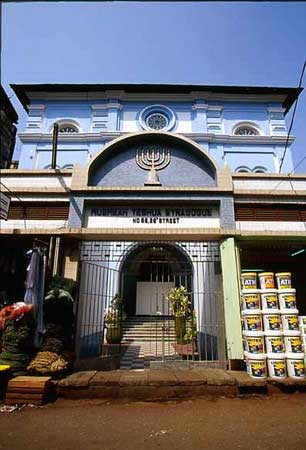
Musmeah Yeshua Synagogue, Myanmar, Yangon

No. (560), Mahar Bhandular Road, Pabedan Township, Yangon, Myanmar (Burma)

Musmea Yeshua Synagogue is the last remaining Jewish house of worship in downtown Yangon and the only synagogue in Burma. The synagogue stands between Indian paint shops and Muslim traders on a small street near the city center. A memorial plaque at the entrance states that the current stone building, constructed between 1893 and 1896, replaced an earlier smaller wooden structure built in 1854. It serves the few Jews remaining in the country, mostly descendants of Baghdadi Jews from Iraq.

Neue Synagoge, Berlin

Oranienburger Str. 28-30, 10117 Berlin, Germany

In 1859, the construction of the New Synagogue (Neue Synagoge) began in Berlin. The architectural design, created by Eduard Knoblauch and Friedrich August Stüler, was executed in the Moorish style. Construction took nearly 7 years, and in September 1866, the opening of the largest Jewish temple in Berlin, and indeed in all of Germany, finally took place: the synagogue had more than 3,000 seats. Moreover, this Jewish temple was one of the most beautiful in Europe. Due to its Eastern Moorish style and resemblance to the Alhambra, the New Synagogue is an important architectural monument in Germany. It is one of the few synagogues to survive Kristallnacht. It was heavily damaged before and during World War II; the surviving part of the building has been listed as an architectural monument.

Old-New Synagogue (Staronová synagoga or in German Altneu-Synagoge), Prague

Červená 250/2, Josefov, 110 00 Prague-Prague 1, Czechia

The Old-New Synagogue (Staronová synagoga or in German Altneu-Synagoge) is the oldest active synagogue in Europe, located in Prague, in the quarter called Josefov. Originally, the building was called the "New Synagogue" or the "Great Synagogue." The year of construction of the Old-New Synagogue is considered to be 1270. It received its strange name because other synagogues previously operated in this area, which unfortunately have not survived, and the newly built one was the "new" synagogue in comparison. However, over the years, other newer synagogues appeared in the Jewish Quarter of Prague, and therefore the New Synagogue soon became the Old-New Synagogue.

Belz Great Synagogue, Jerusalem

Binat Yisas'har St 7, Jerusalem, Israel

The Great Belz Synagogue of Jerusalem is the largest urban synagogue, surpassing in size the Main or "Great" Synagogue of the Capital on King George Street. Its "Aron HaKodesh" (Torah scroll ark) is the largest in the world and has been entered into the Guinness Book of Records. This mighty monolithic building, standing out against the cityscape, was built by the Belz Hasidic dynasty, one of the largest and most devout Hasidic movements, known since the 19th century. The Great Belz Synagogue was constructed according to descriptions of the Second Temple and resembles it in shape and size. The main synagogue of the Belz Hasidim in Europe was destroyed by the Nazis during World War II. Today, Belz is a tiny Ukrainian town in the Sokal district of the Lviv region.

SoHo Synagogue, New York

116 Crosby St, New York, NY 10012, USA

On September 15, 2009, the Soho Synagogue signed a 7-year lease for the first floor of the building at 43 Crosby Street, located between Spring Street and Broome Street. As a result, the former clothing store at this address in New York’s SoHo neighborhood became home to the world’s most fashionable SoHo Synagogue. The goal of its founder, Rabbi Dovi Scheiner, and his wife, Etty, was to create an Orthodox Jewish community for modern Jews living in the area who work in design, art, and architecture.

Cochin Synagogue (Paradesi Synagogue), Cochin, India

X755+2QG, Synagogue Ln, Jew Town, Kappalandimukku, Mattancherry, Kochi, Kerala 682002, India

The Paradesi Synagogue, also known as the Jewish Synagogue of Cochin or the Mattancherry Synagogue, is a synagogue located in the Jewish quarter of Mattancherry, a suburb of the city of Kochi, Kerala state, India. It was built in 1568 AD by Samuel Castiel, David Belila, and Joseph Levi for the thriving Paradesi Jewish community in Kochi. At that time, the Cochin Jews mainly consisted of the old historic Malabar Jewish community and recently arrived Sephardic refugees fleeing Portuguese religious persecution of Jews in Spain and Portugal. It is the oldest active synagogue in the Commonwealth of Nations. Paradesi is a word used in several Indian languages, and the literal meaning of this term is "foreigners," applied to the synagogue because it was built by Sephardic or Portuguese-speaking Jews, some of whom came from families expelled from Aleppo, Safed, and other locations in Western Asia.

Bet El Synagogue, Casablanca, Morocco

H9WF+865, Rue Jaber Ben Hayane, Casablanca 20100, Morocco

The presence of Jews in Morocco dates back more than 2,000 years. Before the establishment of Israel in 1948, their population was estimated to be around 275,000 people, considered the largest Jewish community in the Muslim world. In Casablanca, there is a magnificent synagogue known to locals and tourists as the Bet-El Temple. Its main feature is the luxurious interior decoration; the building is adorned with exquisite stained glass windows, and inside, one can see beautiful handcrafted furniture and other unique decorative elements everywhere. The synagogue building is constructed in the finest Art Deco traditions, decorated with narrow tall windows, carved rosettes, and elegant black domes gilded with gold.

Ohel Jakob (Jacob's Tent) - synagogue in Munich, Germany

Sankt-Jakobs-Platz 18, 80331 Munich, Germany

Ohel Jakob (from Hebrew: "Jacob's Tent") is a synagogue in Munich, Germany. It was built between 2004 and 2006 as the new main synagogue of the Jewish community of Munich and is located on St.-Jakobs-Platz. The synagogue was solemnly inaugurated on November 9, 2006, on the 68th anniversary of Kristallnacht. The building is part of a new Jewish center, consisting of the synagogue, the Jewish Museum Munich, and a community center.

Great Synagogue, Sydney, Australia

166 Castlereagh St, Sydney NSW 2000, Australia

The Great Synagogue is a majestic building located in the central business district of Sydney, near the local government of the state of New South Wales, Australia. Situated opposite Hyde Park, the synagogue extends to Castlereagh Street.

Zholkivska Defensive Synagogue, Zhovkva, Ukraine

Konovalets Square, 3, Zhovkva, Lviv Oblast, Ukraine, 80300

The Zhovkva Defensive Synagogue is known worldwide. It is listed by the New York World Monuments Fund among the "100 Most Endangered Sites," which led to the beginning of its restoration in 2000; however, the building still remains in an unsightly condition. In the future, a Galician Jewish Center is planned to open here. The Zhovkva Synagogue is also famous for its imitations; in particular, there are "Zhovkva-type" synagogues in Tel Aviv.

Synagogue Templo Libertad, Israeli Congregation of the Argentine Republic, Buenos Aires, Argentina

Libertad 769, C1012 San Nicolas, Autonomous City of Buenos Aires, Argentina

The Libertad Temple (officially named "Libertad Temple - Israeli Congregation of the Argentine Republic") is the first synagogue in the city of Buenos Aires. In 1862, the Israeli Congregation of Buenos Aires was established (later renamed), the first institution of the Jewish community in Argentina. For many years, the Jewish community living in Buenos Aires gathered in a private home to perform their religious rites, until in 1871 the government of Domingo Faustino Sarmiento first sanctioned the activities of the Jewish rabbinate in the country, and Rabbi Henry Joseph became its first spiritual authority. From 1879, he engaged in charity work as well as the registration of births, marriages, and deaths within the community. In the same year, he began raising funds to purchase a plot of land to create a cemetery where Jews could be buried according to their ritual. In 1891, the first Jewish school and the Latin American Israeli community, which united Moroccan Jews, also emerged in Buenos Aires.

Kaunas Choral Synagogue (Kauno choralinė sinagoga)

E. Ožeškienės St. 13, 44254 Kaunas, Lithuania

One of the two functioning choral synagogues in Lithuania, located in the center of Kaunas. The synagogue is called choral because the rituals performed there are accompanied by choral singing.

Budapest Great Synagogue (Nagy Zsinagóga or Dohány Street Synagogue)

Budapest, Dohány St. 6, 1074 Hungary

The largest synagogue in Europe. It is located in the Jewish quarter of Pest, where many Jews still live today. The synagogue project, featuring two onion-shaped domes in a pseudo-historical Neo-Moorish style designed to evoke the Middle Eastern roots of the Jews, was created by the Viennese architect Ludwig Förster, who had previously designed a synagogue in Vienna. The construction of the synagogue took place from 1854 to 1859. The Jewish community, not entirely satisfied with Förster’s creation, enlisted the help of local Viennese architects Frigyes Feszl and József Hild. The result of this collaboration was a landmark building in the form of a two-story structure with three naves made of white and red brick, decorated with colorful ceramics, featuring a delicate cornice and a rose window. The building is designed to accommodate 3,000 worshippers.

Synagogue in Trenčín

Štúrovo Square 6994, 911 01 Trenčín, Slovakia

The synagogue in Trenčín is the work of designer Richard Šajbner, a native of the city of Piešťany, from the Berlin studio, along with his colleague Hugo Palya. This remarkable building is an example of early modernist trends that sought to reduce ornamentation while preserving monumental classical forms. It is a blend of Byzantine style and Art Nouveau with a modern reinforced concrete dome structure. As historical postcards show, the main prayer hall was once richly decorated. To this day, some details remain visible, including stained glass windows, blue painting on the dome, and a historic chandelier in the center.

Neue Synagogue, Bochum, Germany

Erich Mendel Square 1, 44791 Bochum, Germany

Next to Stadtpark stands a 17-meter-high synagogue cube on a platform, surrounded by walls made of multilayer concrete. This creates a striking interaction with the metallic shimmering dome of the neighboring planetarium. The ensemble of the synagogue and community center buildings, consisting of three parts, forms a unified whole. The facade of the structure is clad in natural stone from Israel, thus evoking the Temple Mount in Jerusalem. The Star of David is used as a decoration on the facade, clearly indicating the religious function of the building. A series of overlapping stars creates a kind of tele-effect, while the relief of protruding and recessed rows of stones resembles the local typical brickwork.

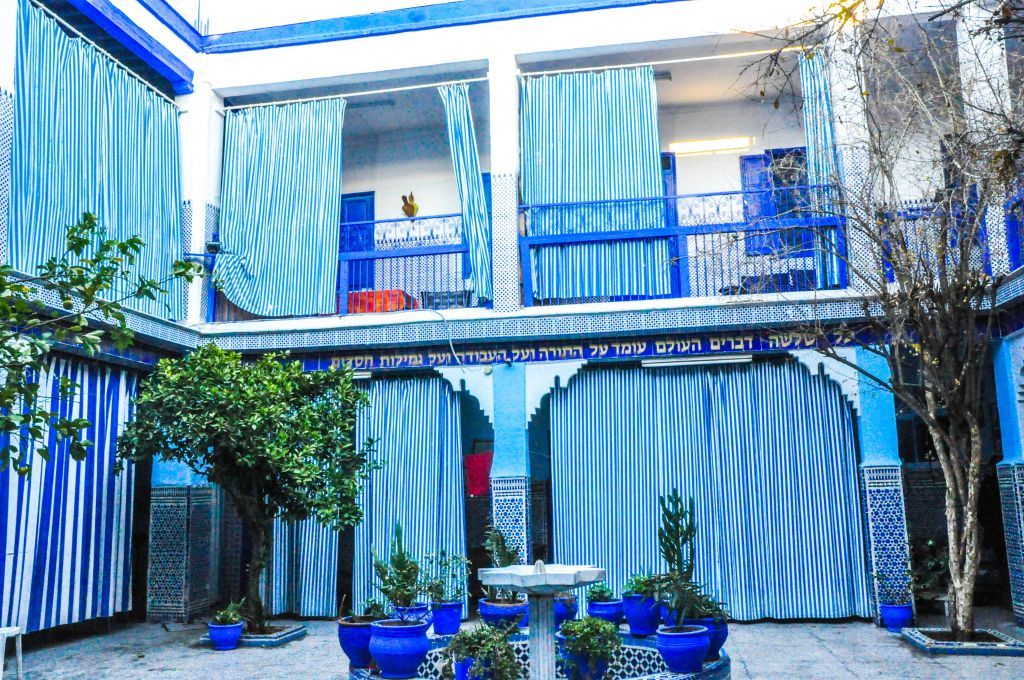
Slat al-Azama Synagogue or Lazama Synagogue, Marrakesh, Morocco

16 Derb Manchoura, Marrakesh 40000, Morocco

The Slat al-Azama Synagogue, or Lazama Synagogue, is one of the most famous synagogues in Marrakech, Morocco. It is located in the historic Mellah (Jewish quarter) of the old city. Only a few synagogues in the Mellah are still used by the shrinking Jewish community of Marrakech, including this one, which also serves as an interesting museum of Jewish life in Morocco. It was originally built in 1492 by Jews expelled from Spain, but its white and blue interior represents a much later version. The synagogue is located on the right side of a beautiful inner courtyard – note the Star of David motif in the zellige (colorful geometric mosaic tile).

Synagogue in Tykocin, Poland

Kozia 2, 16-080 Tykocin, Poland

The fact that the synagogue in Tykocin was not destroyed during World War II should be regarded as a miracle. The near-total destruction of the Jewish community was inextricably linked to the annihilation of the material and cultural heritage of many generations. Almost everything disappeared. From dishes to houses, from Torah scrolls to the Yiddish language, from everyday customs to the craftsmanship of Jewish artisans. Everything was lost—except in Tykocin. Between 2016 and 2018, the synagogue building was completely restored, and its furnishings and collection of Judaica impressed even the most outstanding experts in the field.

The Great Synagogue (Tempio Maggiore di Roma), Rome

Via Catalana, 5, 00186 Rome RM, Italy

The current synagogue building was constructed shortly after the unification of Italy in 1870, when the Kingdom of Italy captured Rome and the Papal States ceased to exist. The Roman ghetto was demolished, and the Jews were granted citizenship. The exterior of the building was designed by architects Vincenzo Costa and Osvaldo Armanni; the building was constructed from 1901 to 1904 on the banks of the Tiber, overlooking the old ghetto. Thanks to its eclectic style, the synagogue stands out even in a city known for its landmarks and structures. The synagogue's aluminum dome is the only square dome among buildings in Rome and easily identifies the religious structure even from a distance.

Tempio Maggiore (Great Synagogue), Florence, Italy

Via Luigi Carlo Farini, 6, 50121 Florence FI, Italy

A beautiful building with a green dome, designed in the Byzantine-Moorish style. It majestically towers above all the other structures, standing out against the overall backdrop both day and night.

El Ghriba Synagogue (Djerba), Djerba, Tunisia

RV75+HPG, Hara Sghira Er Riadh, Tunisia

El-Ghriba is an important feature of Jewish life on the island. According to legend, the construction of the synagogue dates back to the flight of the high priests after the destruction of Solomon's Temple by the Babylonians under Nebuchadnezzar II in 586 BCE (or alternatively, to the destruction of the Second Temple in 70 CE). The high priests took with them a door and a stone from the destroyed temple. Thus, the synagogue connects the Jewish diaspora with the "sole sanctuary of Judaism." Today, the local Jews are distinguished by their clothing, which includes a black band on their trousers, symbolizing the destruction of the Temple.

Synagogue on Eldridge Street, New York

12-16 Eldridge St, New York, NY 10002, USA

An Orthodox Jewish synagogue located at 12 Eldridge Street in Chinatown, in the Lower East Side of Manhattan, New York, New York, United States. This historic landmark, built in 1887, is one of the first synagogues constructed in the United States by Eastern European Jews. The Orthodox community that built the synagogue moved to the lower floor of the Beth Midrash in the 1950s, and the main sanctuary was not used until the 1980s, when it was restored and turned into a museum on Eldridge Street.

The Great or Adrianople Synagogue, Edirne, Turkey

Dilaverbey, Maarif St. No:75, 22020 Edirne Center/Edirne, Turkey

A historic Sephardic synagogue located on Maarif Street in Edirne, Turkey. It was designed in the Moorish Revival style and restored in 2015.

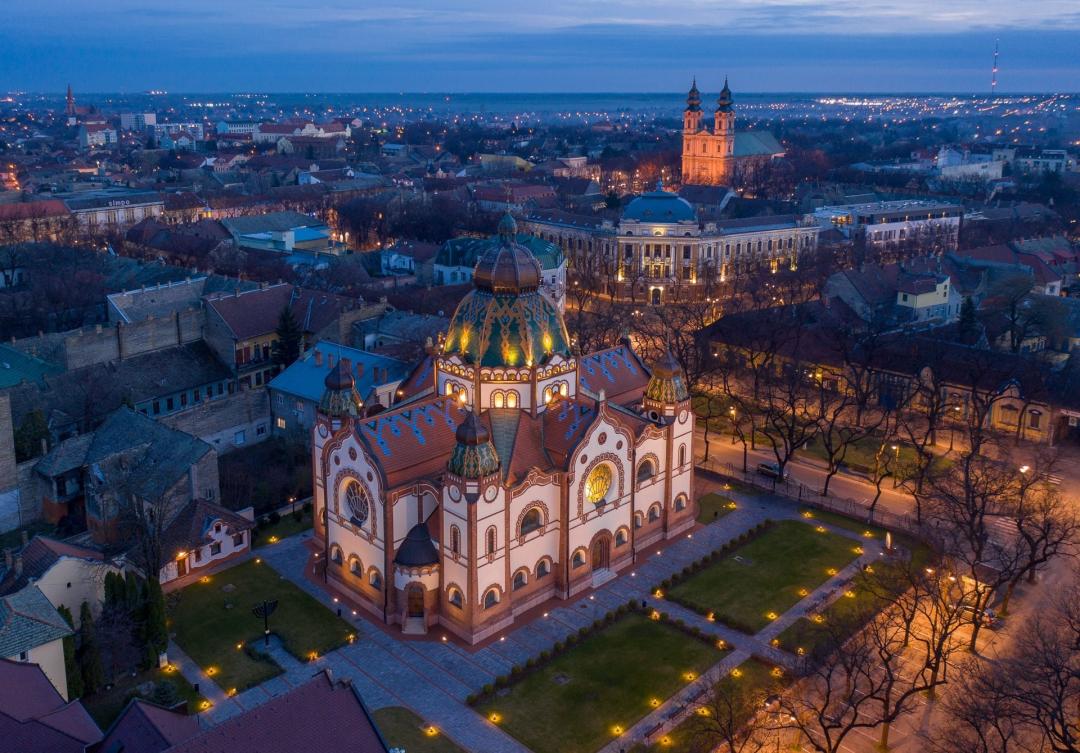
Synagogue Subotica, Serbia

Trg Jakaba i Komora 6, Subotica 24000, Serbia

The Subotica Synagogue, designed in the late 1890s and built in 1902, is one of the most impressive examples of Art Nouveau religious architecture in the region. The original synagogue design was submitted by Marcel Komor and Dezső Jakab as a competition entry for construction in Szeged, Hungary. After the project took second place, it was adapted and built in the neighboring city of Subotica. Eight steel columns support the central dome of the synagogue, the building's dominant architectural feature. The interior dome is made of lightweight concrete and constructed using an unusual and technologically advanced shell construction technique. The building's roof is covered with exquisite glazed Zsolnay tiles. Largely due to economic difficulties and regional conflicts, the building suffered damage and neglect for many years, although restoration work began in the 1980s and continued for nearly forty years.

Knesset Eliyahu, Mumbai, India

52, Forbes St, Kala Ghoda, Fort, Mumbai, Maharashtra 400001, India

An Orthodox Jewish synagogue located in the center of Mumbai, India. It is the second oldest Sephardic synagogue in the city. It was founded in 1884 by Jacob Elias Sassoon, son of Eliyahu David Sassoon and grandson of David Sassoon; the latter immigrated from Baghdad to India in 1832 due to persecution and settled in Mumbai, then known as Bombay. It is maintained by the Jacob Sassoon Foundation. The significance of the building is explained by its Jewish traditions, as well as Indian and English colonial influences. It was designed by the British architectural firm Gostling & Morris from Bombay. The plinth of the building is constructed of stone masonry, while the superstructure is made of brick masonry. The exterior facade of the synagogue is painted turquoise. The sanctuary inside the building faces west, towards Jerusalem.

Abuav (Abuhav) Synagogue, Safed, Israel

Simtat Abuhav 7, Safed, Israel

Safed is one of the four holy cities of Judaism. It is located in the Galilee and for a long time was the center of all religious life of the Jews. The "Abuav" synagogue is located in the Jewish quarter of the historic center of Safed. It is one of the oldest shrines of the city's Sephardic community.

Jubilee Synagogue (Jubilejní synagoga) or Jerusalem Synagogue, Prague, Czech Republic

Jeruzalémská 1310/7, Nové Město, 110 00 Prague-Prague 1, Czechia

The Jubilee Synagogue (Jubilejní synagoga), also known as the Jerusalem Synagogue (Jeruzalémská synagoga) due to its location on Jerusalem Street, is a synagogue in Prague, Czech Republic. It was built in 1906, designed by Wilhelm Stiassny, and named in honor of the silver jubilee of Emperor Franz Joseph I.

Sofia Synagogue, Sofia, Bulgaria

Sofia Center, 16 Exarch Yosif Street, 1000 Sofia, Bulgaria

The Sofia Synagogue (in Bulgarian: Софийска синагога, Sofiyska sinagoga) is the largest synagogue in Southeastern Europe, one of two active synagogues in Bulgaria (the second is located in Plovdiv), and the third largest in Europe. The building of the Central Sofia Synagogue is rightfully considered the pride of the Bulgarian Jewish community. It is one of the three largest Sephardic (Spanish-Jewish) synagogues in Europe and the largest on the Balkan Peninsula.

New Synagogue of Szeged (Szegedi zsinagóga), Hungary

Szeged, Jósika St. 10, 6722 Hungary

The Szeged Synagogue (Hungarian: Szegedi zsinagóga) is a synagogue in Szeged, Hungary. This building, completed in 1902, was designed by the Hungarian Jewish architect Lipót Baumhorn (1860–1932), whose works are considered the finest examples of the unique Hungarian combination of Art Nouveau and late 19th-century historicism styles, sometimes called the Magyar style. Construction was completed in October 1902, providing the growing Jewish population of Szeged, numbering over 6,000 people, with a spacious and extravagant house of worship. Baumhorn combined elements of several different architectural styles in the synagogue — Arabic, Moorish, and Mediterranean — yet managed to create a harmonious overall structure. This eclectic mix is today referred to as the Secession style.

Westend Synagogue in Frankfurt am Main, Germany

Freiherr-vom-Stein-Straße 30, 60323 Frankfurt am Main, Germany

The Westend Synagogue in Frankfurt am Main was opened in 1910, the only one of the four main synagogues of Frankfurt to survive after World War II.