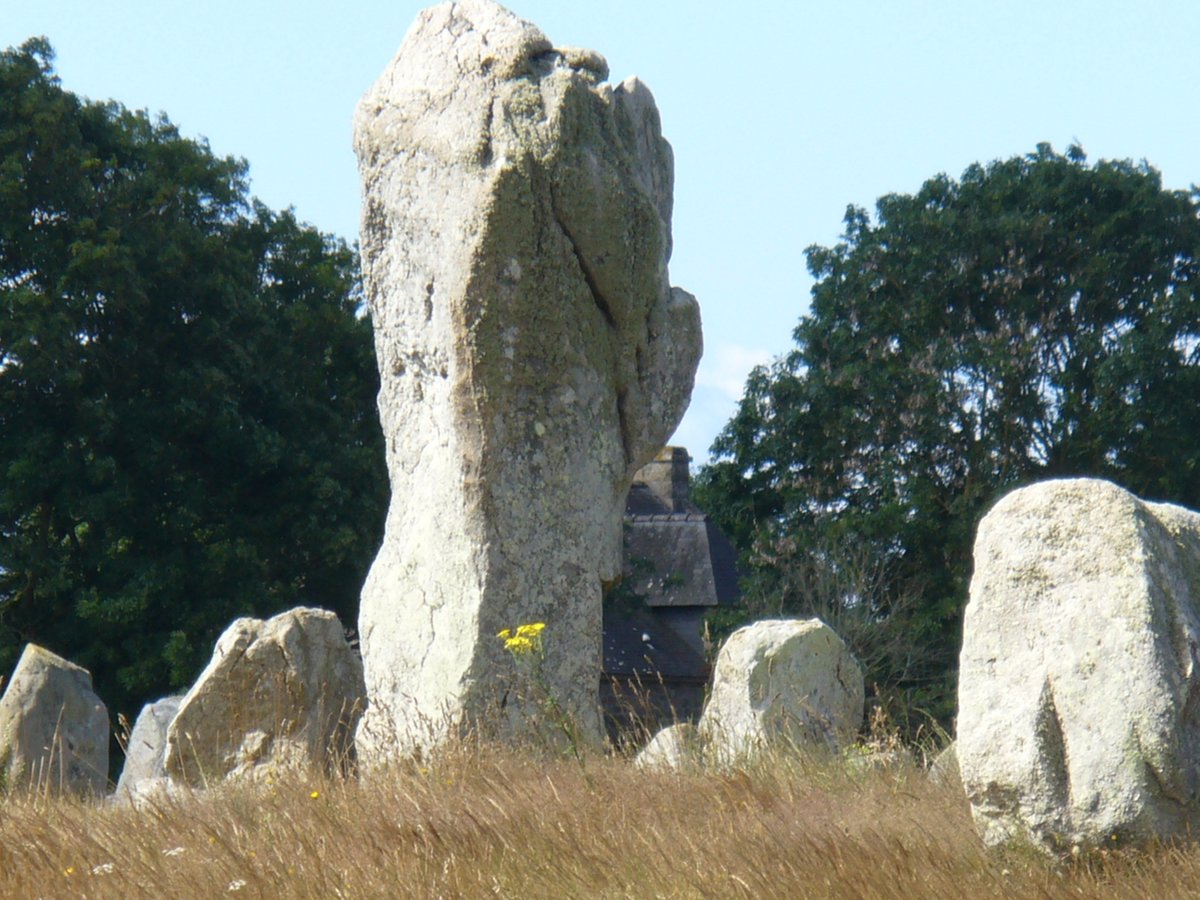

Alignement du Ménec is a megalithic site located in Carnac, within the Morbihan region of France. The site stretches for 950 metres with a general orientation from southwest to northeast. It consists of approximately 1,050 menhirs distributed in 11 rows that are nearly equidistant over a width of 100 metres on the western side. The construction of the modern village of Ménec and the RD196 road are likely the reasons for the disappearance of a number of the original stones.
At the western end of the site sits an oval enclosure measuring 90 metres by 70 metres, delimited by 71 menhirs. This structure is almost entirely integrated into the modern village of Ménec, making its architecture difficult to perceive. As the alignment continues east, the rows bend sharply toward the north. In this section, the organization of the rows degrades, and the two southernmost rows cross one another. Further along, the blocks become very sparse near the hamlet of la Croix Audran.
A notable feature of the site is a menhir known as the Géant du Ménec. It is distinctly slender and tall in contrast with the much more squat blocks surrounding it. It may correspond to a megalithic arrangement that was older and subsequently integrated into the larger alignment. Beyond the RD119, the alignment resumes for about a hundred metres, featuring nine clearly identifiable rows that end in a transverse row of very tight blocks.
The site is listed as a monument historique and shows similarities to the Kerlescan alignment, such as a slightly elevated western enclosure and blocks arranged in decreasing order of size toward the east. However, the Ménec site also features an eastern enclosure and several notable discrepancies in the rows, including the points where the lines converge and the presence of the Géant du Ménec.
Sources: Wikipedia, OpenStreetMap, Wikidata, Wikimedia Commons

Written by Nicolo Ciampini
Discuss this with the author and others
No comments yet. Be the first to start the conversation.