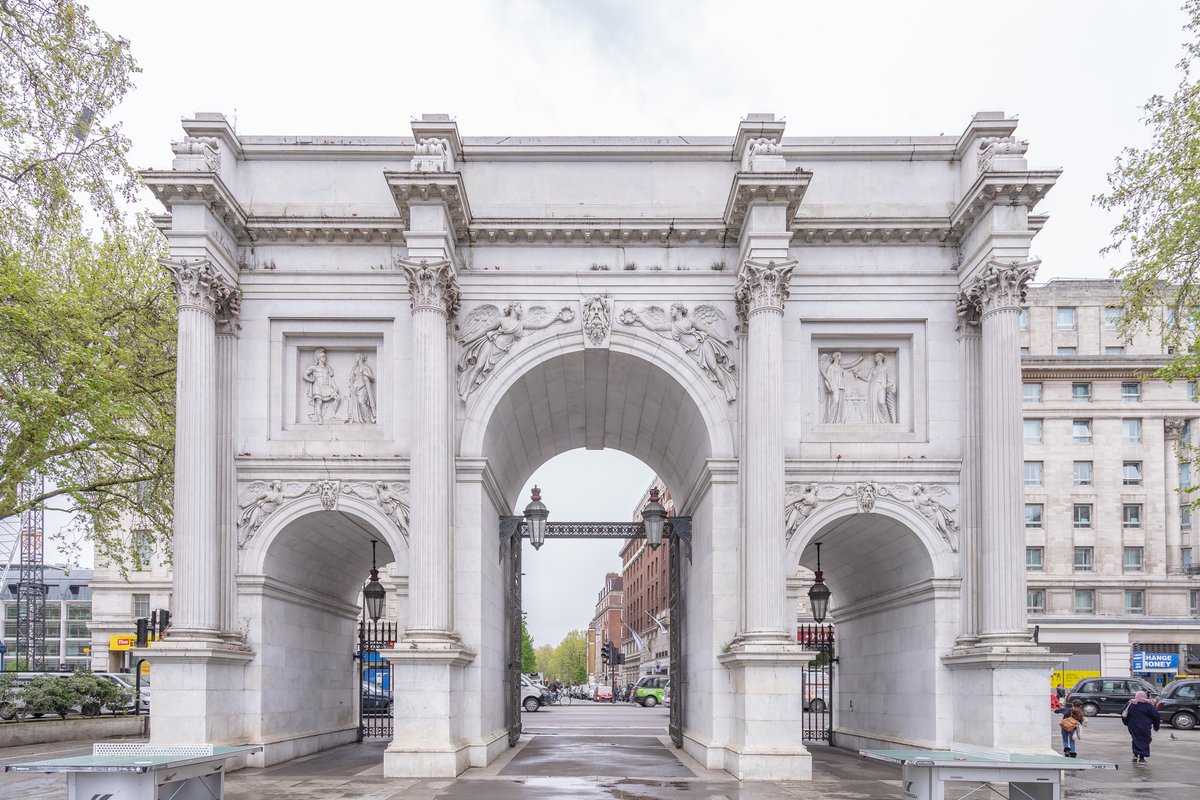

A product of the 19th century, the Marble Arch was initially conceived by John Nash in 1827 as the state entrance to the cour d'honneur of Buckingham Palace. In 1851, on the initiative of architect and urban planner Decimus Burton, a former pupil of John Nash, the arch was relocated to its current site near the northeast corner of Hyde Park. This move occurred as Queen Victoria sought to expand the palace, which required enclosing the cour d'honneur with a new east range.
The move left a lasting impression on the surrounding area, with an underground station and an area nearby sharing the arch's name. The arch is no longer part of the Royal Parks and is maintained by Westminster City Council. Its design is based on the Arch of Constantine in Rome and the Arc de Triomphe du Carrousel in Paris, and it is faced with Carrara marble with embellishments of marble extracted from quarries near Seravezza in Tuscany.
The statue of George IV, which was omitted from the arch's planned attic stage during work under Edward Blore, was installed on one of the pedestals in Trafalgar Square in 1843.
Sources: Wikipedia, OpenStreetMap, Wikidata, Wikimedia Commons



Written by Nicolo Ciampini
Discuss this with the author and others
No comments yet. Be the first to start the conversation.