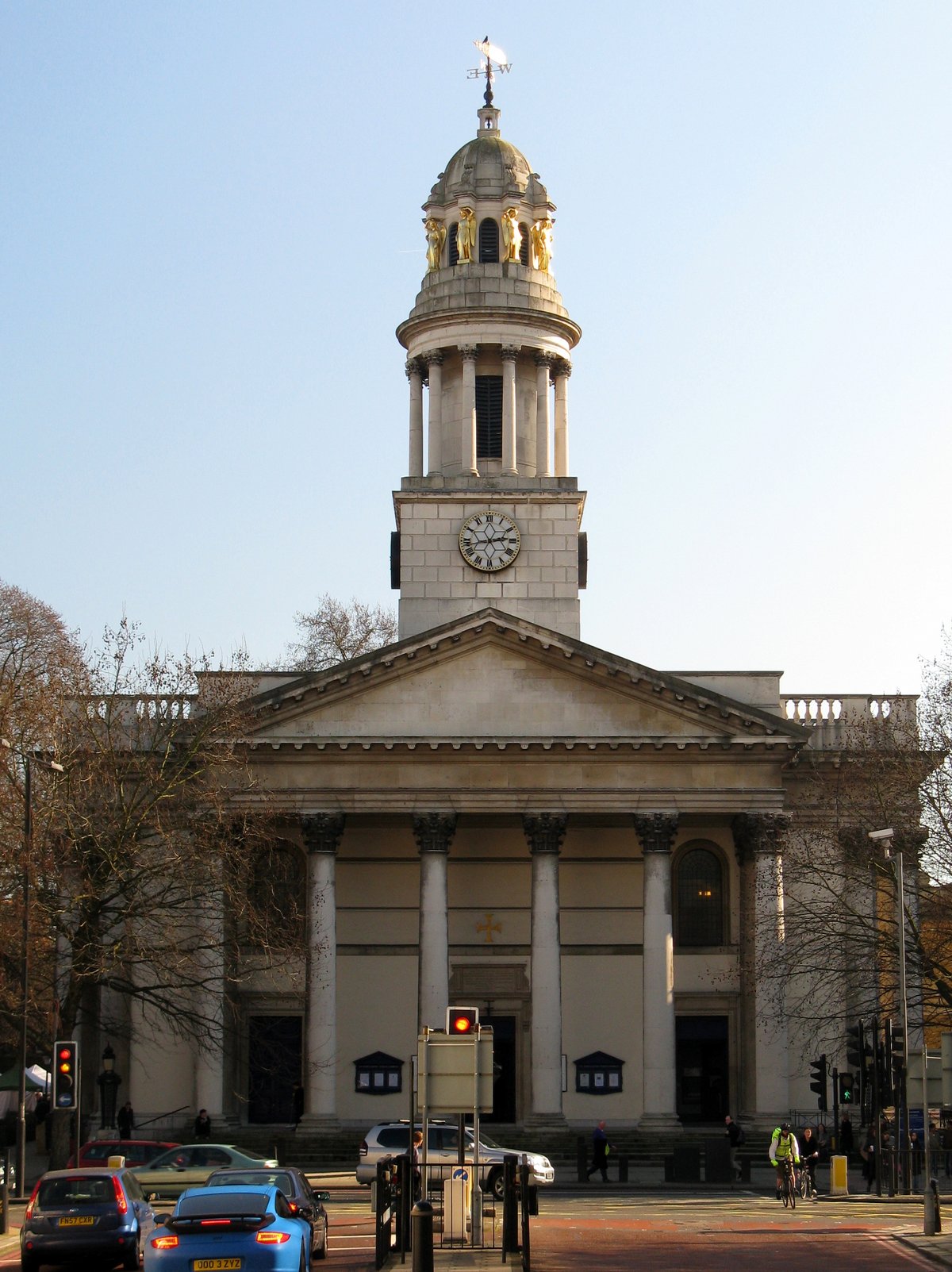

St Marylebone Parish Church is an Anglican church on the Marylebone Road in London. The first church for the parish was built in the vicinity of the present Marble Arch c. 1200 and dedicated to St John the Evangelist. In 1400, the Bishop of London gave permission to demolish that church and build a new one dedicated to the Virgin Mary near the north end of Marylebone High Street. This second church, which was portrayed by William Hogarth in "A Rake's Progress", was eventually demolished in 1740 after falling into a state of decay.
A smaller church was built on that same site in 1742, serving as a chapel-of-ease until it was demolished in 1949. The current church was built to the designs of Thomas Hardwick and was completed in 1817. It was constructed on a site secured in 1810-11 with a foundation stone laid on 5 July 1813. The building features a Corinthian portico with eight columns based on the Pantheon in Rome and was completed at an overall cost of £80,000.
The church has been home to many notable figures. Admiral Horatio Nelson was a worshipper here and his daughter Horatia was baptised here. Charles Wesley, the leader of the Methodist movement, lived and worked in the area and was buried in the churchyard. One of his sons, Samuel Wesley, later served as the organist of the present church. Today, St Marylebone School, a Church of England school for girls, is located behind the church.
Sources: Wikipedia, OpenStreetMap, Wikidata, Wikimedia Commons





Written by Nicolo Ciampini
Discuss this with the author and others
No comments yet. Be the first to start the conversation.