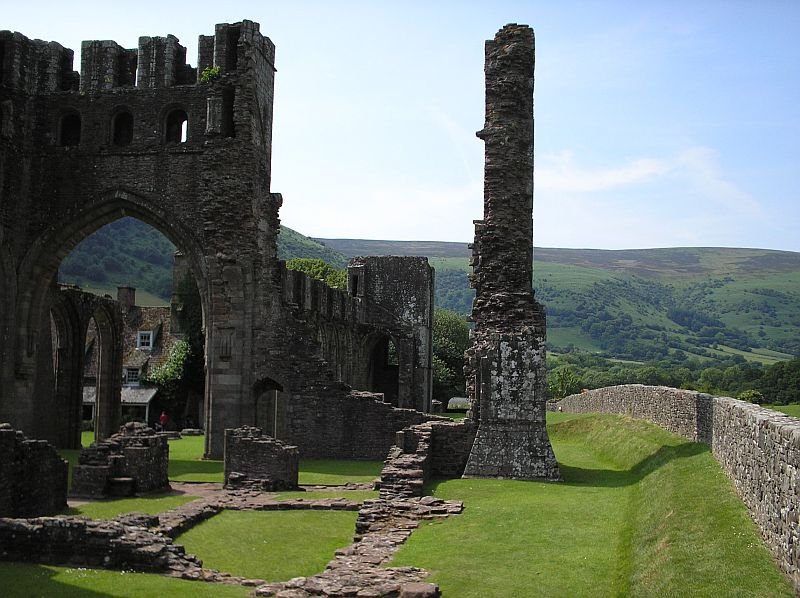
Nestled in the secluded Vale of Ewyas within the Black Mountains of Wales, the remnants of Llanthony Priory stand as an enduring testament to the unbroken spirit of quiet contemplation and faith. Founded in 1100, this remote and serene location saw its first inhabitant, William, a knight inspired to devote himself to solitary prayer and study. Around seven years later, William was joined by Ersinius, a former chaplain to Queen Matilda. The pair began building a church on the site, dedicated to St John the Baptist, which was consecrated in 1108; by 1118, a group of around 40 canons had founded there a priory of Canons Regular.
In 1135, the monks were forced to retreat to Gloucester due to persistent attacks from local Welsh inhabitants, only to return a few decades later, in 1186, when another member of the de Lacy family, Hugh, the fifth baron, endowed the estate with funds from his Irish estates. This funding enabled the rebuilding of the priory church, completed by 1217. The priory continued to grow and showcased a combination of Norman and Gothic architectural features.
Further construction took place around 1325, resulting in a new gatehouse. On April 4, 1327, Edward II traveled to the Priory on his route from Kenilworth Castle to Berkeley Castle, where he is believed to have been later imprisoned and eventually killed. Today, Llanthony Priory stands as a Grade I listed building, under the care of Cadw, welcoming all who tread upon its ancient stones to bear witness to the stories of faith and perseverance that have endured for nearly a millennium.
Sources: Wikipedia, OpenStreetMap, Wikidata, Wikimedia Commons
Written by Nicolo Ciampini
Discuss this with the author and others
No comments yet. Be the first to start the conversation.