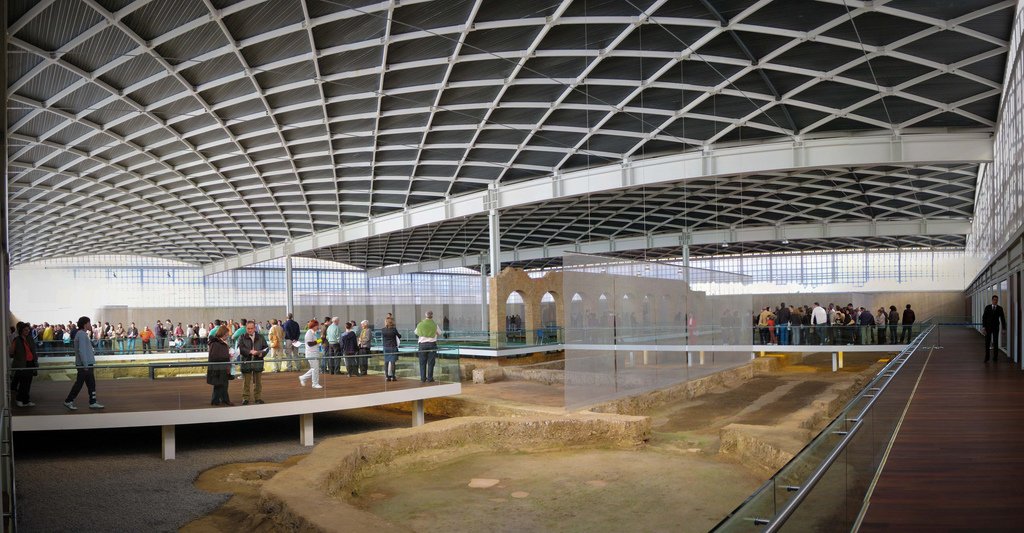

Nestled within Spain’s captivating Palencia province, the illustrious La Olmeda Roman Villa, boasting its height in the 4th AD century, presents a mesmerizing narrative of the Roman elite’s opulent way of life. The villa, marked by its expansive main residence, offers a series of remarkably designed rooms, all crafted for leisure and social engagements. Some standout quarters are:[1]
[1] The resplendent Oecus (Room V-14), stretching over 175 sqm, served as the central locus for social gatherings and demonstrative displays of high status. Featuring fascinating underfloor heating (hypocaust) and intricate mosaic flooring, this space bore an array of mythological scenes, such as Achilles in Skyros. In close proximity, rooms of more intimate nature, like a bedroom and dining area (V-13), catered to familial needs. Accessible via the central peristyle courtyard, these rooms provided effortless accessibility and ventilation. In the western wing, the grand Triclinium (V-32), a dining hall skillfully adapted during the Roman era, accommodated formal banquets, with reclining couches highlighting the villa’s penchant for hosting prestigious gatherings.[2]
[2] The bath complex (Balneum or Thermae), appendaged to the western side of the Pars Urbana, mirrored the Roman bathing sequence, with essential spaces such as the Caldarium (hot room), Tepidarium (warm room), equipped with hypocaust heating systems, a Praefurnium furnace for fuel, and a Frigidarium (cold room) featuring a trefoil-shaped immersion pool and internal steps for soothing cool-downs. The supporting areas encompassed an Apodyterium (dressing room) with benches and rounded corners, small massage chambers, and a Latrina (toilet) with an efficient waste drainage system. Various rooms, including northeastern and northwestern apsed rooms within and adjacent to the baths, possibly served private or ceremonial purposes.
Sources: Wikipedia, OpenStreetMap, Wikidata, Wikimedia Commons
Written by Nik Frost
Discuss this with the author and others
No comments yet. Be the first to start the conversation.