

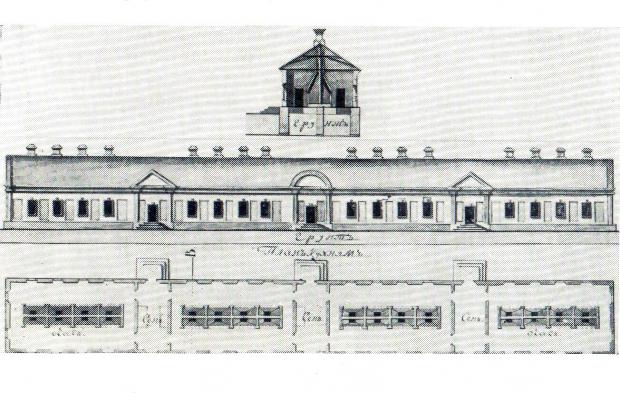
Built on the site of an 18th-century wooden kitchen. Due to frequent fires and floods, very few buildings from the Petrine era have survived to this day. In the first quarter of the 19th century, stone replaced wooden port buildings. The first was the Dutch Kitchen building. It took a place east of its wooden predecessor on the southern shore of the Italian Pond. This is a one-story unplastered building made of red brick, consisting of three identical sections.
The architecture of the building combines elements of the fading Baroque (red brick unplastered walls, window surrounds) and emerging Classicism (rusticated semicircular arches, pediments).
The Dutch Kitchen prepared food for the crews of ships anchored in Kronstadt harbor. Cooking on board was prohibited to prevent fires, as careless handling of fire on a ship or on the shore could lead to a blaze. Therefore, the kitchen was located in such an inconvenient place—to hinder the spread of fire to the city and ships.
The kitchen building was divided lengthwise by hearths into two halves, each with four hearth compartments. A hearth was a brick vault about human height, similar to an arch, with an exhaust pipe. There was a small raised platform by the wall where an iron tripod stood, designed to hold two boilers with a capacity of up to 10 buckets. Boilers and firewood had to be brought by the users. Along the walls near the windows were bunks of questionable cleanliness for cleaning provisions. The floor was paved with large uneven cobblestones. Another inconvenience was the lack of water, which was often taken directly from the harbor. Starting in 1828, a special port fee was charged for cooking in this kitchen, benefiting the city. Initially, it was 3 kopecks, and from the 1870s it rose to 9 kopecks per last (last—a measure of ship capacity equal to two tons).
The number of arriving ships grew. Sailing ships gave way to larger steamships. Although cooking on steamships was allowed, they were still required to pay the kitchen fee. The city’s income grew year by year. By the time the Sea Canal connecting Saint Petersburg to the sea opened, the kitchen brought Kronstadt a quarter of all its income. The kitchen building housed several departments: for English, German, Norwegian, Swedish, and other cooks. There was also a department for Russians, but although they paid the fee, they did not use the kitchen, preferring to cook onshore in taverns. This happened because on “fasting days” Russian cooks prepared food with fasting oil, which produced a terrible smoke. Foreign cooks would rudely grab the food and dump it into the water. This led to quarrels and fights. There were more foreigners, and they always won. Then hundreds of boatmen started going several times a day to one of the taverns at the corner of Gospodskaya and Saidashnaya streets, carrying oars, pots, and “trinkets.” This disturbed the townspeople, as the embankment of the Italian Pond and Petrovsky Park were difficult to pass, especially on dark evenings. On this matter, a special order was issued by the city administration on September 27, 1873, prohibiting boatmen from walking around the city with oars.
In 1828, a port fee for using the kitchen was introduced depending on the ship’s capacity—3 kopecks per last, increased to 9 kopecks in the 1870s.

In 1885, the Sea Canal was opened, and most ships began going to Saint Petersburg. Only coal ships continued to unload in Kronstadt. As a result, the building ceased to be used for its original purpose, and homeless people began to spend nights there, while the police organized raids ending in expulsions. There were projects to repurpose the building, but none progressed beyond the planning stage. The last project dates to 1912: it proposed replacing the long-vacant building with a power station (project by S. N. Petrov). In the end, only the eastern wing was remodeled, housing four generators that operated until 1927, when they were replaced by a single 400-horsepower generator. It worked until the beginning of the war.
With the start of the war, the building was again handed over to sailors. Since then and up to now, it has been used as a warehouse.
Sources:
https://www.citywalls.ru/house19742.html
https://ru.wikipedia.org/wiki/Голландская_кухня


Written by Jermaine
Discuss this with the author and others
No comments yet. Be the first to start the conversation.