Peter and Paul Fortress, Saint Petersburg, Russia, 191186
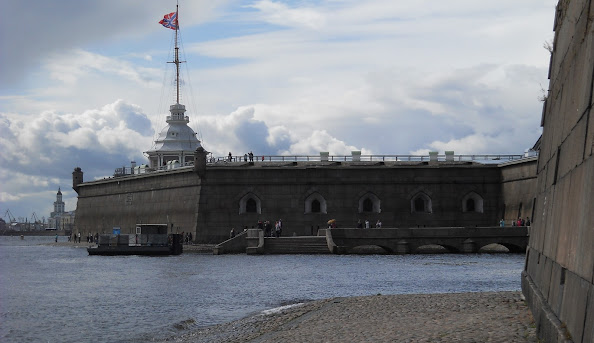
The Naryshkin Bastion is located exactly in the center of the southern wall of the Peter and Paul Fortress and faces directly onto the Neva River. This pentagonal defensive structure, with two front walls—facades—and two side walls—flanks, was designed to provide frontal and flanking fire. It is easily recognizable by its distinctive flagpole tower.
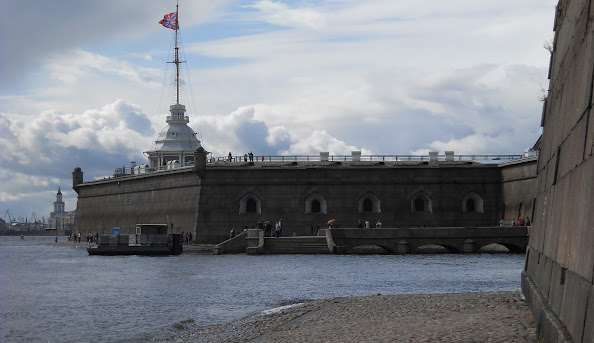
It is named after K. A. Naryshkin, a close associate of Peter I who supervised its construction. Incidentally, he was one of the judges who signed the sentence against Tsarevich Alexei. This happened in 1718, and by that time the Naryshkin Bastion was still under construction. It was actually the last to be built in stone. However, from the Winter Palace, it turned out to be the most prominent—and therefore the main bastion. That is why the flagpole tower was built on the Naryshkin Bastion, which at that time was called the Catherine Bastion after Catherine I, between 1731 and 1733 according to the design by military engineer B. Kh. Minikh. The imperial cypher was attached to the flagpole, and the fortress’s everyday flag—the guidon—was raised, while on festive days and during the emperor’s visits to the fortress, the royal standard was hoisted. Flags and the keys to the fortress gates were kept in the tower. The tradition of raising the fortress flag, lost after the revolution, was revived in 2000. The bastion was built in stone between 1725 and 1728 according to the design of architect and fortification engineer D. Trezzini and military engineer B.-Kh. Minikh, replacing the earlier wooden-earth fortification. The Neva-facing facade of the bastion was clad with granite slabs in 1779–1780 according to the design of engineer R. R. Tomilov. The facades and flanks contained two-tier casemates. In the second half of the 19th century, these were rebuilt into single-tier casemates. A sally port—a passage beyond the fortress walls—was arranged in the right flank to provide communication with the Neva shore.
During the reign of Anna Ioannovna, the bastion was renamed once again to the Bastion of Saint Catherine. It became known as the Naryshkin Bastion again only after the revolution.
From the 18th century to the mid-19th century, the casemates were adapted for production and storage for the Mint. In early 1826, ten solitary cells were equipped in the left flank where the Decembrists were held during their investigation. At the end of the 19th and the beginning of the 20th centuries, the casemates were converted into barracks for the Izhora Reserve and Sapper Battalions, the Rifle Regiment, and the fortress artillery company. On October 25, 1917, a signal was given from the Naryshkin Bastion to the cruiser Aurora to start the armed uprising. In 1957, the tradition of the daily blank noon shot from the Naryshkin Bastion, which dates back to the 18th century, was revived.
Currently, the bastion is under the jurisdiction of the State Museum of the History of St. Petersburg.
Sources:
https://izi.travel/ru/f48b-naryshkin-bastion/ru

