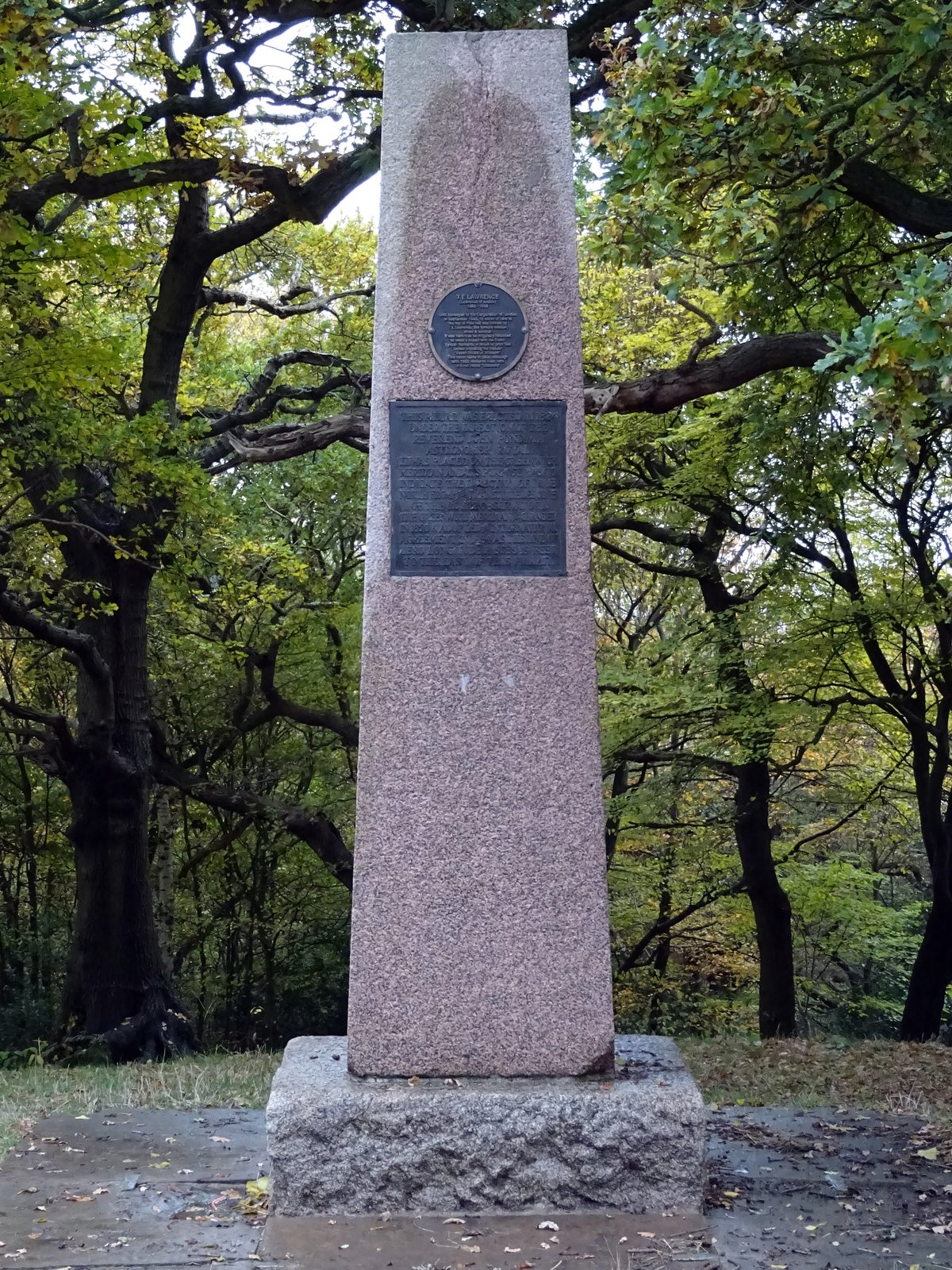
Pole Hill is steeped in history and astronomy, standing on the Greenwich Meridian, 0 degrees longitude, and 51 degrees 38 minutes north latitude. The hill, situated at the border of Greater London and Essex, was known as 'Pouls Fee' or 'Pauls Fee' in 1498, deriving from the Old English 'hawk', meaning 'wood at the corner of the parish'. Pole Hill is a part of the manor of Chingford Pauli, belonging to St Paul's Cathedral in London.
The obelisk on the summit of Pole Hill was erected in 1824 under the direction of John Pond, Astronomer Royal. The obelisk was placed on the Greenwich Meridian to indicate the direction of true north from the transit telescope of the Royal Observatory. In 1850, the Greenwich Meridian was changed, and by international agreement in 1884, it was adopted as the line of zero longitude. The obelisk is now a significant historical landmark, although it lies 19 feet (5.8 meters) to the east of the Greenwich Meridian. An Ordnance Survey trig point marks the top of the hill at this spot.
T. E. Lawrence, also known as Lawrence of Arabia, once owned a considerable amount of land on the western side of Pole Hill. He first rented the land, then began buying it in small parcels after the war. He had plans to set up a private press to print fine-edition books with his friend from Oxford, Vyvyan Richards, inspired by the medievalist ideals of William Morris. Lawrence was planned to design the medieval-style timber hall. He lived in a small hut on the hill for several years before it was dismantled in 1930 and rebuilt in The Warren, Loughton.
Sources: Wikipedia, OpenStreetMap, Wikidata, Wikimedia Commons
Written by Nicolo Ciampini
Discuss this with the author and others
No comments yet. Be the first to start the conversation.