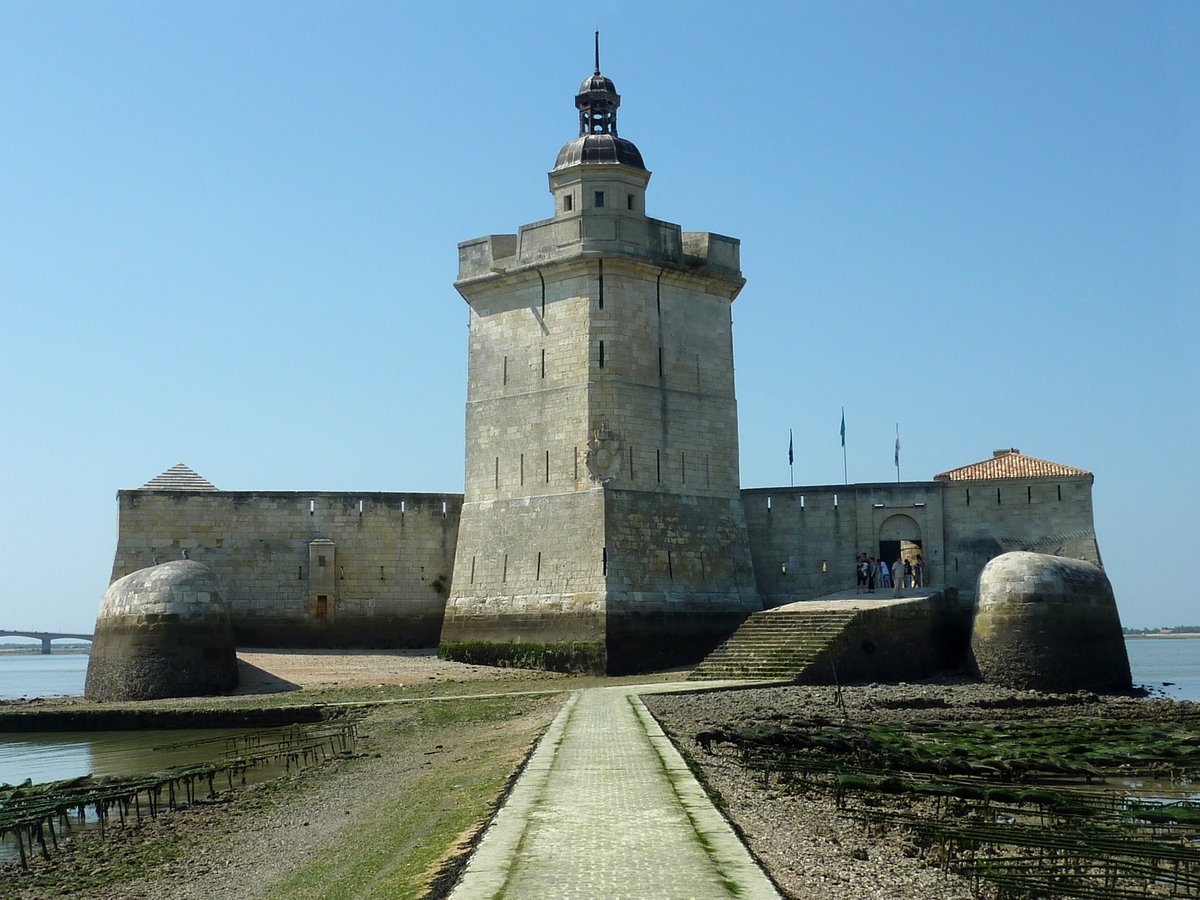

Fort Louvois, known locally as Fort Chapus, is located in Bourcefranc-le-Chapus, department of Charente-Maritime, France. It was built between 1691 and 1694 during the reign of Louis XIV. The fort sits opposite the citadel of Château d’Oléron on the island of Oléron. Its construction was extremely difficult due to the islet being made of shellfish and mud.
Engineer François Ferry initially took charge of the process, designing an oval fort measuring 52 metres by 78 metres. After the completion of the arsenal at Rochefort in 1666, Louis XIV wanted to create a chain of fortifications on the coast of Aunis and Saintonge, and Fort Louvois was the last fort commissioned under his reign. Work on the foundations began on 19 June 1691.
Following the death of the Marquis of Louvois on 16 July 1691, the military architect Vauban took over the project. He modified the original design to create a simpler and cheaper fort, giving it its present-day horseshoe shape and reducing the batteries to one level. Since 1972, the fort has been the site of a museum of oyster farming.
Sources: Wikipedia, OpenStreetMap, Wikidata, Wikimedia Commons
Written by Nicolo Ciampini
Discuss this with the author and others
No comments yet. Be the first to start the conversation.