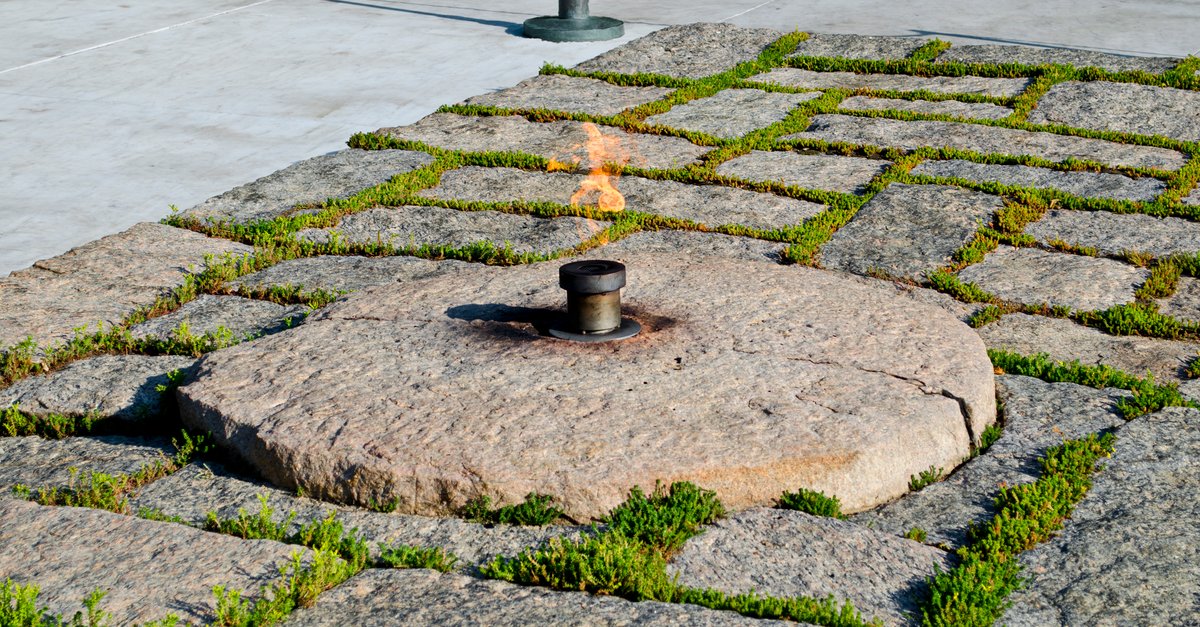
John F. Kennedy was assassinated on November 22, 1963, in Dallas, Texas. Three days later, his state funeral was held. Dignitaries from 92 countries attended the service. On the day of the funeral, Kennedy's body was placed in the ground. A mound of evergreens was placed around the base of the flame to cover the tubing and torch mechanism. Jacqueline Kennedy lit a taper from a candle held by a nearby soldier, and then brought the eternal flame to life at the end of the burial service.
Jacqueline Kennedy agreed to the suggestion made by Secretary of Defense Robert McNamara to bury Kennedy at Arlington National Cemetery. Although Kennedy's sisters and many of his longtime associates from Massachusetts were opposed to burial at Arlington, his brother, Attorney General Robert F. Kennedy visited the site with McNamara and concluded that Jacqueline Kennedy's wishes should be honored.
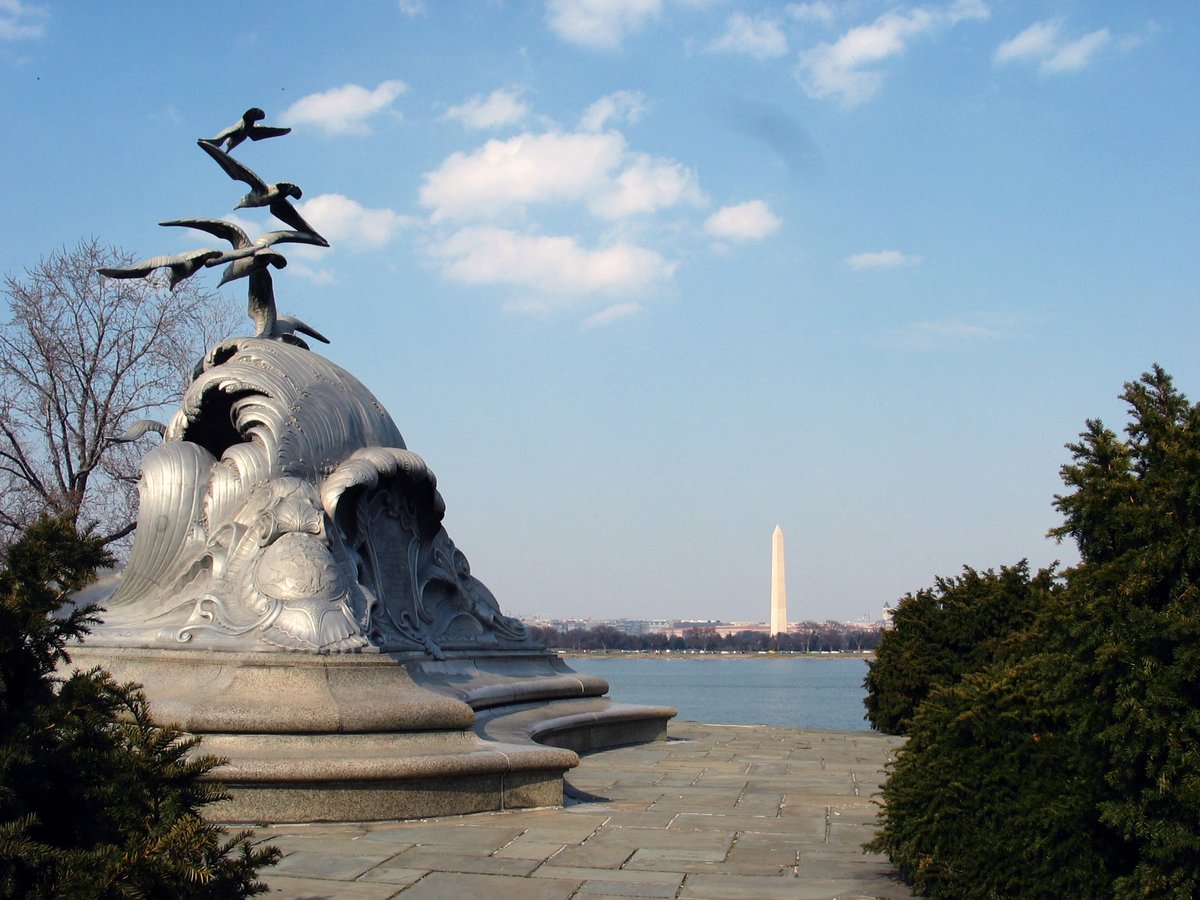
The grave was set in a plot of grass roughly 5 yards on each side, about halfway up the hill on which Arlington House stands. The grave was placed so that it had a view of the Lincoln Memorial and Washington Monument, and was aligned with them. Kennedy's brothers, Robert and Ted, symbolically lit the flame after Jacqueline.
On the evening of November 26, the site was surrounded by a white picket fence. After the fence was erected, flowers continued to be placed inside the enclosure. A canvas-covered circular wooden walkway was built from Sheridan Drive to the grave site to give members of the public access.
John Carl Warnecke, a friend of the Kennedys, visited the grave with Jacqueline Kennedy and Robert F. Kennedy on November 28 to discuss themes and plans for a permanent memorial. The following day, Warnecke was chosen by now former-first lady to design Kennedy's tomb. Warnecke immediately concluded that the permanent grave must be simple and incorporate the eternal flame. The grave design process was placed under tight secrecy.
The U.S. government formally set aside a 3-acre site surrounding Kennedy's grave on December 5, 1963. An extensive research project was conducted in which hundreds of famous tombs were documented and images of them collected. Warnecke discussed design concepts with more than 40 experts, including the sculptor Isamu Noguchi. In the course of the research and conceptualization effort, Warnecke considered the appropriateness of structures or memorials at the site, the history of Arlington National Cemetery, the vista, and how to handle ceremonies at the site. By August 1964, Warnecke and his assistants had written a 76-page research report which concluded that the grave site was not a memorial nor monument, but a grave.
The Army Corps of Engineers was studying the installation of a permanent flame just a week after Kennedy's burial. On December 3, 1963, the Army concluded that the Kennedy plot was not part of the official burial section of Arlington National Cemetery, and agreed to continue to allow an eternal flame. Warnecke sent a memorandum to Jacqueline Kennedy on April 6, 1964, outlining his desire to retain the eternal flame as the centerpiece of the burial site and to keep the site's design as simple as possible.
Sources: Wikipedia, OpenStreetMap, Wikidata, Wikimedia Commons
Written by Friendly Jane
Discuss this with the author and others
No comments yet. Be the first to start the conversation.