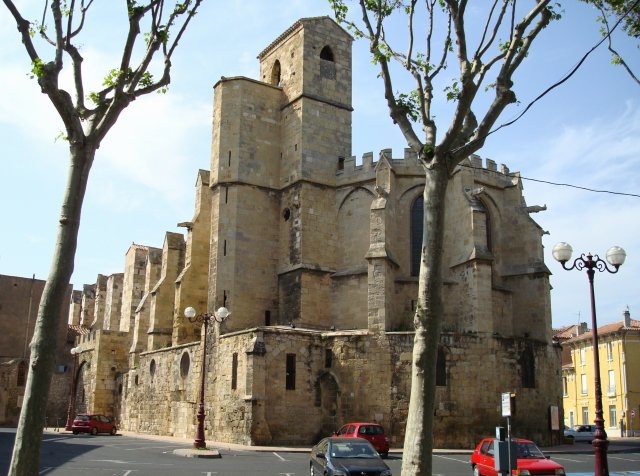

Tucked away in the heart of Narbonne, the Notre-Dame de Lamourguier is a former priory whose church remains today. Its history dates back to the 11th century, when it was affiliated as a regular priory of the order of Saint-Benoît to the abbey of Saint-Victor de Marseille, taking on the name Beata Maria de la Morguia. In 1662, it was pushed to join the congregation of Saint-Maur, which restored the site.
Following the Revolution, the buildings were placed under military administration. From 1824 to 1889, they served as a barracks, though the church itself housed army stores and began housing an archaeological lapidary collection in 1869. The building is covered by a simple framework supported by six masonry diaphragm arches. It was officially classified as a historical monument in 1900.
Beyond its religious duties, the church served as the headquarters for the Club de la Révolution between March 24 and March 31, 1871, during the central Commune of the arrondissement of Narbonne. For over a century, it served intermittently as a lapidary museum, housing more than 1,700 archaeological artifacts. Between 2017 and 2018, these collections were transferred to the future regional museum of ancient Narbonne, Narbo Via.
Sources: Wikipedia, OpenStreetMap, Wikidata, Wikimedia Commons
Written by Nicolo Ciampini
Discuss this with the author and others
No comments yet. Be the first to start the conversation.