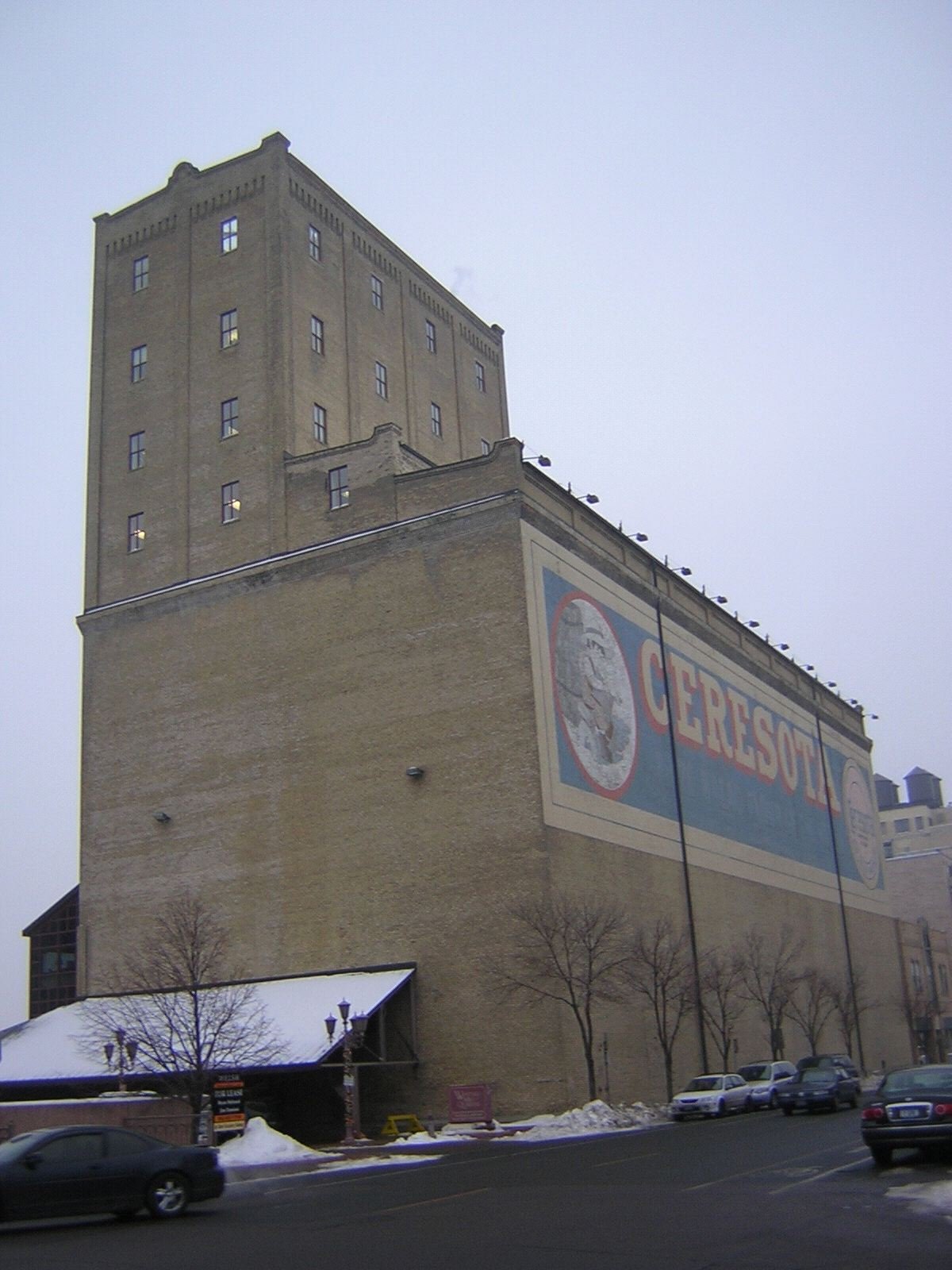
Built in 1908 in Minneapolis, Minnesota, the Northwestern Consolidated Milling Company Elevator A, also known as the Ceresota Elevator or "The Million Bushel Elevator," served as a receiving and public grain elevator. It was a notable structure of brick construction that ran on electricity and provided the source for the Crown Roller Mill and Standard Mill. While the mills eventually closed in the 1940s and 1950s, the elevator continued to store grain until the mid-1980s.
The elevator featured 57 bins, nearly all square and 93 feet high. Grain arrived in railroad box cars at a train shed on the north side, where it was dropped into a pit and moved by bucket elevators to a head house. From there, it was weighed, cleaned, and moved to bins or sent to the nearby mills. During its peak operation, it functioned as a vital component of the city's industrial infrastructure, eventually becoming a contributing property of the St. Anthony Falls Historic District listed in 1971.
In 1987, the Ceresota elevator was converted into 92,081 square feet of office space. During this renovation, the car shed and bridge conveyors were removed, and floors were added without destroying the building walls. The south wall was left intact to preserve the iconic Ceresota sign, though this left the interior with limited daylight, which was addressed by adding an atrium with skylights. By about 2015, the building was converted into Millers Landing Senior Living.
While the elevator was being preserved, the surrounding area underwent significant redevelopment. Nearby, the Standard Mill was converted in 1987 to the luxury Whitney Hotel, which closed in 2003 to become the Whitney Lofts in 2007. The Crown Roller Mill was converted into office space after being repaired following a 1983 fire. These projects ensured that the industrial heritage of the district remained a central part of the neighborhood's evolution.
Sources: Wikipedia, OpenStreetMap, Wikidata, Wikimedia Commons


Written by No Other
Discuss this with the author and others
No comments yet. Be the first to start the conversation.