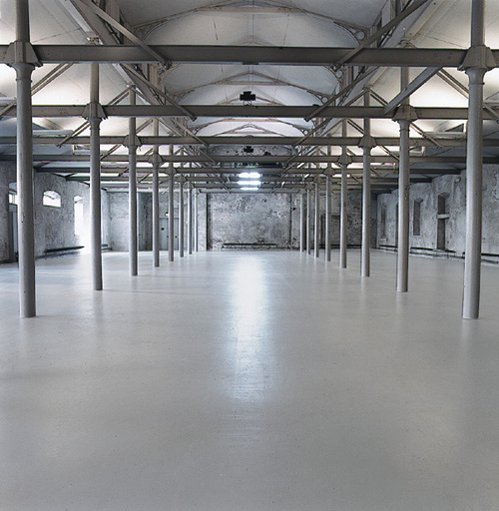

Built in 1889, the structure was originally commissioned by the inventor and industrialist Helge Palmcrantz to house his civil production, including harvest machines, seed machines and the Sveacykeln bicycle. The building also housed early product development of the Ljungströmturbin.
By 1902, the paint company Wilhelm Becker took over the house, which became Beckers paint factory. Manufacturing continued in the house until the 1970s, after which parts of the house were used as a warehouse.
In the mid-1990s, a comprehensive renovation was carried out and in 1995 Färgfabriken opened its doors for its first exhibition. Since then, the art hall has focused on contemporary art, architecture, social issues, and urban development. It has hosted a long series of contemporary Swedish and international artists, including David Byrne and Nathalie Djurberg. The foundation also produces an annual separate exhibition with the recipient of the Beckers art scholarship, a scholarship awarded by Lindéngruppen AB to a young and promising artist.
Today, the building is owned by Lindéngruppen AB. The art hall participates in a number of multidisciplinary projects on a national and international level, involving researchers, community developers and artists in areas such as sustainable urban planning and environmental humanities.
Sources: Wikipedia, OpenStreetMap, Wikidata, Wikimedia Commons


Written by Nik Frost
Discuss this with the author and others
No comments yet. Be the first to start the conversation.