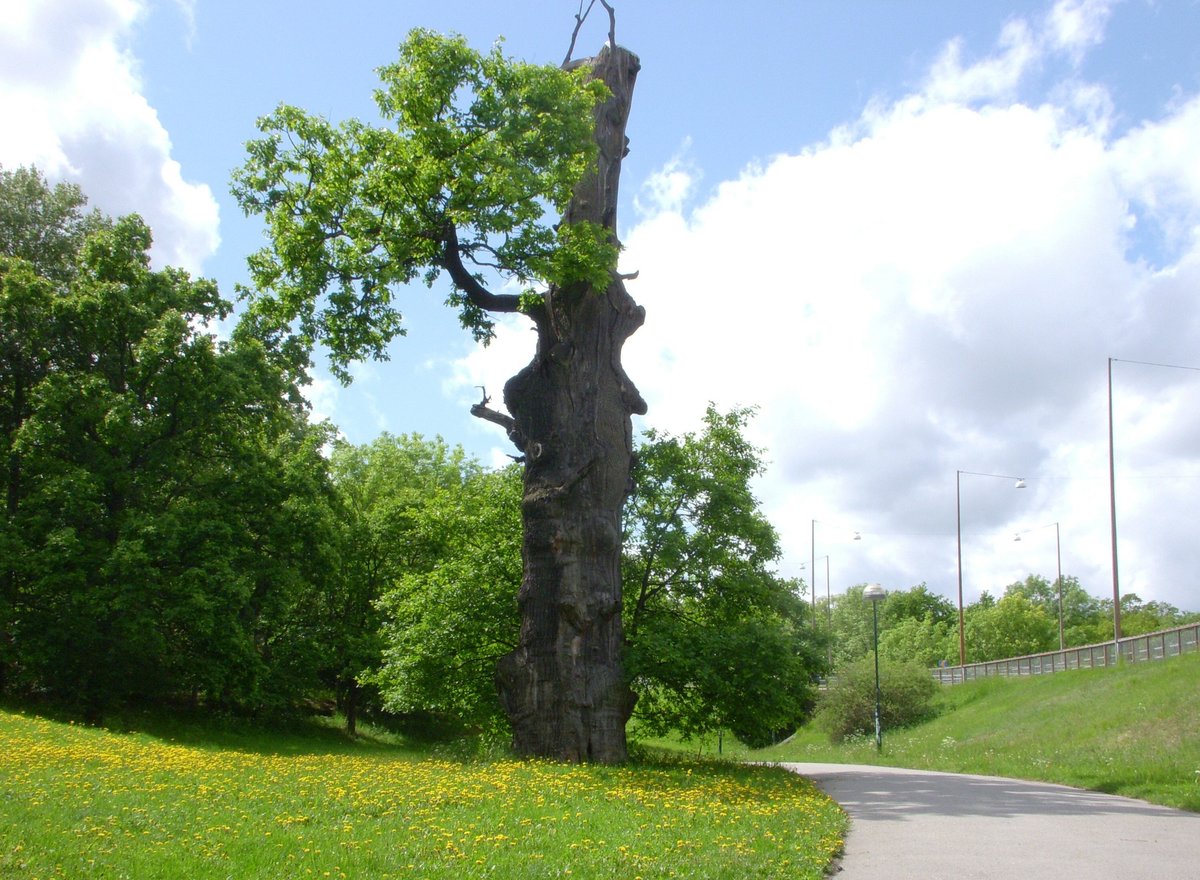

In the middle of the Kristinebergsmotet interchange on western Kungsholmen, ten metres or so west of the Essingeleden motorway, stands an oak that predates almost everything around it. It is thought to be up to 800 years old — about the same age as Stockholm — which is why it carries the name of the city's founder, Birger Jarl. It also goes by Kung Valdemars ek.
It was not always alone. In the 1600s and 1700s it grew among other oaks in the park of Stora Hornsberg. As late as the 1930s it stood undisturbed on a meadow between Kristineberg palace, the Iris-Hornsberg allotment colony and the Hornsberg velodrome. The allotments went. The velodrome went. The buildings moved in.
Rutger Sernander measured the tree in the 1930s: a circumference of 6.10 metres, taken 1.5 metres above the ground. By the end of the 1950s the trunk had gone hollow and was filled with concrete. When the Essingeleden was being planned in the early 1960s, the road's route is said to have been shifted to spare it.
A 2007 survey put its diameter at 202 cm at chest height, one of only nine oaks in Stockholm above 200 cm — the other eight are all on Djurgården. It is classed at the highest natural value, class 1, equivalent to a nature reserve. There is still some life in it, visible in one green branch.
Written by Nik Frost
Discuss this with the author and others
No comments yet. Be the first to start the conversation.