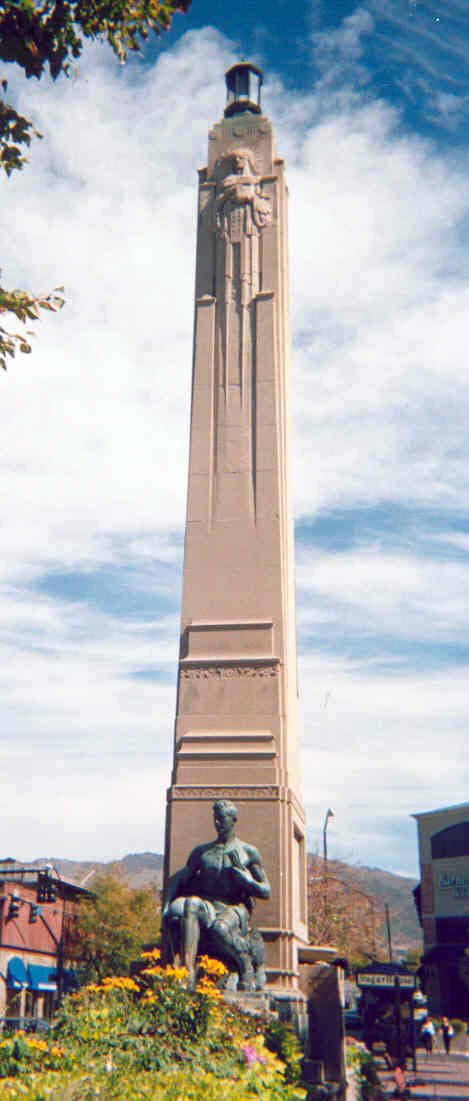

The Sugar House Monument has stood in Salt Lake City, Utah, as a testament to the hard work of early Salt Lake pioneers making the valley sustainable. The monument is located approximately 200 feet east of the original site of a Mormon Pioneer sugar mill.
In 1855, city leaders and early Mormon settlers sought to create the first factory in the western United States to process beets into refined sugar. The process was a failure, and the mill was eventually converted into a paper factory, then a bucket factory, and finally a machine shop. In the 1920s, sculptor Millard F. Malin pitched the idea of erecting a monument in honor of early manufacturing to the Sugar House Business Men's League. The league and the city of Salt Lake jointly funded the $2,000 monument sculpted by Malin and his two fellow artists; Edward Anderson and Lorenzo Young. The monument was completed and dedicated on November 11, 1934.
Malin describes the monument as a fifty foot shaft topped by a light. Near the top, the shaft blended into two Indian figures in relief, about eight feet tall, representing the passing of the red man. The Indian facing eastward, militant, holds war implements, and the one facing westward, defeated holds a peace pipe. At the foot of the shaft, facing eastward and westward, are two eight foot figures. The female figure facing eastward represents the Salt Lake Valley in all its productiveness, while the male figure facing westward, pouring water from an urn over a wheel, represents a mill builder.
On the sides of the shaft between the two figures were two bas-reliefs representing the original old sugar mill on the north side, and a fur-trading scene on the south side. The plaque reads "May the spirit of this courageous venture continue to characterize this community". It was listed on the National Register of Historic Places in 2003.
Sources: Wikipedia, OpenStreetMap, Wikidata, Wikimedia Commons




Written by Friendly Jane
Discuss this with the author and others
No comments yet. Be the first to start the conversation.