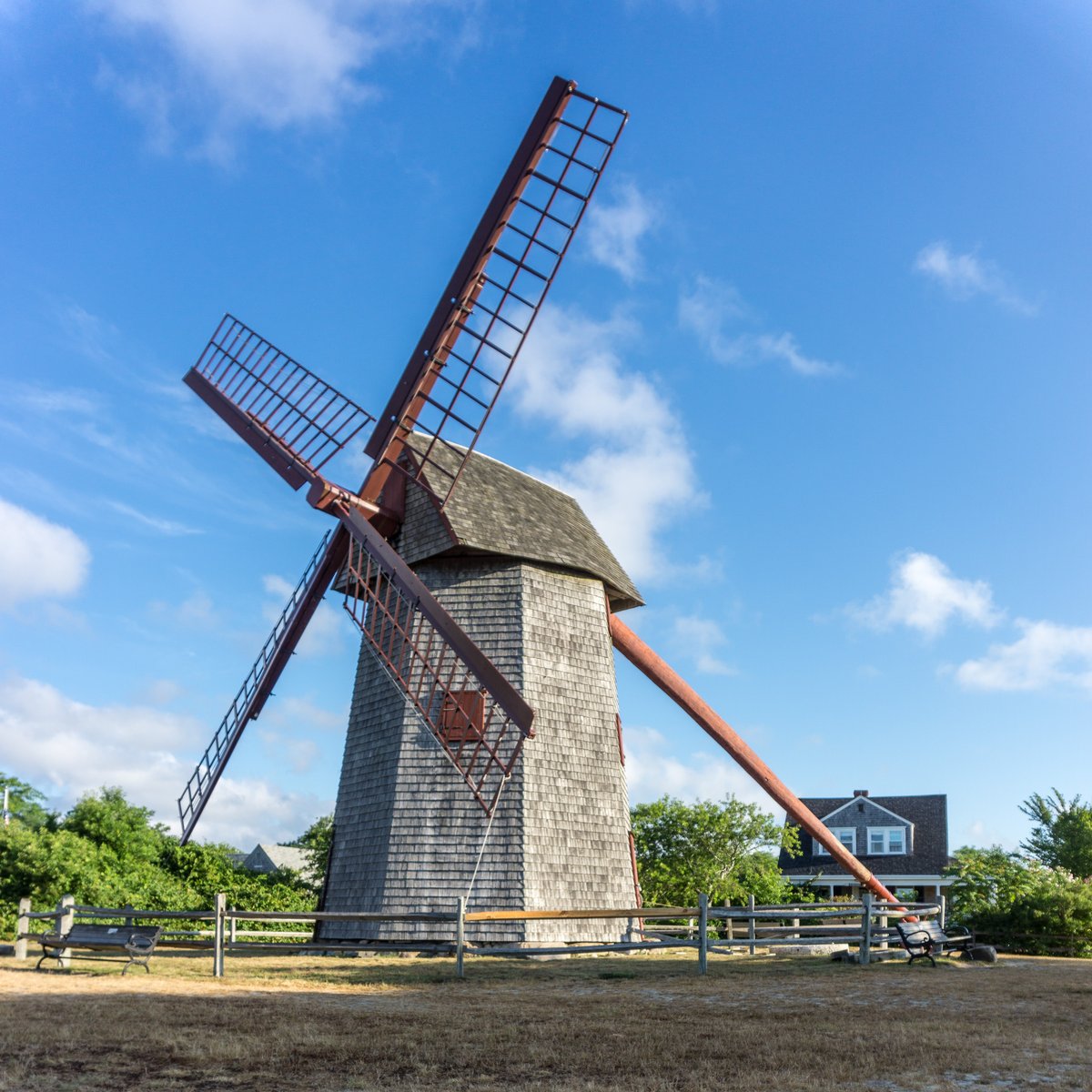
Nathan Wilbur, a local sailor who spent time in Holland, built the mill in 1746. He used oaken beams from wrecked ships for much of the mill's framework, which is held together by wooden pins and scrap metal. This smock type windmill stands at 50 Prospect Street in Nantucket, Massachusetts.
Out of four original windmills on the west side of Nantucket Island, this is the only survivor. In 1828, Jared Gardner, a carpenter, purchased the mill for twenty dollars and restored it to working condition. The mill was later sold to John Francis Sylvia in 1866, who operated it with his assistant Peter Hoy until it fell into disuse in 1892. In 1897, Caroline French purchased the mill at an auction for $850 and donated it to the Nantucket Historical Association.
The mechanics are heavy. A driving wheel at the top connects to four vanes 30 feet in length. Wooden cogs on the driving wheel intersect with wooden teeth in a vertical shaft, which revolves the upper grindstone. To counteract the force of the wind, the mill features a crude brake consisting of a heavy oak beam attached by a rope and pulley to a box of stone weighing several hundred pounds. The stone box can be raised or lowered to press the beam against the shaft.
Today, the Nantucket Historical Association owns and operates the mill as a museum. Visitors can see the gears as corn is ground into meal, producing about 5 bushels per hour. The mill was designated a Historic Mechanical Engineering Landmark by the American Society of Mechanical Engineers in 1992.
Sources: Wikipedia, OpenStreetMap, Wikidata, Wikimedia Commons
Written by Kyle McLonely
Discuss this with the author and others
No comments yet. Be the first to start the conversation.