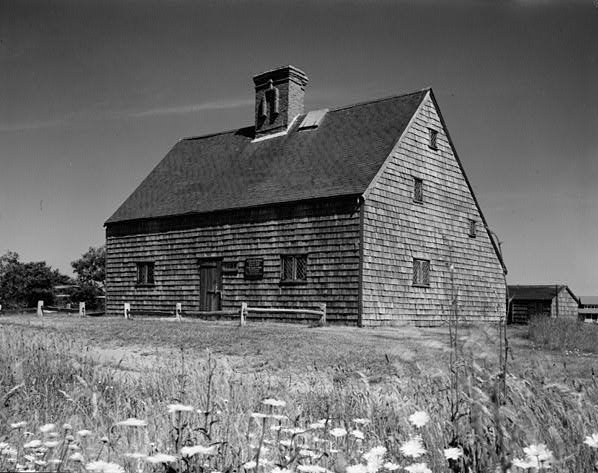
The Jethro Coffin House was built in 1686 as a wedding present for Mary Gardner and Jethro Coffin. Jethro was the grandson of one of Nantucket's original proprietors, Tristram Coffin, while Mary’s father was John Gardner, one of the leaders of the so-called Half-Share Revolt - a movement where the island's tradesmen rallied against wealthier full-share proprietors. The relationship between the Gardner and Coffin families was never amicable, but the house was built on Gardner land using Coffin lumber.
In the 17th century, this was an impressive two-story dwelling. It sat on a hill with a view for miles and featured a south-facing front with twin gables to let light into the second-floor rooms. It had a long, sloping north roof sometimes called a "catslide" and massive fireplaces that were the dominant features of the parlor, hall, and kitchen. The kitchen was a lean-to at the rear under a low-hanging roof.
By the late 1800s, the house was abandoned. It was used as a hay barn from 1867 until 1881, when two off-island members of the Coffin family purchased the house for $300. The house was opened for its 200th anniversary in 1886 and later opened as a house museum in the summers of 1897. The Nantucket Historical Association acquired the house in 1923, and the Society for the Preservation of New England Antiquities commenced an extensive reconstruction in 1927.
Nature struck the house again in 1987 when lightning caused extensive damage to the roof and chimney. Today, it is a historic house museum where visitors can see a reconstruction of a circa-1700 herb and vegetable garden. The garden uses a raised-bed system and includes common staples such as carrots, onions, cabbages, and parsnips, along with approximately thirty varieties of herbs, all maintained without modern fertilizers, herbicides, or pesticides.
Sources: Wikipedia, OpenStreetMap, Wikidata, Wikimedia Commons
Written by Kyle McLonely
Discuss this with the author and others
No comments yet. Be the first to start the conversation.