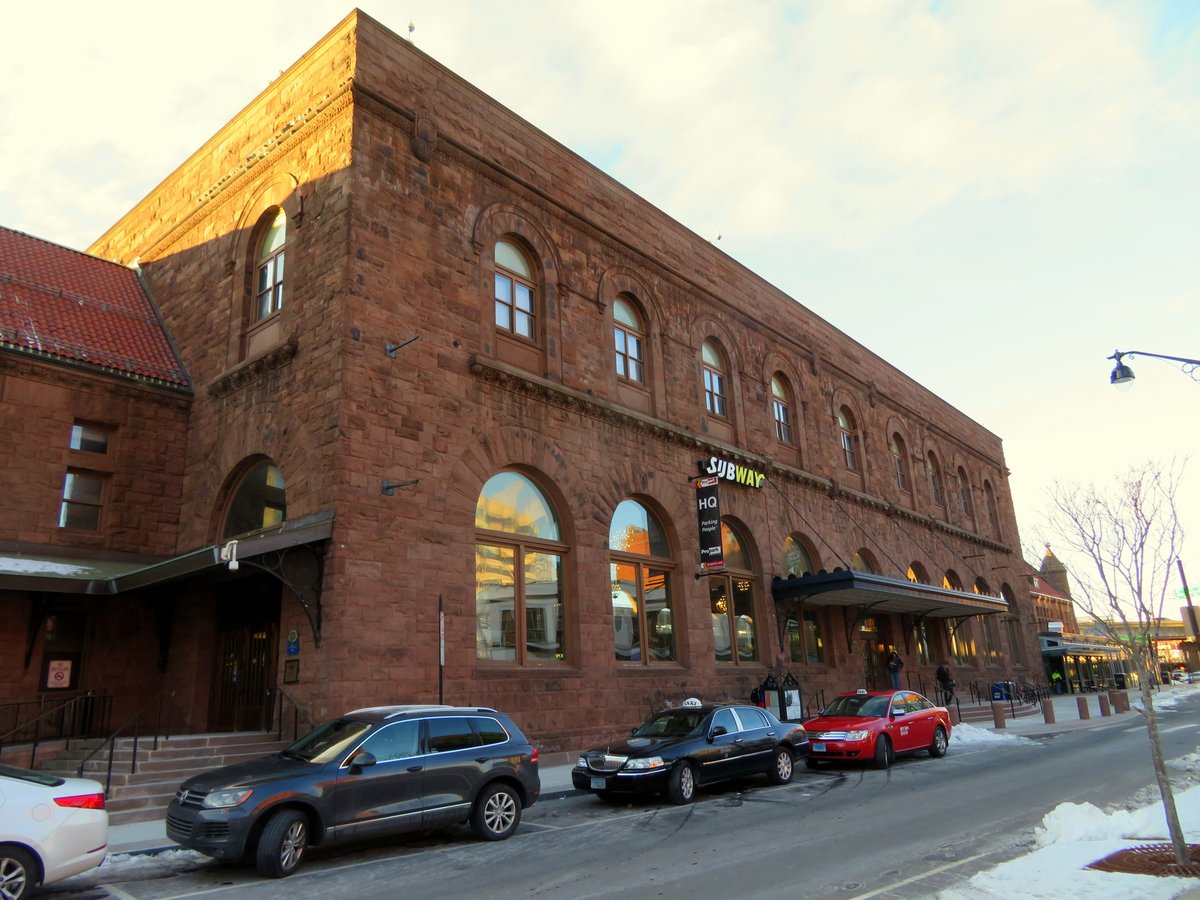
Hartford Union Station is a railroad station in Hartford, Connecticut, located on the New Haven–Springfield Line. Built in 1889, the building is designed in the Richardsonian Romanesque style. It was designed by George Keller and executed by Shepley, Rutan and Coolidge. The station underwent a rebuild following a fire in 1914 and received an interior renovation in 1987. It has been listed on the National Register of Historic Places since 1975.
The main building is a three-story rectangular structure made of rough-faced Portland brownstone, featuring two smaller two-story wings to the north and south. The front facade features a wide set of steps leading to a main entrance under large segmental arches. The second story includes similar smaller arches with recessed panels; the central bay has the year 1914 carved into its panel. Inside, the station features red tile flooring, an open area with stairs along the west wall leading to elevated tracks, and benches along the east wall.
The station serves as a hub for several transit services, including Amtrak's Hartford Line, Northeast Regional, Valley Flyer, and Vermonter, as well as CT Rail commuter rail and CTfastrak bus rapid transit. While it originally featured four tracks, it now operates with one track and a side platform. A 260-foot section of the platform was converted to a high level for accessible boarding in 2016, featuring a hinged edge for freight trains to pass.
Located on the western edge of downtown Hartford, the station is surrounded by a mix of old buildings, parking lots, and infrastructure. To the west lies a triangular parking lot and the viaduct carrying Interstate 84 and U.S. Route 6. Across Asylum Street to the south is Bushnell Park, which is also listed on the National Register of Historic Places. The station continues to serve as a ticketing and waiting area for the region's rail and bus networks.
Sources: Wikipedia, OpenStreetMap, Wikidata, Wikimedia Commons
Written by No Other
Discuss this with the author and others
No comments yet. Be the first to start the conversation.