Maya Cities of Mexico: Uxmal

For Browsing

When the sun sets over the jungles of the Yucatán, its fading light falls on the western staircase of the Pyramid of the Magician, just as it has for over a millennium. In pre-Hispanic times, during Maya religious festivals, a priest or ruler could ascend this staircase to pass through the gates into the sacred temple. Watching from the plaza below, commoners saw the leader emerging from this richly decorated doorway as a manifestation of the sun itself. Imagine you were born in the Classic Maya period around the year 900 on the Mexican Yucatán Peninsula. If you were lucky, you might have had the chance to travel to Uxmal. As you entered the city, you would be greeted by a lively, bustling city with a population of about twenty-five thousand people and many more thousands in the surrounding areas. Approaching the city center, giant stone structures would block out the sun as you drew near, towering even above the tallest trees, shattering the limits of what you thought possible. Intricately decorated buildings would convince you that the rulers and priests were truly anointed by the gods.

Foundation and History of Uxmal

965J+XJ Ushmal, Yucatan, Mexico

Uxmal is located in the second main area of the Maya habitat on the Yucatan Peninsula, called Puuc (literally - the Land of Low Hills). According to archaeological data, settlements in this territory had existed for at least 200 years by that time. The name Uxmal, according to the most common version, means "thrice built," which likely indicates that the city underwent multiple large-scale reconstructions. The preserved buildings, such as the Quadrangle of the Nunnery, the Governor’s House, the House of the Turtles, and the later upper temples of the Magician’s Pyramid, are among the finest architectural works of the ancient Maya world. All these names undoubtedly belong to modern times, having been assigned based on the guesses of the discoverers. The true purpose of the buildings remains a mystery. The date of Uxmal’s final abandonment is unknown and controversial, although the Maya probably remained there longer than in their southern cities, which fell approximately starting from the 9th century.

Wizard's Pyramid (Piramide del Adivino)

966J+84 Uxmal, Yucatán, Mexico

The pyramid got its name from the legend of a dwarf wizard, the son of a witch, who hatched from an egg already grown. Determined to compete in power with the ruler of the city, the Dwarf Wizard built a huge pyramid in just one night.

Women's Monastery (CuadrÁngulo de las Monjas)

966H+JP Uxmal, Yucatan, Mexico

A very interesting complex of four buildings is called the Women's Monastery, or if translated in detail from Spanish, the Quadrangle of the Nuns. This name was given by Spanish explorers who thought that the ancient structures closely resembled a Catholic convent. Scholars who have studied Uxmal almost unanimously lean toward the idea (and such unanimity in judgments about Maya monuments is quite rare) that the "Women's Monastery" was indeed a real monastery, a dwelling place for Maya priests, possibly priestesses as well. Here they likely lived in the secluded cells of their magnificent home, from where they would go out to perform rituals in the sanctuaries of the Pyramid of the Magician, and to which they returned after completing the ceremonies. And when they looked out from the Monastery, they saw on the opposite slope, on three terraces, the Palace of the Governors shining under the scorching Yucatan sun, the residence of the "great men" of this remarkable indigenous city.

Governor's Palace (El Palacio del Gobernador)

965H+FG Ushmal, Yucatan, Mexico

The building that the ruling Shiv dynasty made their residence, and which throughout the subsequent history of Uxmal has been so closely associated with the name of this powerful dynasty, was, as can be assumed, constructed during the earlier, preceding "second" era of the Thrice-Built city of Uxmal. This diamond of Maya architecture is usually referred to in specialized literature as the "Governor's Palace," the "Shiv Palace," or the "Palace of the Rulers."

The Old Woman's House (Casa de la Vieja)

965H+7G Ushmal, Yucatan, Mexico

As for the name Casa de la Vieja, it is known that when Stevens visited the ruins of Uxmal in the nineteenth century, at the foot of the pyramid there still stood a crude female sculpture, which is now identified as an image of the goddess of earth and vegetation. However, the locals identified her as an old witch, so the American researcher followed the custom and named it accordingly.

Temple of the Phalluses (Templo de los Falos)

965J+53 Ushmal, Yucatan, Mexico

Phalluses in jewelry are associated with an important figure in the Uxmal pantheon and simultaneously with the legend of the origin of its rulers and the city's structures. They are connected by the legend of an old woman who was the mother of a dwarf and at the same time the goddess Ix Chel, considered the Moon Goddess among the Maya.

House of Turtles (Casa de las Tortugas)

965H+RG, 97884 Ushmal, Yucatan, Mexico

The building is named after the images of turtles on the upper cornice. It is constructed in the classic Puuc style. From the north, a large staircase leads to the House of the Turtles. The House of the Turtles is one of the most simply decorated temples in the city; the frieze of short half-columns, resembling "rolled scrolls," that runs around the temple beneath the turtles is characteristic of the Puuc style. The closely spaced columns resemble wooden posts used in the walls of village houses.

Dovecote, or Pigeon House (Casa de las Palomas)

El Palomar, Uxmal, Yuc., Mexico

Presumably a ceremonial building dedicated to Kukulkan. Most likely, ceremonies similar to those held in temples were conducted here. It was constructed from rubble and limestone during the early period of the civilization. Like many other structures, the exterior and interior walls of the Dovecote were carved, and all the walls were painted in bright colors. It was also believed to have been built for tracking the movement of celestial bodies and supernatural forces. The building received its modern name due to its characteristic stepped roof, which reminded archaeologists of a dovecote. Unfortunately, the structure is very poorly preserved; only a fragment of one wall has survived to the present day.

Main Pyramid (Piramide Mayor)

El Palomar, Uxmal, Yuc., Mexico

The main pyramid of Uxmal is a freestanding structure located behind the Governor's Palace. Its base is square-shaped with a side length of 80 meters. In the 8th century, there was a building on top of the pyramid, accessible by a staircase on the northern side. This building had five rooms in the back row and three in the front.

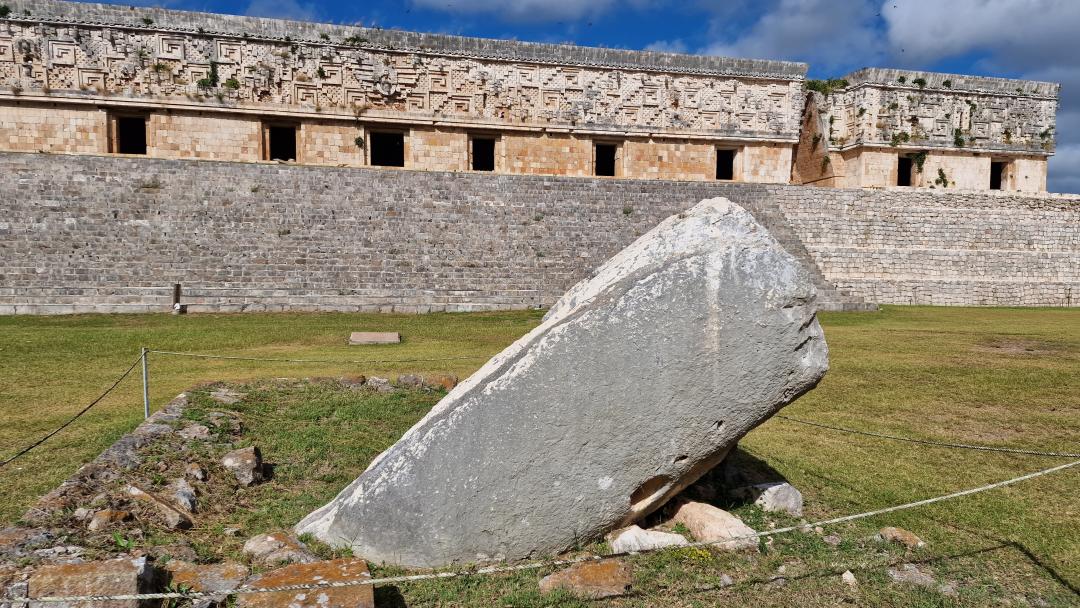
Altar Stone (Adoratorio de la Picota)

965H+CM Ushmal, Yucatan, Mexico

On the esplanade in front of the Governor's Palace, there are two very interesting monuments.

Ballgame court (Juego de Pelota)

Uxmal Archaeological Zone, Uxmal, Yuc., Mexico

Why the game can lead a person to the abyss, why players need corsets, and other essential knowledge that can be gleaned from the sports activities of the Maya

Birds' Courtyard (Cuadrángulo de los Pájaros in Uxmal)

966H+9X Ushmal, Yucatan, Mexico

The Birds Quadrilateral is formed by four buildings enclosing a closed inner courtyard. On the eastern side is the Seer's Pyramid, which serves as the focal point of the quadrilateral and this sector of the settlement.

House of the Iguana (Casa de la Iguana)

Uxmal Archaeological Zone, Uxmal, Yuc., Mexico

The Iguana House lies south of the Bird Square. It consists of a single long portico supported by eleven columns and oriented to the west. During the excavations, the building was found to be completely destroyed, but it has now been reconstructed. Therefore, nothing definite can be said about the decoration of the facade or other features of the structure.