Maya Cities of Mexico: Coba (Kabah)

For Browsing

Kabah is an archaeological site of the Maya civilization located in the southeastern part of the Mexican state of Yucatán. It lies south of Uxmal and is connected to this city by a huge 18-kilometer paved pedestrian road, 5 meters wide, with monumental arches at each end. Kabah is the second largest ruins in the Puuc region after Uxmal. The name "Kabah" or "Kabaah" is believed to mean "strong hand" in the archaic Maya language. This is a pre-Columbian name of the area, mentioned in Maya chronicles. Another name is Kabahaucan, or "royal snake in the hand."

Temple of Masks (Codz Poop or Palacio de las Mascaras)

Archaeological Zone of Kabah, Puuc, Kabah, Yuc., Mexico

The majestic temple Kodz-Poop (Temple of Masks) is located in the archaeological zone of Kabah. These are the ruins of an ancient city of the Maya civilization that existed in the 9th-10th centuries. Kodz-Poop is one of the few structures preserved on its territory.

Other buildings of Kabah

Archaeological Zone of Kabah, Puuc, Kabah, Yuc., Mexico

On the southern side of the path, opposite the Pyramid complex, is the Quadrangle. This unstructured structural grouping resembles the layout of the one observed in Uxmal. Along the trail, parts of the northern side are visible. Slightly south of the quadrangle is another group of unprotected structures. It is here that the Maya road (sacbe) from Uxmal ends. From the southern part of this complex, another road (sacbe) runs directly south through Highway 261 to the South Pyramid complex.

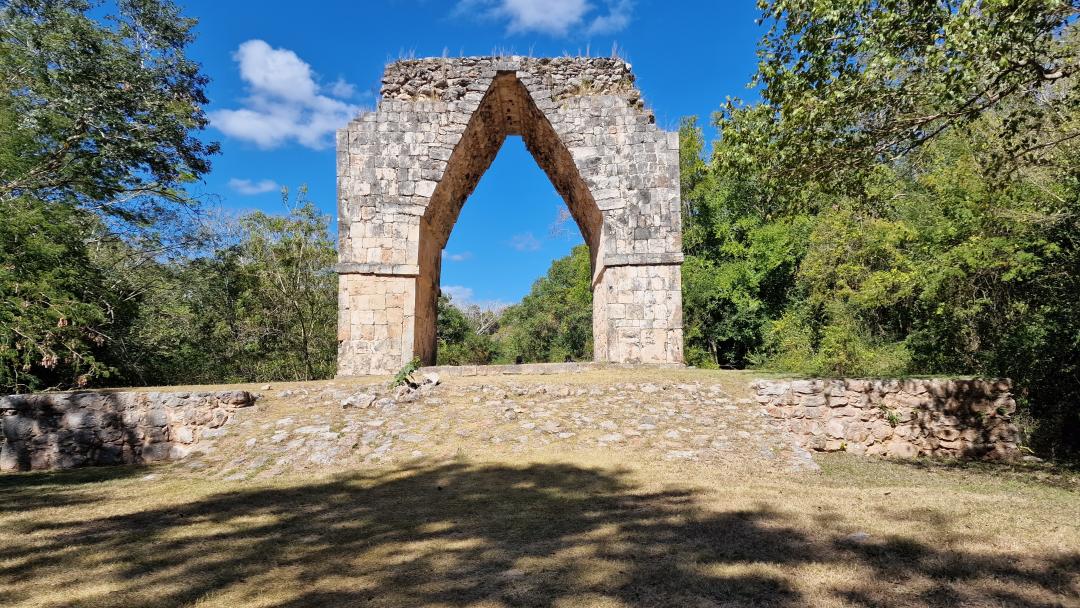
Arch (Triumphal Arch)

Arch of Kabáh, Puuc, Yuc., Mexico

Арка построена как ворота в город, служащие городской достопримечательностью. Это отдельно стоящая конструкция, расположенная на платформе высотой 4 метра в центре проезжей части, доступная по лестнице с северной стороны или по пандусу с южной стороны.

The Great Pyramid (La Gran Pirámide)

Kabah Arch, Puuc, Yuc., Mexico

No less impressive an architectural monument is the large pyramid, which reaches a height of 24 meters. Next to it are the ruins of another imposing structure, closely adjoining the pyramid. This building may have been intended for public use; one hypothesis suggests that it could have hosted meetings of the city’s elite, who made key decisions.