

On the south side of the path, opposite the Pyramid complex, is the Quadrangle. This unstructured structural grouping resembles the layout of the one observed in Uxmal. Along the trail, parts of the northern side are visible. Slightly south of the quadrangle is another group of unprotected structures. This is where the Maya road (sacbe) from Uxmal ends. From the southern part of this complex, another road (sacbe) runs straight south across Highway 261 to the South Pyramid complex.
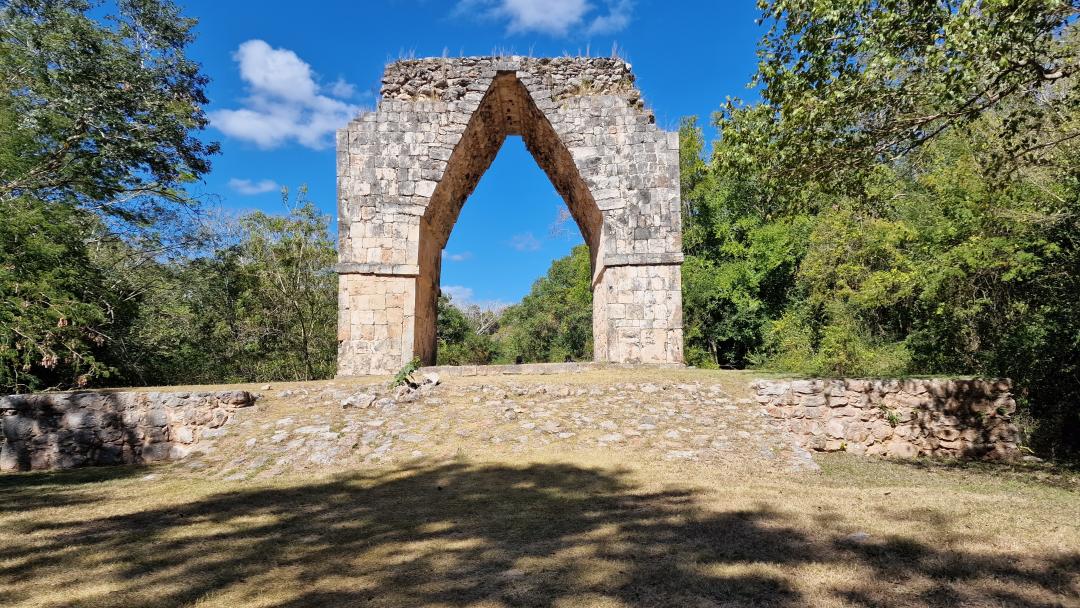
The trail continues west and intersects with the road to Uxmal-sacbe. An impressive arch is visible to the north and is believed to have been the entrance to the ceremonial city. This unadorned arch, located on a stepped platform, still impresses with its height of over 4.5 meters.
To the west of the Arch is the Early Group and the Northwest Group. The Early Group consists of several unstructured structures. The Northwest Group runs from north to south along a low mountain ridge. Here are two main structures in a partially restored state, structures 1A1 and 1A2. It was from the northern building that John Lloyd Stephens took a carved wooden lintel back to the United States, which was soon destroyed by fire after arrival.
Further south along the ridge is the Western Group. This group consists of two separate complexes, both apparently undergoing restoration. Structures 1A7 and 1A8 lie at the top of the ridge line. Slightly below is the Courtyard of structures, consisting of four buildings arranged around a small central plaza and numbered 2A2, 2A3, 2A6, and 2A7. They contain several beautifully executed stucco patterns, sculpted door jambs, and mosaic masonry. One structure contains numerous red handprints similar to those observed in San Gervasio and several other locations. The meaning of these handprints is not fully understood.
There are many other individual structures and small groups scattered throughout the site, awaiting excavation and restoration.


Written by Jermaine
Discuss this with the author and others
No comments yet. Be the first to start the conversation.