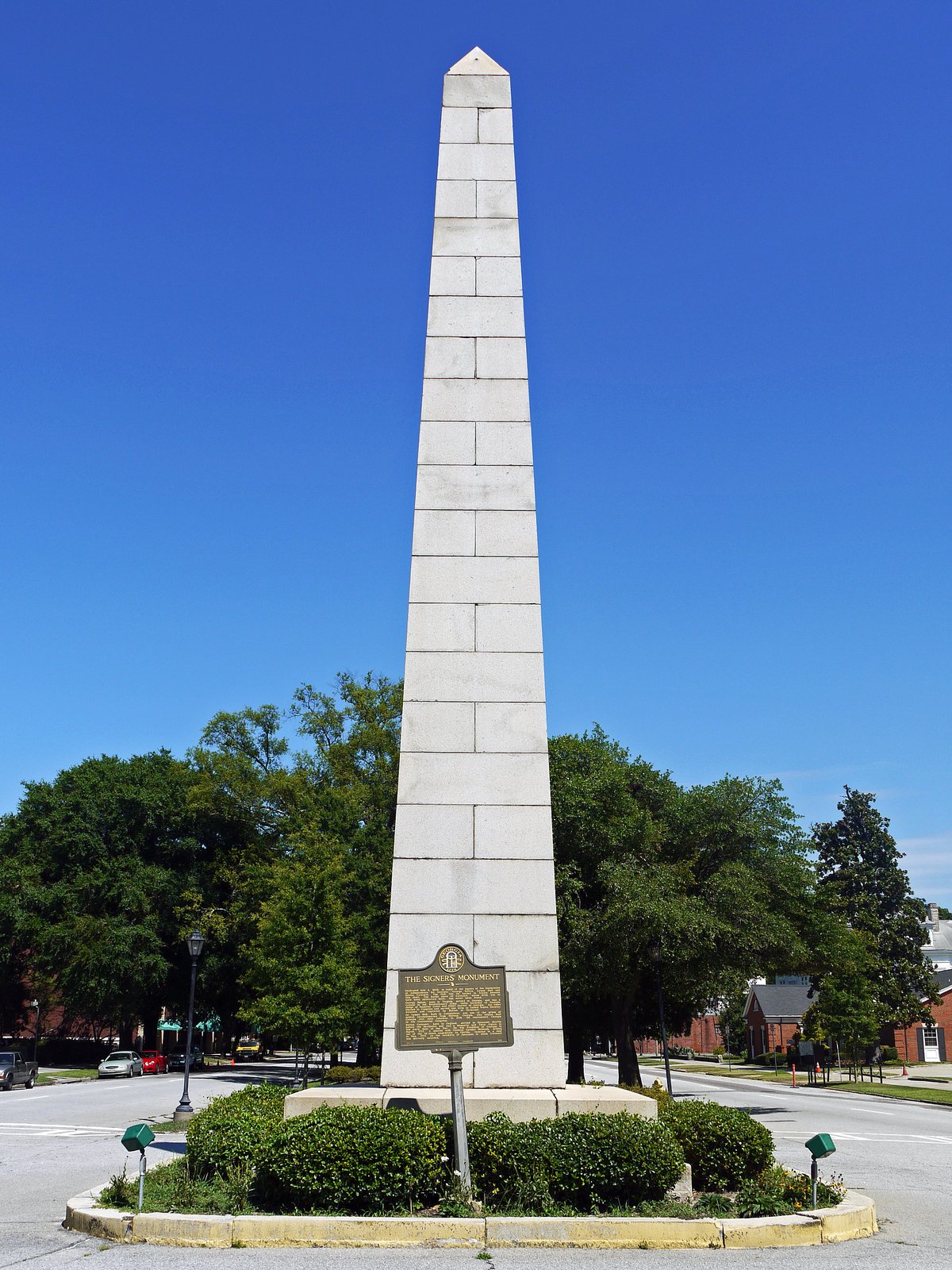
In Augusta, Georgia, a granite obelisk called the Signers Monument honors three signatories of the Declaration of Independence: George Walton, Lyman Hall, and Button Gwinnett. Designed by Robert French and dedicated in 1848, the monument narrows at the top, displaying Georgia’s emblem and the names of the three men. The remains of Walton and Hall lie beneath the monument, while Gwinnett's remains have not been located for certain.
The conundrum of locating Gwinnett's body arose as he died in Savannah after a duel in 1777. Although it was generally believed he was buried in the old cemetery on Savannah's South Broad Street, a gravestone bearing his name could not be found. In 1848, a committee removed and reburied the bones of Walton and Hall beneath the monument, but they were unable to find Gwinnett's remains to join them.
The mystery persisted until the late 1950s, when an amateur historian convinced the Georgia Historical Commission to excavate a site in the Colonial Park Cemetery. The dig turned up a badly-preserved skeleton with a damaged left femur. Analysis by the Smithsonian Institution suggested the skeleton was too short to be Gwinnett and that the femur was most likely a woman's. However, a later 34-page report by the city's historic commission declared that "beyond a reasonable doubt" the remains were Gwinnett's. The skeleton was re-interred at the Savannah cemetery in 1964, leaving the exact location of Gwinnett's original burial unknown.
Sources: Wikipedia, OpenStreetMap, Wikidata, Wikimedia Commons


Written by Leroy
Discuss this with the author and others
No comments yet. Be the first to start the conversation.