9VHV+XGR, Baku, Azerbaijan
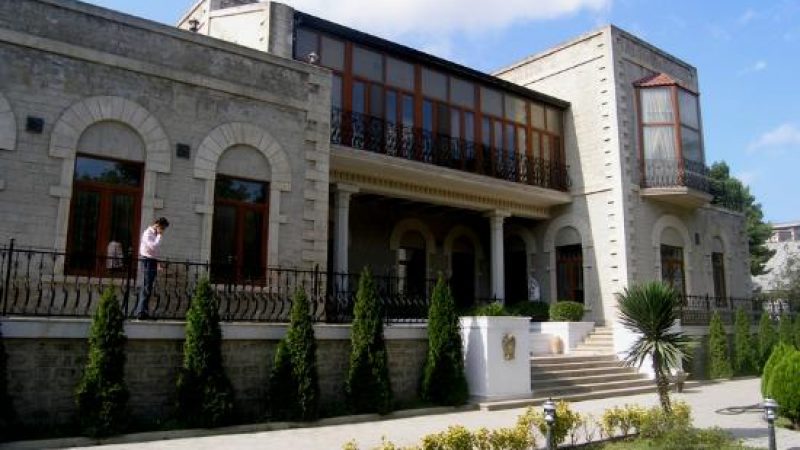
The history of the Nobel brothers in Baku began in the 1870s when Robert Nobel came to the largest city of the Baku province—the city of Baku (Russian Empire)—in search of wood material for making Berdan rifle stocks. Robert’s attention was drawn to the oil potential of the Baku region. Returning to Saint Petersburg in 1873, he tried to attract his brother’s attention to Baku oil, but since Ludwig did not believe in the prospects of the venture, he was content with only a small amount.
In 1875, Robert bought a small kerosene plant in the "Black City" and several oil-bearing plots in Sabunchi from the Tiflis Society for 25,000 rubles. Amidst great disputes and scandals surrounding Baku oil, Alfred developed a strong interest in Baku oil on the Paris Stock Exchange. In a telegram sent to Ludwig, he wrote that business circles in Paris mentioned Baku oil and that Rothschild’s people were trying to acquire the best land plots in Baku and wanted to push out the Nobel brothers. He also expressed his desire to start operations there. Thus, a new area emerged in the Nobels’ entrepreneurship.
In 1876, Ludwig Nobel moved to Baku. The first drilling well was laid by Robert Nobel in April 1876 on plot No. 52 of the Sabunchi estate.
In 1878, the Nobel brothers built the first oil pipeline with a steam pump in the Russian Empire. It stretched from Balakhany to the Black City, was 9 km long, three inches in diameter, and had a capacity of 80,000 poods per day.
Similar oil pipelines soon began to be installed by other oil industrialists in the neighboring Sabunchi and Raman fields.
On May 18, 1879, the largest foreign oil industrial company in the Russian Empire was founded in Baku—the "Nobel Brothers Oil Production Partnership (Branobel)." The initial capital was 3 million rubles (30 million rubles by 1913). In a short time, the partners became owners of oil fields in Surakhany, Balakhany, and Bibi-Eibat.
In Saint Petersburg, the partnership’s headquarters was located at: 6 Ekaterininsky Canal Embankment / 2 Italian Street, Gorchakov Mansion. (https://reveal.world/story/osobnyak-m-a-gorchakova-dom-tovarishchestva-neftyanogo-proizvodstva-brat-ya-nobel).
The "Nobel Brothers Oil Production Partnership" made a real revolution in the oil industry. In their discoveries, the Nobels used ideas from scientists such as Dmitri Mendeleev. Mendeleev always complained that the Nobels did not fully appreciate the potential of oil; they discarded many residual products because they were only interested in kerosene. Later, Mendeleev convinced them that there was no useless substance in oil and that all its components could be utilized.
The use of manual labor and workforce in the oil extraction process increased the cost of oil production. However, thanks to the Nobels’ ingenuity, the first oil fields began to appear in the Balakhany oil fields. Now oil was extracted from wells not by a lever but by pumps.
Transportation of oil was also a serious problem. Extracted oil was filled into barrels and then sent by ship to Astrakhan, where it was loaded onto railway cars. Unloading barrels sent to Russia and other countries also created problems. The Nobels wanted to reduce the cost of oil transportation to such an extent as to displace other types of fuel in the market.
To this end, the Nobel brothers decided to turn the barrels themselves into oil wagons and ships. However, they did not have sufficient funds to implement this project alone and decided to turn to industrialists and financiers from Europe. As a result, a large sum of money was raised, and the assets of the "Nobel Brothers Association" grew to 20 million rubles. Thus, under strict confidentiality, the ship "Zoroaster," carrying oil, became the world’s first oil tanker.

The first tank car in the world also began to be produced.
In 1882/83, a unique settlement for the employees of the "Nobel Brothers Partnership" called "Villa Petrolea" appeared on the border of the Black and White cities.
The famous Baku architecture researcher Fatullaev writes:
Touching on the architecture of Baku’s industrial districts, one should especially note the architectural phenomenon of that time, the so-called "Villa Petrolea"—a complex of buildings and structures erected on the territory of a large park belonging to the "Nobel Brothers Partnership." The structures of this complex were not only the first successful example of park architecture in an industrial district of the city but also a largely unique example for the world’s dendropark architecture of that time.
The emergence of "Villa Petrolea" is explained very simply. The factory district of the city, located almost 8 km from the center, was unfavorable both in natural conditions and in amenities, but it was considered acceptable for the Baku proletariat to live there. However, the administrative and technical staff did not agree to work, let alone live, in such conditions even for a large reward.
For the senior staff of the Baku administration, Ludwig Nobel built a special settlement behind the Black City, called Villa Petrolea.

In a letter to his family dated August 10, 1882, the chief manager of the "Nobel Brothers Partnership," Gustav Törnudd, describes in detail what the Petrolea settlement looked like in 1882. He even sends a drawing of the Petrolea settlement, attaching a description—the park and houses are located in a charming valley, with two mountains rising on the southern side, picturesque descending to the sea.
We own about 10 tunilands (1 tuniland = 4,936 square meters) of land on which we are building a settlement for about one hundred company employees. All houses are located on one slope, so from every window facing east or south, the sea can be seen—sometimes over the roofs, sometimes between them.
All buildings are constructed in Byzantine style from white, finely worked sandstone; some will be one story, others two stories, and beautiful gardens and parks will spread around. On the south and east sides—both on the first and second floors—the houses are bordered by elegant spacious verandas. Fresh water is delivered daily from the Volga and poured into a reservoir, from where it flows through pipes to kitchens, bathrooms, and fire hydrants.
Törnudd talks about everything in detail: here is the living room, bowling alley, utility block with baths, sauna, laundry, room for rolling and ironing laundry, and he describes the apartments.
There is also a club housing a restaurant, music and ballroom halls, billiard room, and library with a reading room.
The cellar is packed full of ice from the Volga, and this icehouse has become a true salvation for all of us.
Later, a greenhouse, stables, carriage sheds, a poultry yard, ponds for ducks, a cowshed, and a pigsty will be built; in addition, we hope to buy more land and eventually establish a large agricultural enterprise.
Gas is supplied from the factory to the houses for cooking and heating rooms. Lighting at both the factory and the settlement is already partially electric.
There is also a telephone line, but branches need to be made to each division and to the offices—both city and in Balakhany.
I almost forgot to mention: we are installing very expensive equipment to lower the temperature in the rooms of "Villa Petrolea" to 15–20 degrees using compressed air, i.e., to the normal temperature to which we, Scandinavians, are accustomed. A hospital surrounded by a beautiful garden will also be built.
We are building an excellent barracks for our security—40 selected St. Petersburg guardsmen, all well-armed, and some even on horseback...
The territory of Villa Petrolea was closed to outsiders, as Baku residents were informed in city newspapers.

Newspaper "Kaspi" (1893)
Outside the walls of Villa Petrolea, housing was also built for gardeners, coachmen, and guards. Drinking water was supplied by a desalination plant. In late spring, 800 tons of ice were delivered by sea, which was supposed to last the entire summer season. The first Bell telephone line in Baku was stretched from the port to the oil fields.
For senior employees, entertainment facilities such as halls for social gatherings, billiards, and bowling alleys were built (Black City, Baku).
In the traveler Markov’s book "Russia in Central Asia. Sketches of Travels through Transcaucasia, Turkmenistan, Bukhara, Samarkand, Tashkent, and Fergana Regions, Caspian Sea and Volga" (1901), who visited Baku, this unusual "corner" for industrial areas is described in detail.
Villa Petrolea is the residence of all the main managers and figures of the Nobel factories. The villa is located right on the seashore, one and a half versts from the factory. A sandy ridge separates the seaside slope, where this pretty estate is nestled, from the rest of the plain.
Black smoke and the suffocating smell of countless factory chimneys do not reach here. The tired worker can breathe in the invigorating sea air here and rest his eyes on the fading horizons of the blue distance.
Several very beautiful and spacious buildings have been built in the villa.
One of them is a club for employees with a library and billiard room, with a very large dance hall. This club is visited by many outsiders besides factory employees, so factory lines and the factory steam boat are constantly busy transporting guests on certain days. However, a steam tram runs from the Baku station to the Nobel office, and from the station to the city—a regular tram. Another building houses a wonderful Kegelbahn (bowling alley) with a buffet and beer hall. All announcements and rules of the bowling game are written in Swedish because the vast majority of players are Swedes. Up to 1,000 rubles a year are collected from fines for the maintenance of the bowling alley.
The two largest houses—villas, a kind of palaces—are built in the Italian style from hewn stone, with picturesque galleries, occupied by employees’ apartments.
We visited some of them... Almost everyone here is Swedish, so there is Swedish order and cleanliness everywhere.
The kitchens shine with their utensils like a copperware shop. The rooms are comfortable and spacious.
The chief director of the factories also lives at "Villa Petrolea."
His house is a real dacha surrounded by flower beds and grape galleries; a large vineyard was recently planted in front of the house.
A garden is being cultivated nearby. The local soil and climate are deadly for gardening, so despite large expenses and daily watering of trees with water brought from Astrakhan, the results are still far from brilliant. Now a water supply has been brought here, and it is hoped that with its help, this lovely corner will turn from the current "kerosene villa" into a real green and flowered villa, which will become a decoration of the seaside.
Alongside this, the Nobel brothers created the first oil pipeline. In 1883, the Baku-Batumi railway opened the way for Baku oil to the West.

Towers of the Nobel Brothers Oil Production Partnership in Baku. Photograph from the collection of Swedish chemist Albert Werner Kronkvist. 1903
In 1885, the "Branobel" company produced 15 million poods of kerosene. The annual kerosene production by all Baku oil refineries in 1885 was 28 million poods.
By 1893, there were already 26 pipelines ranging from 7 to 14 versts in length, with a total length of 262 versts. Of these, 20 served to pump oil from the fields to the factories, and six delivered seawater to the fields for steam boilers.
The factory activity of "Branobel" from 1879 to 1904 amounted to processing 1 billion 195 million poods of its own and purchased oil. The partnership’s factories produced in million poods: kerosene — 379.5; gasoline — 2.4; solar oil — 46.3; lubricating oils — 49.8; oil residues — 712.8.
The participation of "Branobel" in the export of mazut from Baku was: in 1892 — 22.4%; in 1897 — 28.6%; in 1902 — 34.3%.
The main capital in 1900 reached 15 million rubles, and the percentage ratio of net profit to main capital was 56.4%.
In 1908, the company had 42 oil fields in the Baku district. In 1909, the partnership owned 20% of all kerosene production in Baku and 50% of its sales, as well as 35% of mazut sales.
The net profit for 1913 amounted to 14.853 million rubles. In the summer of 1914, the share capital of "Branobel" increased 3.6 times. About 30,000 people worked in the Nobel "oil empire."
From 1914 to 1917, the company owned a main capital of 30 million rubles, more than 13 factories (including 6 oil refineries). In 1916, the company’s total oil production was 76 million poods of oil.
The Nobel Brothers Oil Production Partnership was the largest oil industrial company in the Russian Empire until 1918. Essentially, it was the first oil company in Russian history to carry out all technological production cycles—from exploration and development of oil fields, drilling and extraction, to refining and marketing of commercial oil products.

The company conducted oil extraction and refining in the Baku and Grozny districts, created its own transport and sales network, including pipelines, tankers, tank cars, and oil depots with berths and railway branches. Besides oil refining, the company produced auxiliary substances. In particular, it established its own production of soda and sulfuric acid.
The company owned oil fields in Balakhany, Raman, Sabunchi, and Bibi-Eibat near Baku, on the Cheleken island on the Caspian Sea coast, and in Berikse (Dagestan region), among others.
7 factories in the Black City near Baku
Warehouses and bases in Russia, as well as in Marseille, Manchester, Antwerp, Geneva, Berlin, Hamburg, Gothenburg, London, and other European cities, and much more.
In Baku, the Nobel brothers built a family residence and the Villa Petrolea settlement for company employees. The residence has now been restored and houses the Nobel Brothers Museum.
The company’s shares were listed on the Berlin, Amsterdam, Frankfurt, and St. Petersburg stock exchanges.
Ludwig Nobel died in 1888. At the time of his death, the partnership had capital of 35 million rubles in gold, which accounted for one-fifth of the total capital of foreign companies in the Russian oil industry. Robert Nobel died in 1896.
From 1888 to 1917, the Russian enterprises of the Nobel family were headed by Ludwig’s son, Emmanuel.
After the 1917 revolution, numerous oil warehouses, bases, enterprises, and towns of the Nobel brothers were nationalized by the Bolshevik government. Subsequently, they became the foundation for the oil extraction and refining industry of the USSR.
In 1918, Emmanuel Nobel moved to Sweden.
After the establishment of Soviet power in Baku, the former owners left the villa, which was later used at different times as a rest home for children of oil workers, an orphanage, then a military unit, a cavalry company, and other purposes.
In the last ten years, the once magnificent mansion, built in Byzantine style by the famous Italian architect Bora, was in a state of disrepair and was nothing but walls without windows and doors. There were no ceilings at all, beams collapsed, everywhere was neglect, stray dogs and cats.
In April 2008, the half-ruined mansion was transformed into a beautifully restored International Museum Center, the only Nobel family museum outside Sweden.
Sources:
https://ru.wikipedia.org/wiki/Товарищество_нефтяного_производства_братьев_Нобель
"https://ourbaku.com/index.php/"Villa_Petrolea"_-_settlement_of_employees_(Black_City,_Baku)"
Fatullaev Sh. Urban Development of Baku at the End of the 19th - Beginning of the 20th Century
B. Osbrink. The Nobel Empire


