VWM5+65 Petrodvortsovy District, Saint Petersburg, Russia
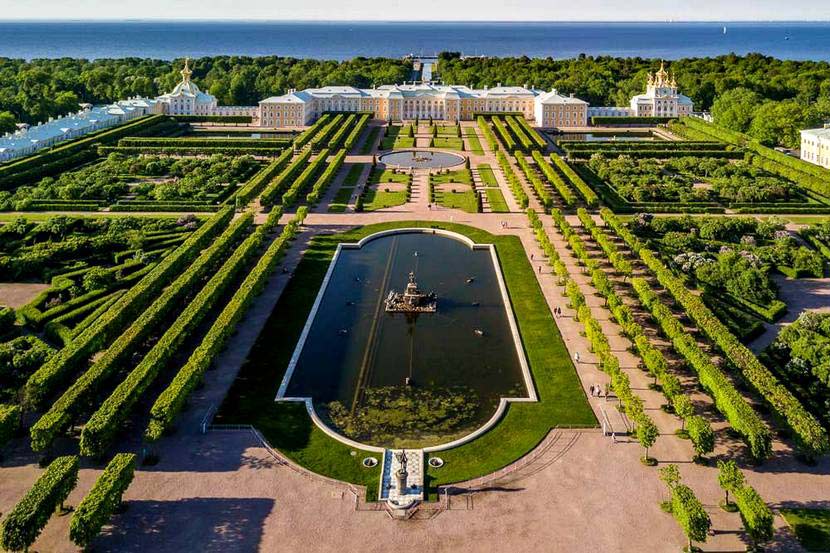
The Upper Garden is the ceremonial entrance to the imperial residence, a fine example of formal garden design, created based on sketches by Peter the Great. At that time, the famous architect Jean-Baptiste Le Blond arrived from France to serve the Russian tsar, and he was entrusted with leading all the construction work at Peterhof. Considering the scale of the territory, the talented master brilliantly coped with the assigned task. By 1725, the royal residence welcomed its first guests, and subsequently, its layout changed only slightly. During the lifetime of the first Russian emperor, the ceremonial character was combined with practical purposes. Vegetables, fruits, aromatic herbs, and medicinal plants were grown here, and fish were bred in the ponds, which served as reservoirs for the fountain system.
In the 1730s, the Upper Garden acquired an exclusively ceremonial appearance: the beds were removed, trellis pavilions and gilded sculptures were installed in the parterre, and fountains were arranged in the pond-basins. In the mid-18th century, the garden was expanded and enclosed on three sides by a fence with stone pillars and grilles made of wooden replicas. At that time, the ceremonial entrance from the Peterhof road was decorated with gates featuring massive pylons and wrought iron leaves. The Upper Garden, located on the terrace in front of the southern facade of the Grand Palace, is perceived today primarily as the ceremonial entrance to the imperial residence. It is a kind of green open-air vestibule—harmonious, bright, spacious. Its layout was executed based on sketches by Peter the Great himself and has changed only slightly over time.
Compositionally, the garden is connected with the architecture of the Grand Palace. The central part corresponds to the parterre with green lawns, including three pools with fountains arranged along the central axis. On the sides of the parterre are two square ponds and three pairs of symmetrically arranged bosquets framed by clipped shrubs. According to the layout principle, the bosquets are called square, oblique, and circular.
Since the time of Anna Ioannovna, the Upper Garden has been adorned with five fountains; a rose garden is laid out in the bosquets near the eastern pond, and near the western pond, the Peter the Great’s medicinal herb garden has been revived, where St. John's wort, oregano, echinacea, lemon balm, mint, and other medicinal herbs are grown on the beds.
The geometric layout of the formal garden is emphasized by straight alleys of trimmed lindens, greenery-covered gallery-bersos, green lawns bordered by thuja shaped as spheres and cones, as well as park sculptures. In the central pool of the Upper Garden is the most interesting Baroque composition—the sculptural group "Neptune." On the southern side of the pool stands a bronze statue of Apollo Belvedere. In the parterre, one can see marble statues of the god of gardens Vertumnus, the goddess of fertility Pomona, the god of the warm wind Zephyr, and the goddess of spring Flora, created by the Italian sculptor Antonio Bona.
As a result of comprehensive restoration carried out in the 1960s based on historical documents, the Upper Garden became one of the best examples of the restoration of an 18th-century formal park.
Attractive at any time of year—whether in bloom with fruit trees, blazing with autumn colors, or resembling a crystal magical forest in winter—the Upper Garden is a wonderful place for walks for the residents of Peterhof and its guests.
Sources:

