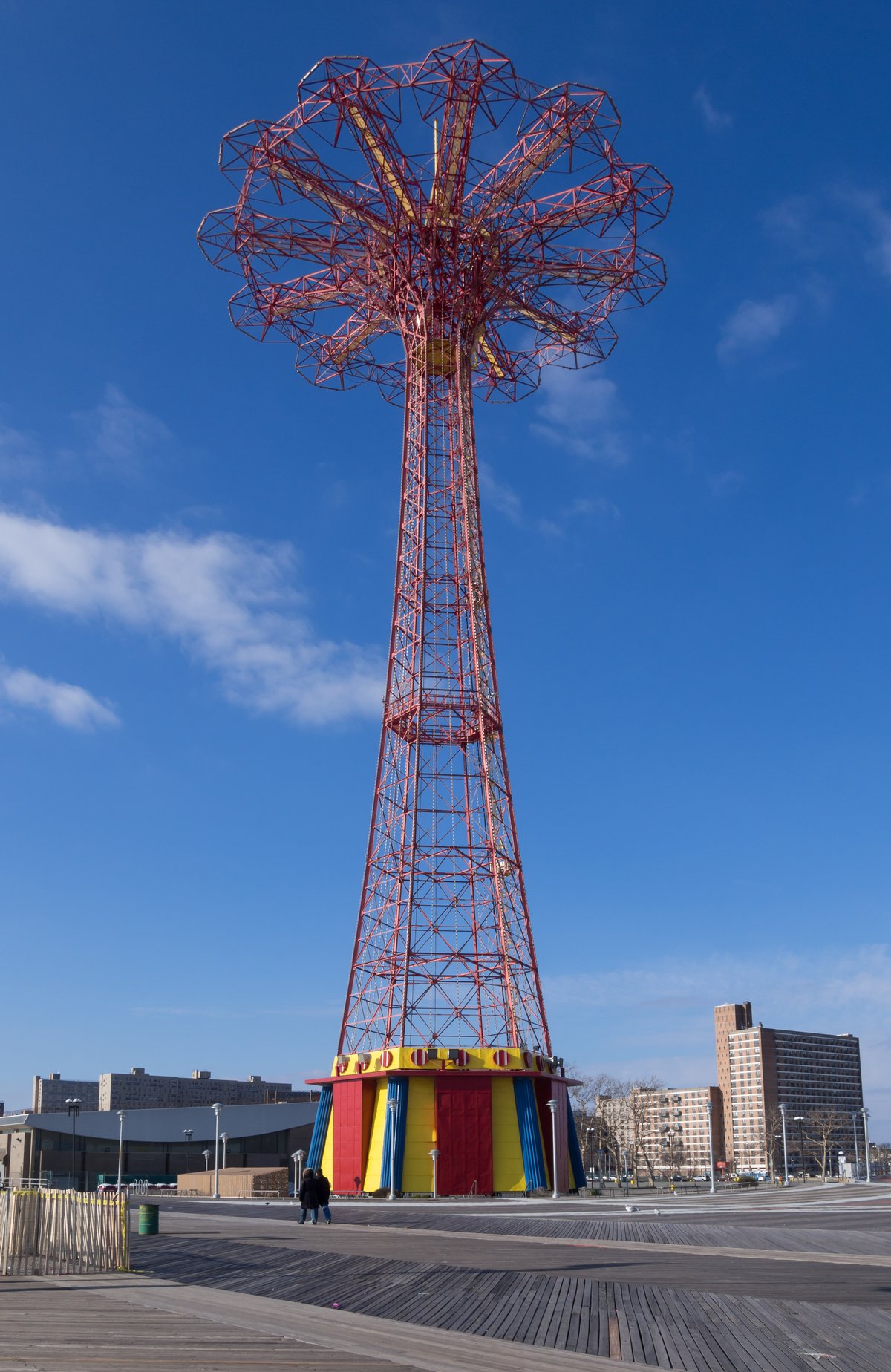
The Parachute Jump is a 170-short-ton (150 t) steel tower that lifted two-person canvas seats to its summit before letting them free-fall. Parachutes and shock absorbers were used to slow the descent of the riders. The structure, situated along the Riegelmann Boardwalk at Coney Island, features twelve cantilever steel arms radiating from the top.
The ride debuted in 1939 at the New York World's Fair at Flushing Meadows–Corona Park. Capped by a 12-foot flagpole, it was the second-tallest structure at the fair. During the fair's first season, the ride was sponsored by Life Savers. It was relocated during the fair's second season to attract more visitors, and in 1941, it was moved to the Steeplechase amusement park. The ride ceased operations in the 1960s following the park's closure.
After the park closed, the structure remained unused through the 1980s due to disputes over its use. It has been renovated several times since the 1990s for stability and aesthetics. In the 2000s, it was restored and fitted with a lighting system containing about 8,000 fixtures. The lights were activated in 2006 and replaced in 2013.
Today, the Parachute Jump stands as the only remaining portion of Steeplechase Park. It is a New York City designated landmark and is listed on the National Register of Historic Places. The tower stands 250 feet (76 m) tall, though it reached 262 feet (80 m) during the 1939 World's Fair when topped by its flagpole.
Sources: Wikipedia, OpenStreetMap, Wikidata, Wikimedia Commons

Written by Kyle McLonely
Discuss this with the author and others
No comments yet. Be the first to start the conversation.