Krasnoarmeysky Ave., 1, Gatchina, Leningrad Region, Russia, 188304
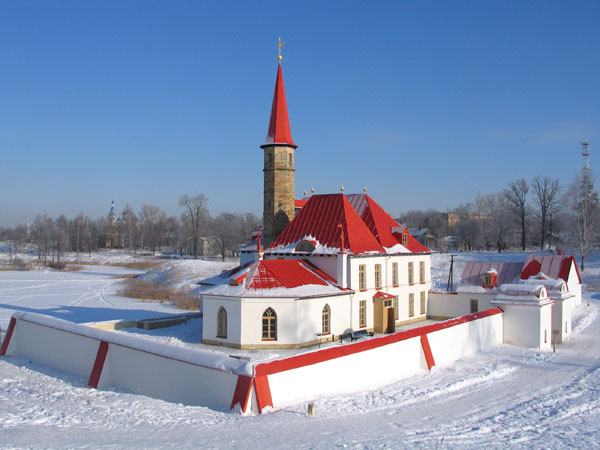
The Priory Palace or Castle is an original palace in Gatchina. It is often called the Priory (from the French prieuré — "small monastery, monastic estate"). It was built in 1799 by the architect Lvov. The name "Priory Palace" became associated with the Priory in the 20th century. The Priory Palace is not as luxurious as other palaces in the suburbs of Saint Petersburg. Its fame is determined by the unusual construction technology, original appearance, and the amazing combination of the palace and the surrounding landscape.

The Priory is the only surviving architectural structure in Russia built mainly using the rammed earth technology: layers of compressed loam are poured with lime mortar. The palace walls, fence, and courtyard buildings were built using this technology. The retaining wall is made of the famous Pudost stone, which was used in many Gatchina buildings. The palace tower is built from Paritsa stone. The Priory is located on the southeastern shore of Black Lake. The park containing the lake was later also called the "Priory Park" (previously it was called the "Small Menagerie"). The Priory was built in the style of Russian architecture of the last third of the 18th century, known as the pre-romantic direction. The structure is a stylization of medieval Catholic monasteries. The tower serves as the church bell tower, and all buildings are united into a single whole by an inner courtyard and a solid fence. The Priory is located, like monasteries, in a secluded place. The monastic character is emphasized by the ascetic interior decoration. The Priory also resembles a medieval castle. Some details of the palace are characteristic of the classicism style. These include the horizontal divisions of the facades and the ceilings — the main decoration of the palace rooms.

All researchers note the precise location of the Priory, its original composition, and the characteristic rejection of symmetry. The originality of the Priory lies in the fact that there are no repetitions; every viewpoint is new. From the side of Black Lake, an illusion is created as if the palace is located on an island. The retaining wall gives the palace fortress-like features. From the south, the Priory resembles a Gothic chapel. The northern facade seems to rise from the water. From the main entrance side, it looks like a country estate. The kitchen building is designed in the form of a Russian log house.
The creation of the Priory is connected with the history of Europe at the end of the 18th century. As a result of the French Revolution, the Maltese Order lost a significant part of its possessions. The Order turned to Paul I, who had just ascended the throne, for help. In January 1797, the emperor signed a Convention according to which the "Grand Priory" of the Maltese Order was established in Russia. To house the priory administration, the former Vorontsov Palace in St. Petersburg was transferred to the Order's ownership. Shortly thereafter, Paul I decided to build a summer residence for the Prior of the Maltese Order, Prince Condé. Gatchina — Paul I's country residence — was chosen as the location for the palace.
Before the construction of the palace, Lvov built several structures using the rammed earth technology, including, in 1797, a "hut" for Paul I's favorite Nelidova. Before building the Priory, a corner of a log house with a foundation was constructed in the garden of the Gatchina Palace under Lvov's supervision using the rammed earth technology. Courtiers tested its strength by trying to pierce it with umbrellas, and officers tried to destroy it with sabers. After inspecting the structure, Paul I suggested that the architect choose the site himself and build the Priory there.
Preparatory work began in the autumn of 1797. The rammed earth walls of the palace and palace buildings were erected in three months: from June 15 to September 12, 1798. The cost of the walls was 2,000 rubles, while the cost of similar stone walls would have been 25,000 rubles. The Priory was accepted by the emperor on August 22, 1799, and on August 23 was granted to the Maltese Order. By this time, Emperor Paul I was de facto already the Grand Master — head of the Order, thus becoming the full owner of the Priory. On October 12, 1799, the knights of the Maltese Order handed over to their new Grand Master three ancient relics of the Hospitallers in the palace — a fragment of the wood of the Holy Cross, the Philerme Icon of the Mother of God, and the right hand of St. John the Baptist (in memory of this event, in 1800 a holiday was established — the Transfer of the Part of the Holy Cross from Malta to Gatchina).
In 1800, the emperor stayed in the palace with his sons Alexander and Constantine during maneuvers. Emperor Alexander I — protector of the Order — transferred the Priory to the state treasury. The palace was hardly used. Members of the imperial family occasionally came to the palace for short rest. In the 1820s, with the permission of Empress Maria Feodorovna, a Lutheran church was temporarily housed in the palace. In the 1840s, Nicholas I sometimes provided the Priory to the generals during maneuvers. The first meeting of Princess Maria of Hesse (fiancée of the heir to the throne) and Alexander Nikolaevich (Emperor Alexander II) took place in the Priory. After Alexander III ascended the throne and the royal family moved to Gatchina, it was decided to house the singers of the court chapel in the Priory. For these purposes, from 1884 to 1887, architect Dmitriev carried out a major renovation, and the palace was adapted for year-round residence of fifty people. Heating was reconstructed, plumbing and sewage were installed, and the ceilings were reinforced. Later, apartments were provided to courtiers. Lieutenant General Kutepov lived in the Priory with his family.
In 1913 and 1914, various charity exhibitions were held in the palace. During World War I, the Priory housed a hospital. After the October Revolution, the Priory came under the jurisdiction of the Gatchina Palace Museum but was not turned into a museum. The historical furnishings remaining in it were moved to the Grand Gatchina Palace. In 1924, an excursion station was located in the Priory; from 1930 to 1940, it served as a recreation base for some Leningrad factories.
During the war, the Priory survived, although part of the fence and one of the guard booths were destroyed, and the roof was demolished. After the war, it housed first a military construction unit, then the House of Pioneers and Schoolchildren, and from 1968 until the start of restoration — the district local history museum.
As with many similar buildings, several legends exist about the Priory. The most famous is the legend of an underground passage connecting the Priory Palace with the Gatchina Imperial Palace. Interestingly, during foundation reinforcement, restorers did indeed come across an underground passage lined with stone. The passage reaches human height at the beginning and gradually lowers. The tunnel has not been fully explored, and its purpose is unknown. There is an opinion that the tunnel is part of Gatchina's underground communications, which have yet to be studied.
Sources:
http://history-gatchina.ru/part/fpriory.php
https://ru.wikipedia.org/wiki/Приоратский_дворец

