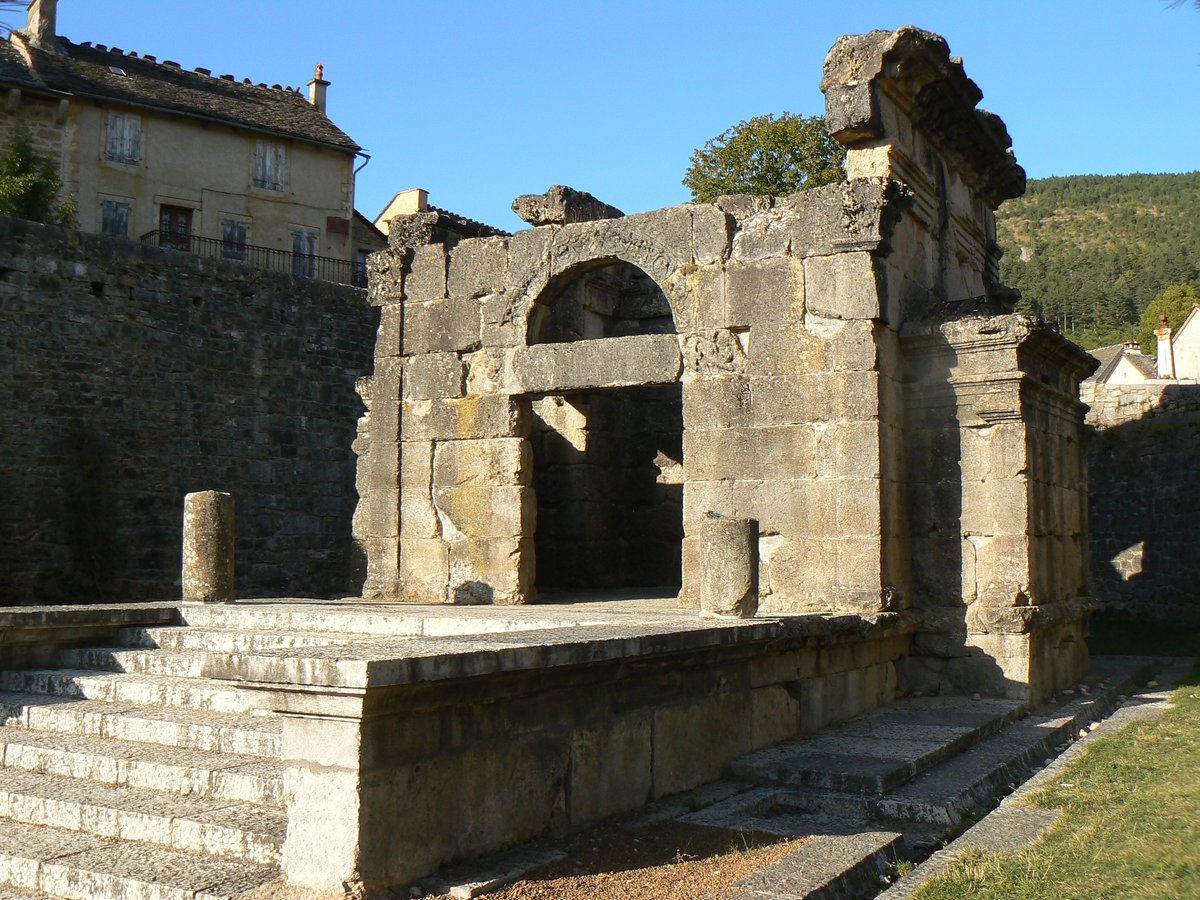

Deep in the heart of southern France lies a fascinating historical monument: the Mausoleum of the Pomponii, a Gallo-Roman funerary monument that dates back to the second half of the 2nd century AD. According to the source material, it was built on the model of a mausoleum-temple in the second half of the 2nd century AD by a wealthy family of Syrian origins. The Mausoleum, also known as 'Lou Mazelet' in the local Occitan dialect, is located in the commune of Lanuéjols, in the Lozère department of the Occitania region.
The Mausoleum is part of a funerary complex that also includes an altar, where funerary or commemorative ceremonies were likely held. Despite the exact origins and purposes of the Mausoleum being a source of debate among scholars, the monument stands as a symbol of the family's power and wealth in the heart of France. Today, the Mausoleum of the Pomponii stands as a testament to a bygone era. Its morphology resembles traditional Latin temples, with a cella and pronaos, and it is thought to resemble the Ummidia Quadratilla Mausoleum at the Italian archaeological site of Cassino in terms of construction materials and style.
Sources: Wikipedia, OpenStreetMap, Wikidata, Wikimedia Commons
Written by Nicolo Ciampini
Discuss this with the author and others
No comments yet. Be the first to start the conversation.