Archaeological Zone of Kabah, Puuc, Kabah, Yuc., Mexico

The majestic Kodz-Poop Temple (Temple of Masks) is located in the Kabah archaeological zone. These are the ruins of an ancient city of the Maya civilization that existed in the 9th-10th centuries. Kodz-Poop is one of the few structures preserved on its territory.
The temple was built between 900 and 1100 AD. Its facade is decorated with several hundred stone masks of the long-nosed rain god Chaac and was most likely used as a ceremonial temple. The name of the temple translates as "rolled mats," referring to the appearance of the stone mosaic. The masks repeat 260 times; this number is very important in Maya culture because it is the result of multiplying 13 tones by 20 Maya symbols, which marks the beginning of the Maya solar calendar. All these protrusions shaped like trunks on the facade of each mask represent Chaac's nose.
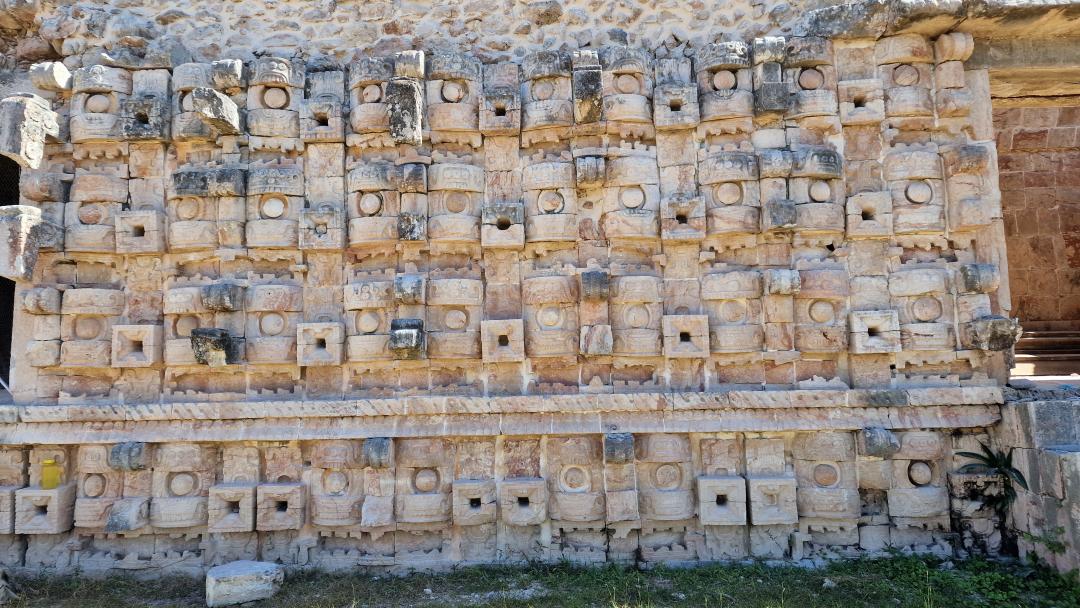
The palace is situated on its own three-tiered platform facing a large elevated plaza in front of it. A majestic staircase leads from the plaza level up to the palace. Completing the structure is a tall decorative roof crest, which creates an impression of even greater height and grandeur. The building is about 45 meters long and has 4 entrances on the facade, each leading to 2 interior halls. Thus, there are a total of 10 internal chambers. Maya architecture is full of symbolism and signs; on the western facade, 260 Chaac mascarons are depicted, below them intertwined snakes, and above the mascarons—a symbolic geometric decoration based on triangles. Additionally, directly opposite the Chaac masks, on the terrace itself, there is an altar with hieroglyphs on the sides (Maya glyphs).
The eastern side of the Kodz-Poop palace has a remarkable facade decorated with intricate mosaic patterns, with pedestals embedded in the upper medial stucco. Several magnificently sculpted statues once stood on these pedestals. Two of these original sculptural statues have been restored and returned to their place. They are very detailed, larger than the life-sized depictions of warriors and rulers of this site.
A series of adjoining rooms on the rear side of the palace have richly decorated door jambs depicting rulers, captives, and hieroglyphic information. On one of the jambs, the date 987 AD was inscribed, which is the latest known carved date in northern Yucatan.
As Paul Gendrop and Rio Bec write in their book, "In this amazing building, whose facade repeats the same theme again and again like a litany, the precise sense of composition turns what could have been mere monotony into charm. Designed with absolute rigor, every element fits into the overall composition without the slightest error.
Thus, while the rows of masks covering the frieze continue uninterrupted along the length of the facade, those covering the lower wall and aligned vertically with others are clearly separated by the door frame (the total width of which exactly corresponds to the sum of all the masks and two halves, excluding the noses of those adjacent to the doorways)."
Sources:
Paul Gendrop, Rio Bec, Chenes and Puuc Styles in Maya Architecture

