Gatchina Palace Park, Krasnoarmeyskiy Ave., 1, Gatchina, Leningrad Region, Russia, 188307
Signal whistles are blowing, sailors skillfully climb the yards, the mooring lines are cast off – the “Mirolyub” is moored at the Large Pier. The playful fleet of Paul I has completed its maneuvers.
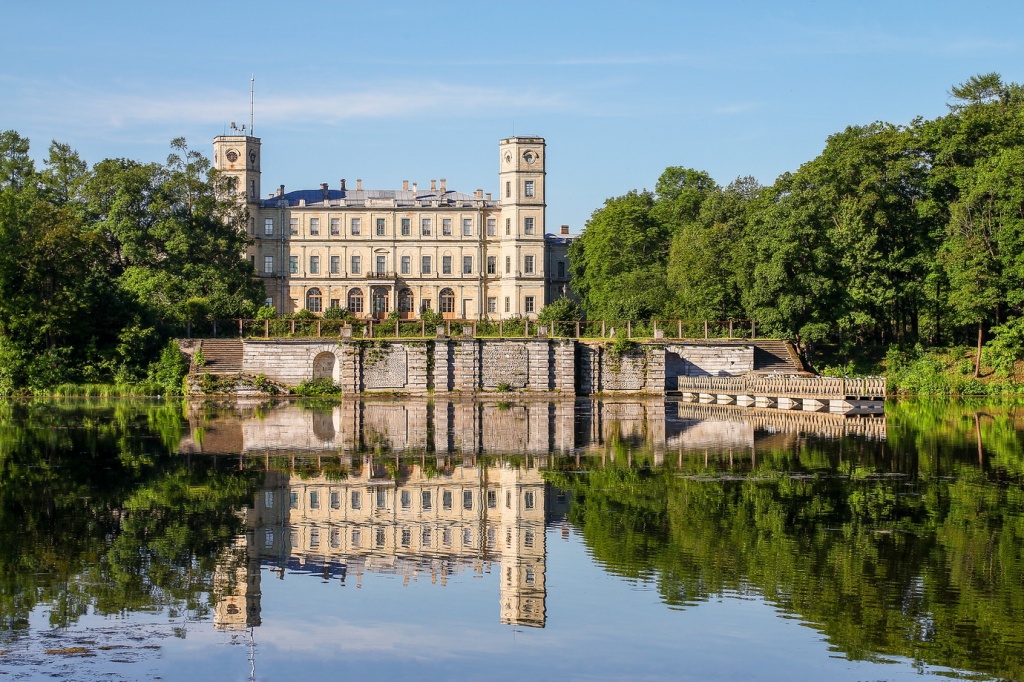
The Large Terrace on the Long Island in the 18th–19th centuries served as a pier where the ships of the “Gatchina flotilla” docked. It was adorned with marble sculptures of muses and stone vases. To this day, two lion statues carved from local limestone remain at the historic site. The solemn stone pier on the White Lake, one of the largest structures in the Palace Park, was constructed from 1792 to 1795. The architectural genius of Vincenzo Brenna allowed him to select the site for the future building with exquisite precision and to achieve a grand scale ratio between the terrace and the Gatchina Palace. The architect positioned the pier so that its central axis aligned with the central axis of the palace. As a result, when viewed from the eastern shore of White Lake, the architectural structure appears as the base or porch of the palace.
The renowned master of stonework Kiryan Plastinin and his team undertook the construction of the Large Terrace. The stone wall made of Pudost stone, stretching over five hundred meters, seems to rise from the calm water surface. On both sides of the terrace are wide staircases built from Chernitsa stone. They lead down to the mooring platforms right at the water’s edge. Two sculptures of reclining lions, made from Pudost limestone, are placed on the steps of the staircase. It is said they were brought from the Orlov manor, though there is no documentary evidence for this. Perhaps because of these sculptures, the terrace received its second name – the Lion’s Terrace.
Eighteen stone vases made of Pudost limestone are arranged around the perimeter of the pier. Between them stand four marble statues symbolizing the “fine arts”: romantic Poetry, graceful Painting, harmonious Sculpture, and austere Architecture. The terrace’s decoration is completed by a carved stone balustrade running along the entire perimeter.
At the turn of the 18th–19th centuries, the Large Pier was used for mooring the sovereign’s playful fleet. Later, Paul’s favorite yacht “Mirolyub” was permanently stationed here. In 1868, it was replaced by an exact replica, which remained at the Large Terrace until 1895.
During the war, the pier suffered heavy damage. The balustrade was completely destroyed, the lion statues were damaged, and the vases and sculptures were broken or sunk. During restoration work, parts of the stone balustrade, sculptures, and vases were raised from the lake bottom, but they never returned to their original places.
Despite the absence of decorative elements, the Large Terrace Pier still leaves an indelible impression on park visitors.
Sources:
https://peterburg.center/maps/gatchina-bolshaya-terrasa-pristan.html
https://gatchinapalace.ru/park/attractions/large_terrace_jetty.php

