JH8X+P4V, Al Bahri Rd, Muscat, Oman

On the coast of Muscat, majestically towering over the endless waves of the Arabian Sea, stands Al Jalali Fort. Its walls, permeated with time and history, hold the secrets of the past and legends passed down from generation to generation.
At the very beginning of the 16th century, when the great Portuguese navigators invaded the waters of the Arabian Gulf, there arose a need for defensive structures to strengthen influence over trade routes. Al Jalali Fort, proudly standing on a cliff facing the blue waves, began its history at the end of the 16th century, when the Portuguese ruled these lands. In search of strategic points and control over trade routes, they created this fort, rising above the hot desert and sea.

The Portuguese named the fortress Forte de São João (Fort St. John). The origin of the current name "Al Jalali" is disputed. According to one version, it comes from the Arabic Al Jalal, meaning "great beauty." Legend has it that it was named after a Balochi military commander named Mir Jalal Khan from the tribe, and Al Mirani Fort was named after his brother Mir Miran, who was also a commander. Al Jalali Fort is also known as Fort Ash-Sharqiya.
"Muscat" means "anchorage." True to its name, Old Muscat is a natural port in a strategic location between the Persian Gulf and the Indian Ocean. It is located on the coast of the Gulf of Oman in a bay about 700 meters (2300 feet) long, protected from the sea by a rocky island. The port is surrounded by mountains, making access from the land side difficult. Muscat may have been described by the geographer Ptolemy in the 2nd century, who noted a "hidden harbor" in this region.
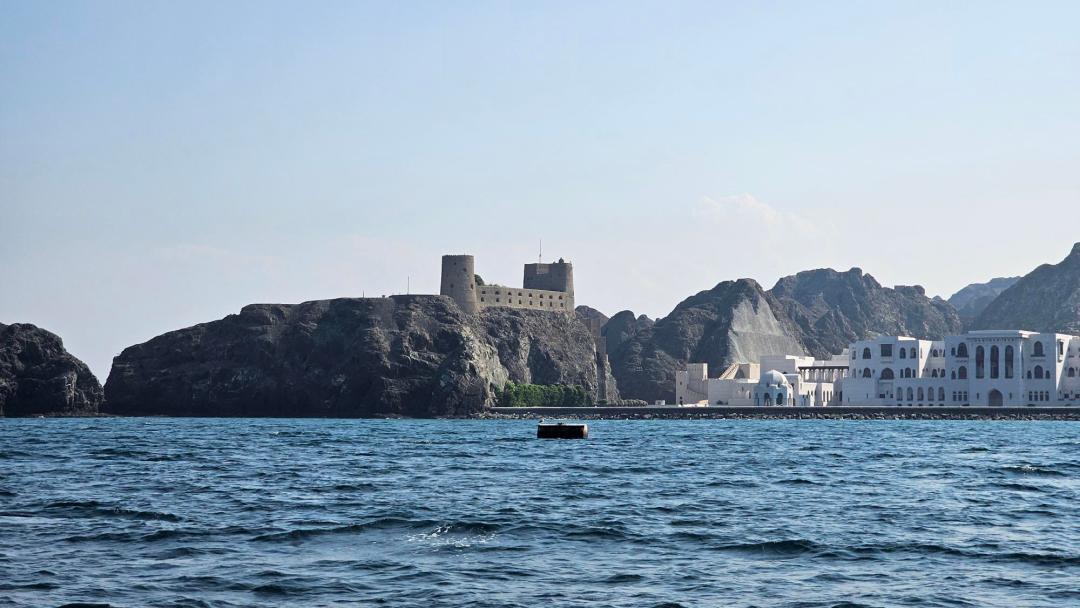
Al Jalali Fort is located on a rocky outcrop on the eastern side of Muscat harbor. It faces Al Mirani Fort, which is built on another outcrop on the western side. Muscat was securely protected from sea attacks by these two forts, Mutrah fortress further west, and other fortifications on the rocky ridges surrounding the bay. Until recently, the fort could only be accessed from the harbor side via a steep stone staircase. As a result of land reclamation on the sea side of the cliff, there is now space for a helicopter landing pad. A funicular railway makes the fort more accessible.
In the early 15th century, Muscat was a minor port used by ships as a water collection point. By the early 16th century, it was becoming an important trading center. At that time, the interior parts of Oman were ruled by an Arab imam, but the coast where Muscat was located was under the control of the Persian king of Ormuz. In 1497, Portuguese navigator Vasco da Gama charted a route around the southern cape of Africa eastward to India and the Spice Islands. The Portuguese quickly began attempts to establish a monopoly on the trade of spices, silk, and other goods. They came into conflict with Mamluk Egypt, whose trade with Europe through the Red Sea was threatened. Ormuz was the main center of the trade route with modern Iraq and Iran through the Persian Gulf. The Portuguese wanted to control this route as well.
On August 10, 1507, an expedition of six ships under Admiral Afonso de Albuquerque left the newly established Portuguese base on Socotra to control the Strait of Ormuz. The Portuguese sailed along the coast of Oman, destroying ships and plundering towns. In Kurayyat, which they took after a fierce battle, the Portuguese mutilated their prisoners, killed inhabitants regardless of age or gender, looted, and burned the town. Muscat initially surrendered unconditionally to avoid the same fate. However, the people refused to submit when reinforcements arrived. Albuquerque began a successful offensive on Muscat. He slaughtered most of the inhabitants, then looted and burned the city.
The Portuguese continued along the coast. The governor of Sohar agreed to pledge loyalty to the King of Portugal and pay tribute. The Portuguese arrived in Ormuz on September 26, 1507. They took the city after fierce resistance on October 10, 1507. Albuquerque signed a treaty under which the Portuguese were exempt from customs duties and could build a fort and trading factory in Ormuz. Muscat then became a regular port of call for the Portuguese. Diogo Fernandes de Beja came here in 1512 to collect tribute. Albuquerque, now Viceroy of India, visited him in March 1515. In 1520, a fleet of twenty-three Portuguese ships anchored in the harbor on the way from the Red Sea to Ormuz. When a general uprising against Portuguese rule over Ormuz broke out in November 1521, Muscat was the only place where the Portuguese were not attacked.
In 1527, the Portuguese began construction of barracks, warehouses, and a chapel in Muscat, which were apparently completed by 1531. Four Ottoman galleys entered the harbor in 1546 and shelled the city but did not land. To secure their base, the Portuguese sent an engineer to build a fort west of the harbor, where Al Mirani stands today. The Portuguese built this first Muscat fort in 1550. In April 1552, an Ottoman fleet of twenty-four galleys and four supply ships under Piri Reis left Suez en route to Ormuz, aiming to destroy the Portuguese presence in the region. An advance detachment landed in Muscat in July 1552. After an eighteen-day siege, Muscat fell and the fort was destroyed. Commander João de Lisboa and 128 Portuguese were taken prisoner. The main Ottoman fleet arrived, and the combined fleet headed to Ormuz. Two years later, the Portuguese retook the city and in 1554 repelled another Turkish attack.
Al Jalali Fort was built after the Ottomans raided Muscat for the second time in 1582. In 1587, Captain Belchior Calaça was sent to Muscat to build the fortress, which was named Forte de São João. The top of the promontory on which the fort stands was first leveled, and the rock was cut. Calaça built a cistern to hold water for the inhabitants and armed the fort with a cannon. It appears to have been built on an older foundation. The main improvement made by the Portuguese was the construction of a gun deck overlooking the harbor. Al Jalali Fort and its twin Al Mirani Fort were built between 1586 and 1588.
The Portuguese faced growing competition in the region from English and Dutch traders. In 1622, joint Persian-English forces took Ormuz. After this, the Portuguese built forts in other ports on the Omani coast, although they abandoned most of them in 1633–1634, focusing on defending Muscat. After 1622, the Portuguese began strengthening Al Jalali Fort, apparently intending to make it the main fort. However, in 1623, Forte do Almirante (today's Al Mirani Fort) was still considered the more important of the two forts and was used by the governor of Muscat as a residence in hot weather.
In 1625, the Portuguese built walls and towers around Muscat to improve defense. Remnants of these fortifications still exist today. Muscat drained Portuguese finances as its defense required maintaining large military and naval forces. Trade did not flourish as expected since the Persian market was closed to them until 1630. By then, the Dutch and English dominated trade in the Persian Gulf.
Nasir bin Murshid (reigned 1624–1649) was the first imam of the Yaruba dynasty in Oman, elected in 1624. He was able to unite the tribes with the common goal of expelling the Portuguese. Nasir bin Murshid expelled the Portuguese from all their bases in Oman except Muscat. He was succeeded by his cousin Sultan bin Saif in 1649. In December 1649, Sultan bin Saif's forces captured the city of Muscat. About 600 Portuguese managed to escape by sea, and others fled to Forte do Almirante (Al Mirani). They surrendered on January 23, 1650. The capture of Muscat from the Portuguese marked the beginning of the expansion of Oman's naval power, which soon threatened Portuguese possessions in India and East Africa.
After the death of the fifth Yaruba Imam of Oman, Sultan bin Saif II, in 1718, a struggle began between rival claimants to the Imamate. Al Jalali Fort was damaged during the civil war. The country was divided between Saif bin Sultan II and his cousin Bilarab bin Himyar, rival imams. Finding his power waning, Saif bin Sultan II sought help from Nader Shah of Persia. In 1738, the two forts were surrendered to Persian troops. The Persians returned to Persia, taking their loot with them.
Several years later, Saif bin Sultan II, who had been deposed, called for help again. The Persian expedition arrived in Julfar around October 1742. The Persians made an unsuccessful attempt to take Muscat, defeated by the cunning of the new imam Sultan bin Murshid. Later in 1743, the Persians returned, bringing Saif bin Sultan II with them. They took the city of Muscat, but the forts Al Jalali and Al Mirani held out, and Saif bin Sultan II did not order them to surrender. Omani historians say that the Persian commander Mirza Taqi invited Saif to a feast on his ship. Saif was intoxicated with wine, and his seal was taken. It was used to issue orders to the fort commanders to surrender, a trick that proved successful.
The strategic location of the fort on a coastal cliff provided it with a unique advantage. From here, there was a panoramic view of the Arabian Sea, and its walls became an impenetrable barrier protecting the shores from possible attacks. The Portuguese used their possession as a strategic military base, controlling trade and ensuring the security of their lands.
Over time, Oman broke free from Portuguese rule, but Al Jalali Fort remained in historical memory. In the early 17th century, when Imam Sultan Bin Saif Al Yarubi expelled the Portuguese from Oman, this fort became a symbol of national liberation. For its exceptional role in the country's liberation, Al Jalali Fort witnessed the intertwining of historical threads, gaining deep meaning in the hearts of Omanis.
The fort demonstrates the skill of Portuguese engineers. Externally, it was a majestic structure rising to the skies. Its walls reached a height of 24 meters, and the stone bastions seemed unshakable. Inside the fort, where time flowed in its slow waves, there were defensive rooms, seven wells, and numerous corridors connecting this stone labyrinth.
Construction of the fort lasted more than 12 years, and every stone was laid with care and attention. Inside its walls, like in a sacred vault, memories were preserved of how this fort witnessed important moments in Oman's history. Looking at the fort's walls was like looking into a mirror of time, where past epochs intertwined with the present.
Ahmad bin Said al-Busaidi, the first ruler of the Al Said dynasty, blockaded Muscat and captured the forts in 1749. He repaired them, especially Al Jalali. The function of Al Jalali changed from passive harbor defense to a base from which troops could be dispatched. In the following decades, large central buildings and round towers were added.
In early 1781, two of Ahmad bin Said's sons, Sultan and Saif, took control of Al Mirani and Al Jalali forts. When the governor of Muscat tried to regain the forts, Sultan and Saif began a destructive bombardment of the city. The two brothers secured the support of the powerful Sheikh Sakhar, who marched on the capital in April 1781. Their father agreed to amnesty, allowing his rebellious sons to hold both forts. He changed his mind and took Al Mirani, while the brothers held Al Jalali for several months.
Sultan and Saif then kidnapped their brother Said bin Ahmad and imprisoned him in Al Jalali. The imam, their father, hurried to Muscat, which he reached in January 1782. He ordered the commander of Al Mirani to open fire on Al Jalali, while his ships joined from the east of the fort. While this was happening, Said bin Ahmad bribed his jailer and escaped. Isolated and without a hostage, the two brothers agreed to surrender. The imam took Saif and kept him under surveillance to prevent another rebellion. Said bin Ahmad ruled from 1783 to 1789. During his reign, his son was imprisoned for a time in Al Jalali Fort by the governor of Muscat until another of his sons managed to free him.
The fort is mentioned several times in 19th-century Omani history. While the ruler of Oman was on pilgrimage to Mecca in early 1803, his nephew Badr bin Saif attempted to gain control of Jalali Fort. The story goes that he was carried to the fort in a large box but was discovered by an Indian merchant. He managed to escape and took refuge in Qatar. In June 1849, the governor of Sohar signed a treaty with the British resident to suppress the slave trade. This caused an uprising by the religious party; the governor was killed, and his father, Hamad, became governor. The Sultan of Oman, then residing in Zanzibar, arranged a confrontation with Hamad and imprisoned him in Al Jalali Fort. Hamad died on April 23, 1850, either from starvation or poison. In 1895, tribes looted Muscat. Sultan Faisal bin Turki took refuge in Al Jalali Fort until his brother, who controlled Al Mirani Fort, restored control over the city.
For most of the 20th century, Al Jalali Fort was Oman's main prison, holding about 200 inmates. Some were Omanis from the interior regions captured during the Jebel Akhdar War (1954–59) or taken after this war. The rest of the prisoners were taken during the Dhofar Rebellion (1962–76). It was the most notorious of Omani prisons, known for its horrific conditions. Colonel David Smiley, commander of the Sultan's armed forces in Muscat, called the prison "a real hellhole." In 1963, forty-four prisoners escaped in a well-planned breakout, but most were quickly caught due to poor physical condition. In 1969, a guard helped two members of the royal family escape, but they were caught a few days later. The prison was closed in the 1970s.
But perhaps the most fascinating are the legends mysteriously woven around the stone walls. One tells of the spirit of an old sailor who, having lost his love in a shipwreck off the coast of Oman, became the guardian of the fort. Eternally wandering the towers and corridors, he searches for his lost beloved, ready to pass through time to embrace her again in his arms.
Another legend tells of a mysterious chest hidden somewhere in the depths of the fort. It is said that whoever can solve its riddle will gain access to priceless treasures left there by ancient rulers. Many adventurers have come and gone, leaving only mysterious records of unknown dangers guarding this chest.
Tales of the fort's defense during wars and sieges inspire heroic stories of defenders whose souls, according to legend, dwell within the fort's walls. Every stone, every crack in the walls—they have witnessed courage and devotion, preserving the spirit of the eternal guardian.
Once, during a full moon, according to legend, inside the fort one can hear the sounds of ancient songs and whispers of ghosts, coming alive again in their stories. Those who dared to stay inside the fort after sunset claim they witnessed mysterious phenomena that defy explanation.
Today, Al Jalali Fort continues to attract thousands of curious visitors. Every stone of this magnificent structure is a witness to history, and every legend adds its shade of mystery and magic to this historic site. Future generations will continue to explore its secrets and admire the majestic beauty of Al Jalali Fort, where centuries and memories intertwine, creating an eternal saga about Oman and its ancient wonders.
Sources:
https://wiki5.ru/wiki/Al_Jalali_Fort

